
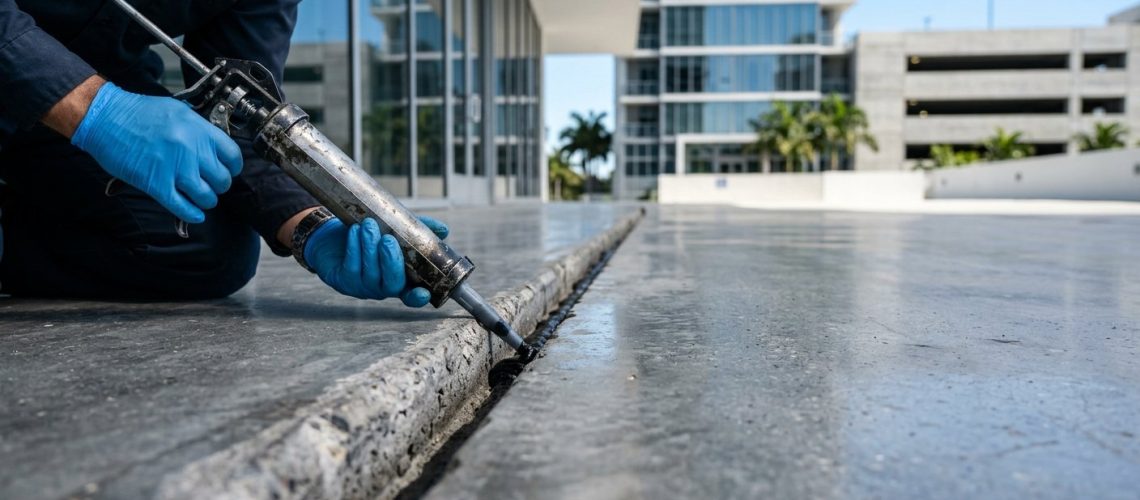
When a concrete expansion joint leaks, the right answer is almost always targeted repair — not full replacement. Full replacement is warranted only when the joint substrate has structurally deteriorated beyond sealing capacity. For the vast majority of South Florida commercial buildings, condominiums, and parking structures, a professional injection-based repair permanently stops water intrusion without demolition, tenant disruption, or the cost of concrete removal.
- Leaking expansion joints rarely require full concrete replacement — targeted sealing is the permanent solution in most cases.
- South Florida’s saltwater exposure, high humidity, and thermal cycling accelerate joint degradation faster than in other regions.
- Polyvinyl injection technology seals expansion joints from within the concrete, eliminating the path water takes rather than just covering it.
- Delaying repair allows water to corrode rebar, undermining structural integrity and dramatically increasing future costs.
- A professional site assessment determines whether repair or replacement is appropriate — there is no universal answer without inspection.
Why Expansion Joints Fail in the First Place
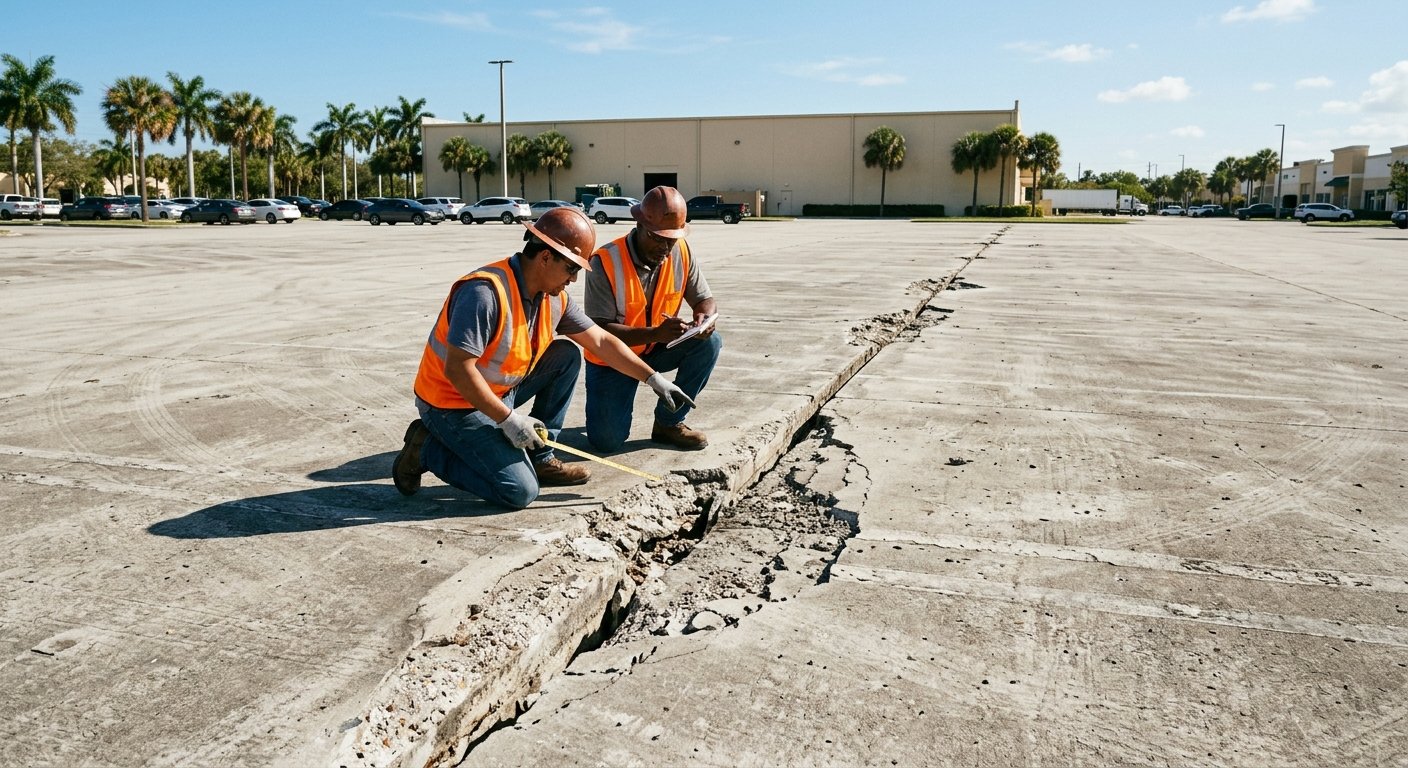
Concrete expansion joints are engineered gaps — intentional breaks in a slab or wall that allow the structure to move without cracking. In South Florida, that movement is relentless. Daytime heat causes concrete to expand; cooler nights cause contraction. The coefficient of thermal expansion for standard concrete is approximately 5.5 to 6.5 millionths per degree Fahrenheit, which translates into measurable joint-width cycling in every high-rise, parking deck, and condominium podium across Miami, Fort Lauderdale, and West Palm Beach.
The sealant materials originally placed inside those joints — typically polyurethane foam backer rods or flexible caulk — are not designed to last indefinitely. UV degradation, salt-laden air, and repeated compression-tension cycling cause them to crack, shrink, and pull away from the concrete substrate. Once that seal fails, water has a direct path into the structure. The question then is whether the joint itself can be resealed or whether the surrounding concrete has deteriorated to the point where the joint must be removed and reconstructed.
Saltwater proximity dramatically accelerates sealant degradation. Chloride ions from salt air penetrate even hairline cracks, initiating corrosion of embedded steel reinforcement. Parking structures within a mile of the South Florida coastline can experience joint failure in half the time of inland structures under the same traffic load.
The Case for Repair: When Sealing Is the Right Call
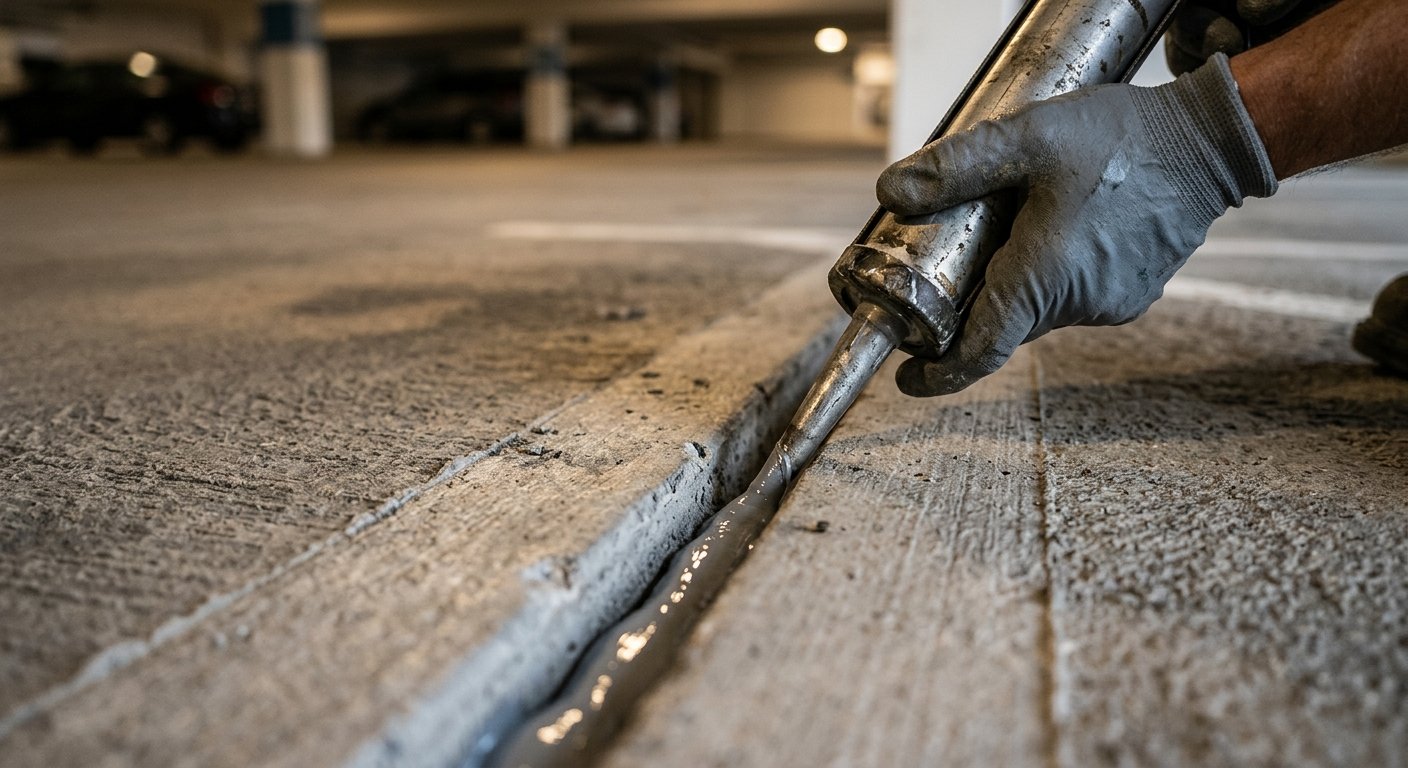
The overwhelming majority of concrete expansion joint water intrusion problems are sealant failures, not concrete failures. The joint geometry is intact, the surrounding slab is sound, but water is entering because the flexible seal has broken down. In these situations — which represent most of what property managers encounter in South Florida high-rises and parking garages — injection-based expansion joint sealing is the appropriate, permanent solution.
CL Wizard’s proprietary polyvinyl injection technology works by introducing a flexible, hydrophilic compound directly into the joint from within. Unlike surface-applied caulk or tape-over approaches, the injected material bonds to the concrete walls of the joint and accommodates ongoing thermal movement without losing adhesion. The result is a seal that works with the joint’s designed purpose rather than fighting it. Because no concrete is removed, tenants remain undisturbed and operations continue normally — a critical advantage in occupied residential towers and active commercial parking structures.
Indicators that a repair approach is appropriate include:
- Active water intrusion at joint lines during or after rain events
- Visible sealant cracking, shrinkage, or disbondment
- Water staining on ceilings or walls directly below expansion joints
- Efflorescence (white mineral deposits) along joint edges
- No visible concrete spalling or aggregate exposure at the joint margins
For more on how water enters concrete structures at these points, see our detailed overview of water intrusion solutions for concrete buildings.
| Evaluation Criterion | Repair (Injection Sealing) | Replace (Demolition & Rebuild) |
|---|---|---|
| Concrete substrate condition | Sound, structurally intact | Severely deteriorated or spalled |
| Rebar corrosion | Minimal or none detected | Significant corrosion and section loss |
| Joint geometry | Maintained within design tolerance | Collapsed, faulted, or displaced |
| Tenant disruption | Minimal — no demolition required | Significant — area must be closed |
| Timeline | Days, not weeks | Weeks to months |
| Longevity | Permanent seal; 5-year warranty | Dependent on new sealant quality |
The Case for Replacement: When You Cannot Avoid It
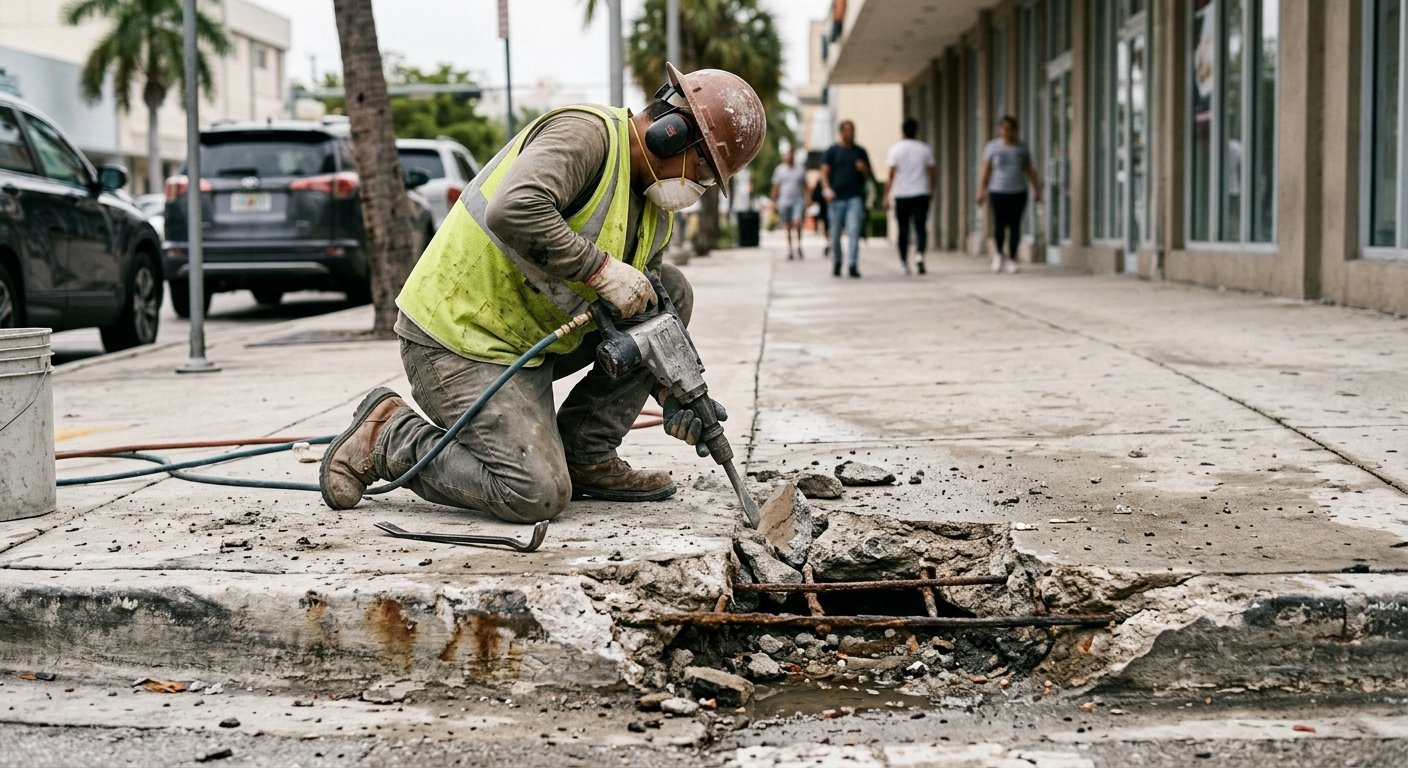
Full joint replacement becomes necessary when the concrete itself — not just the sealant — has failed. This typically presents as concrete spalling at the joint edges, exposed and rusted reinforcing steel, or significant differential movement between slabs indicating a deeper structural problem. The American Concrete Institute distinguishes between surface deterioration and structural deterioration, and that distinction drives the repair-versus-replace decision.
In South Florida parking structures particularly, chloride-induced corrosion can progress rapidly once the sealant fails and concrete cover is thin. Corroding rebar expands, generating internal pressure that spalls the concrete away from the joint edge. At that point, no injection alone will restore structural integrity — the damaged concrete must be removed, rebar treated or replaced, and the joint reconstructed.
An honest assessment requires an on-site inspection. There is no reliable remote diagnosis for structural concrete deterioration. Property managers who are seeing significant concrete loss or hearing reports of differential slab movement should engage a licensed specialist immediately rather than waiting for the next maintenance cycle.
Deferring repairs when active corrosion is present is not a cost-saving strategy — it is a cost-multiplying one. Chloride-induced rebar deterioration is self-accelerating: once the concrete spalls and the steel is exposed, corrosion rates increase dramatically, and what was a repair candidate becomes a replacement requirement.
South Florida’s Unique Pressure on Expansion Joints
Property managers in Miami, Fort Lauderdale, and West Palm Beach are managing concrete structures in one of the most chemically aggressive environments in North America. The combination of factors at work here — marine salt air, high ambient humidity year-round, intense UV exposure, and daily thermal cycling — creates degradation conditions that standard sealants simply were not engineered to survive long-term.
Florida’s Florida Building Code addresses concrete construction standards for high-velocity hurricane zones and coastal exposures, but code compliance at the time of construction does not eliminate the ongoing maintenance obligation. Expansion joint sealants in these environments require proactive monitoring, not just reactive repair after leaks appear.
The smart approach for HOAs and commercial property managers is periodic joint inspection — ideally before the wet season intensifies — so that failing sealants can be addressed with injection repair before water has the opportunity to initiate rebar corrosion. Catching the problem at the sealant-failure stage, rather than the concrete-deterioration stage, is the difference between a focused repair and a costly reconstruction.
Our full technical resource on concrete expansion joint leak repair covers the inspection criteria and repair process in detail for property managers who want to understand exactly what a professional assessment involves.
The smart approach is catching sealant failure before water initiates rebar corrosion — the difference between a focused repair and a costly reconstruction.
Initial Site Assessment
A licensed specialist inspects joint geometry, sealant condition, concrete substrate integrity, and signs of rebar corrosion. This determines whether repair or replacement is appropriate — no two structures present identically.
Joint Preparation
Existing failed sealant material is removed and the joint faces are cleaned to ensure maximum adhesion of the injection compound to the concrete substrate.
Polyvinyl Injection
The proprietary compound is introduced under controlled pressure directly into the joint. The material expands to fill voids, bonds to concrete walls, and remains flexible to accommodate thermal movement.
Verification and Documentation
The sealed joint is inspected and the repair is documented. CL Wizard provides a 5-year warranty on completed repairs, giving property managers and HOA boards a concrete assurance to take back to their boards and stakeholders.
Protecting Your Investment Long-Term
For building owners and HOA boards managing multi-story residential or commercial concrete structures, the fix-versus-replace question ultimately comes down to: how early did you catch it? Expansion joint sealing addressed at the sealant-failure stage is a fraction of the cost and disruption of a full joint reconstruction — and with the right injection technology, it is a permanent solution, not a temporary patch.
If your building has not had a professional expansion joint inspection in the past two to three years, or if you are seeing any of the warning signs described above, the next step is scheduling that assessment. For properties with concrete slab concerns beyond the joint lines themselves, our resource on waterproofing concrete slabs provides additional context on protecting the broader structure.
Frequently Asked Questions
How do I know if my expansion joint needs repair or full replacement?
The key indicators are the condition of the concrete substrate and reinforcing steel, not just the sealant. If the concrete at the joint edges is intact and rebar shows no significant corrosion, injection-based repair is appropriate. If you see spalling, exposed rust-stained steel, or significant differential movement between slabs, replacement evaluation is necessary. A professional on-site inspection is the only reliable way to determine which category applies.
How long does injection-based expansion joint repair last?
CL Wizard backs its polyvinyl injection repairs with a 5-year warranty. The proprietary compound is designed to remain flexible and bonded through South Florida’s thermal cycling and humidity cycles. Unlike surface caulk, which can disbond within a few years, the injected material works within the joint geometry rather than on top of it.
Will the repair process disrupt tenants or close the parking structure?
In most cases, no. The non-disruptive nature of injection-based concrete expansion joint repair is one of its primary advantages for occupied buildings. There is no jackhammering, no extended closures, and no demolition debris. Specific access requirements depend on the joint location and volume of work, which is discussed during the assessment phase.
Can expansion joint water intrusion damage the structural integrity of a building?
Yes, if left unaddressed. Water entering through failed joints carries chloride ions in coastal South Florida environments, which initiate corrosion of embedded steel reinforcement. Corroding rebar expands, cracking the surrounding concrete and progressively weakening the structural system. Early repair stops this process before structural damage occurs.
Is parking garage expansion joint repair different from other concrete structures?
The core repair technology is the same, but parking structures face additional stressors — vehicle traffic loading, petroleum spills, and deicing chemicals in other climates. In South Florida, the primary accelerant is marine salt exposure. Parking garage expansion joint repair often requires attention to traffic-rated sealant performance and joint width tolerances specific to vehicular loading conditions.
Schedule Your Expansion Joint Assessment
A professional inspection is the only way to know whether your building needs targeted repair or something more — and the sooner you know, the more options you have.

About CL Wizard
CL Wizard provides permanent concrete leak repair solutions for South Florida commercial property managers, building owners, and HOAs using proprietary polyvinyl injection technology. Unlike traditional waterproofing methods that offer temporary fixes, CL Wizard's non-disruptive approach permanently seals concrete expansion joints and water intrusion points without requiring extensive demolition or tenant displacement. The company specializes in addressing South Florida's unique challenges including saltwater exposure, humidity, and thermal expansion in high-rises, condominiums, and parking structures. Visit clwizard.com →
