
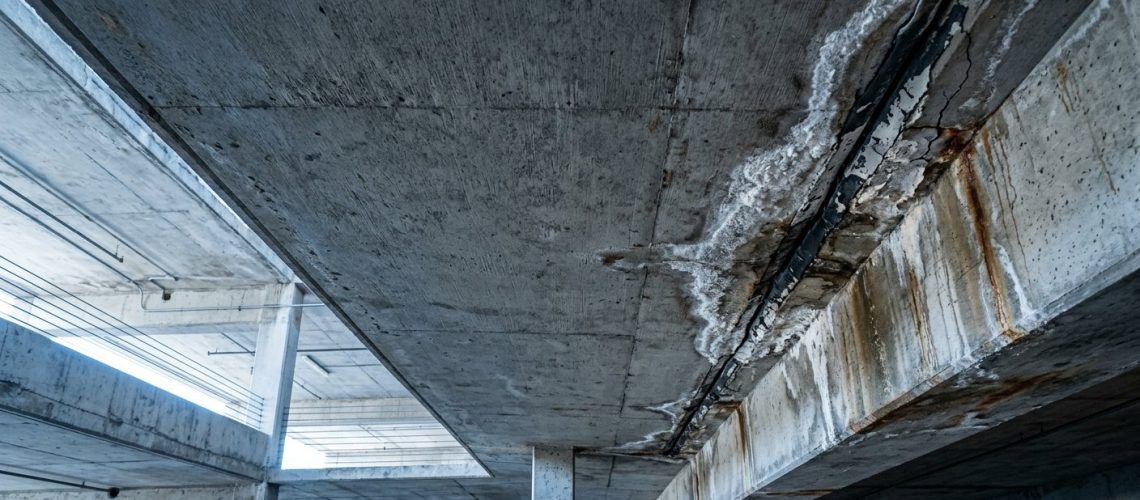
Walk through almost any South Florida parking garage or condominium lobby and you’ll likely spot the evidence: staining on soffits, efflorescence crawling along expansion joints, or the faint drip of water where there should be none. These aren’t cosmetic nuisances. They’re symptoms of concrete moisture problems that, left unaddressed, compound into structural liability.
Understanding what actually drives water intrusion in concrete — not just where it shows up, but why it happens — is the first step toward choosing repairs that last rather than those that merely delay the next service call.
The Fundamental Nature of Concrete and Water
Concrete is not waterproof by default. It’s a porous material — a matrix of cement paste, aggregate, and deliberately or inadvertently formed voids. According to the Portland Cement Association, the water-to-cement ratio used during mixing directly controls the density and porosity of the finished slab. Higher ratios create more capillary channels. In South Florida, where humidity routinely exceeds 75% and construction timelines push for faster cures, this trade-off is made frequently.
Those capillary channels are the highway system water intrusion in concrete uses. Hydrostatic pressure, vapor drive, and gravity all push water molecules through pores measuring as small as 0.1 microns. Once inside the slab, water migrates toward lower-pressure zones — typically the interior face, a joint, or a crack — and that’s when property managers first notice the problem.
The Six Primary Causes of Concrete Moisture Problems
1. Thermal Expansion at Joints
South Florida experiences temperature swings that strain concrete more than most property managers realize. Concrete expands and contracts at a coefficient of approximately 5.5 × 10⁻⁶ per °F. A 200-foot concrete parking deck cycling between 75°F at night and 110°F on a summer surface can experience dimensional movement of nearly ¼ inch across its length every single day.
Expansion joints are engineered to accommodate this movement. But when joint sealants age, harden, or debond — which conventional caulk-based products typically do within 3–7 years under South Florida UV and heat exposure — those joints become direct channels for water seepage through concrete. This is one of the most common and most misdiagnosed sources of recurring leaks in high-rise structures and parking garages.
CL Wizard’s proprietary polyvinyl injection technology addresses this specifically by filling and bonding within the joint itself, maintaining flexibility as the joint moves rather than cracking like rigid sealants. Learn more about how permanent solutions work at the concrete expansion joint repair resource page.
2. Concrete Porosity and Water Penetration
Beyond designed joints, concrete porosity water penetration occurs through the body of the slab itself. Factors that increase porosity include:
- Excessive water added during mixing or finishing
- Inadequate curing time in humid conditions
- Aggregate segregation during pour
- Micro-cracking from shrinkage during cure
- Carbonation from long-term CO₂ exposure
In coastal South Florida, saltwater compounds this issue significantly. Chloride ions from marine air penetrate porous concrete, accelerating corrosion of internal rebar. As rebar corrodes, it expands — approximately 2 to 4 times its original volume — creating internal pressure that fractures concrete from within. What begins as concrete porosity water penetration becomes structural delamination.
3. Hydrostatic Pressure from Below
Properties near Biscayne Bay, the Intracoastal, or low-lying areas of Broward County face an additional challenge: hydrostatic pressure from groundwater. South Florida’s shallow water table — often just 2–5 feet below grade — means that during heavy rainfall, water-saturated soil pushes upward with measurable force against slab undersides and below-grade walls.
This type of concrete water damage cannot be solved by surface-applied membranes alone. The pressure drives water through any available path, including hairline cracks too small to see with the naked eye. Effective concrete water damage repair in these scenarios requires injection-based solutions that seal from within the substrate, not just coat the surface.
4. Cracks from Structural Movement and Settlement
Concrete cracks. Every engineer and property manager in South Florida knows this. The question is whether those cracks are static or dynamic, and whether they provide a path for water.
Settlement cracks in slabs, shear cracks from lateral loads, and reflective cracking above old repair patches are all common in commercial concrete structures older than 10–15 years. Each crack wider than approximately 0.2mm (0.008 inches) is considered a potential water intrusion pathway under most building science guidelines. Concrete crack injection — the practice of filling cracks under pressure with bonding or flexible resins — is the engineered approach to sealing these pathways permanently rather than patching them on the surface.
5. Failed or Absent Waterproofing Systems
Many South Florida buildings constructed before stricter Florida Building Code updates went into effect were waterproofed with systems that have since degraded. Traffic coatings on parking decks, crystalline slurries on walls, and sheet membranes beneath planters all have finite service lives. Once they fail, the concrete beneath them absorbs moisture unimpeded.
The challenge for property managers is that failed waterproofing often isn’t visible until significant moisture has already penetrated deep into the structure. By the time efflorescence or staining appears, the substrate has typically been wet for months. The concrete slab waterproofing guidance page outlines what to look for and when professional assessment is warranted.
6. Joint and Penetration Details
Pipe penetrations, conduit sleeves, and utility entries through concrete slabs are among the most overlooked concrete moisture problem sources. As the concrete around these penetrations shrinks, settles, or is disturbed by vibration, small annular gaps form. In multi-story residential buildings with dozens of penetrations per floor, these gaps collectively represent significant water intrusion risk — particularly in mechanical rooms and transfer slabs.
Why Traditional Repair Methods Fall Short
Surface-applied caulks and elastomeric coatings address concrete moisture problems the way a bandage addresses a broken bone — they cover the symptom without resolving the cause. These methods work best on stable, dry, accessible substrates. South Florida’s wet season (June through October) means substrates are often damp at the time of repair, preventing proper adhesion. Hydrostatic pressure from below can delaminate surface membranes entirely.
Concrete crack injection using epoxy resins offers a more durable bond in static cracks, but rigid epoxies fail in moving joints and may crack again as thermal cycling continues. The evolution of commercial concrete waterproofing has moved toward flexible, pressure-injected polymers that accommodate movement — a design philosophy central to CL Wizard’s approach.
The critical distinction for property managers evaluating repair options: ask whether the proposed repair works from within the concrete substrate, or only at the surface. Permanent concrete leak repair requires material to penetrate, fill, and bond at the point of water entry.
The South Florida Difference
National concrete repair guidelines don’t always account for South Florida’s specific exposure conditions. The combination of high humidity, salt-laden air, intense UV radiation, and frequent thermal cycling creates an accelerated deterioration environment. According to the USDA Natural Resources Conservation Service, South Florida’s coastal soils have high chloride content that affects concrete structures from the ground up as well as from ambient air exposure.
This is why CL Wizard focuses exclusively on Miami, Fort Lauderdale, and West Palm Beach. The company’s polyvinyl injection technology was refined specifically for these conditions — tested against humidity, chloride exposure, and the thermal movement profiles common in South Florida high-rises and parking structures. A 5-year warranty on all repairs reflects the confidence that comes from working within a known and challenging environment rather than applying generic solutions.
For a deeper look at addressing water entry points specific to South Florida structures, the water intrusion solutions page covers assessment and repair approaches in detail.
Concrete Leak Detection: Finding the Real Source
Effective concrete moisture management begins with accurate diagnosis. Water rarely leaks exactly where it appears. A stain on Level 2 of a parking structure may originate from a failed joint on Level 3. This migration makes concrete leak detection a specialized skill — one that requires tracing the water’s path rather than simply treating the visible wet spot.
Professional assessment typically involves:
- Visual mapping of efflorescence, staining, and active drips
- Probe or moisture meter readings at multiple slab depths
- Infrared thermography in some cases to identify subsurface saturation zones
- Joint and crack condition evaluation, including width measurement and movement classification
- Review of drainage design and slope conditions on traffic-bearing decks
No reputable repair provider should offer a diagnosis or pricing without completing an on-site assessment. Concrete moisture problems vary enough between structures that remote evaluations are unreliable.
Frequently Asked Questions
What is the most common cause of water seepage through concrete in South Florida?
Failed or aging expansion joint sealants are among the most common causes, particularly in parking structures and condominium buildings. Thermal movement cycles daily in South Florida’s climate, and conventional sealants typically fail within 3–7 years. Concrete porosity and rebar corrosion from chloride exposure are also significant contributors in coastal buildings.
Can concrete moisture problems be repaired without tenant displacement?
Yes, when the right technology is used. Injection-based repair methods — including polyvinyl injection — are applied from accessible faces of the concrete and don’t require demolition of finished interior spaces. This makes them particularly well-suited for occupied condominiums and active commercial parking structures where downtime is costly.
How long does a professional concrete crack injection repair last?
This depends on the repair method and the nature of the crack. Static cracks filled with rigid epoxy injection can bond permanently if the crack has stopped moving. Dynamic or moving cracks require flexible injection materials. CL Wizard backs its repairs with a 5-year warranty, reflecting the durability expected from proper material selection and application technique.
What’s the difference between commercial concrete waterproofing and concrete leak repair?
Waterproofing is typically a preventive system applied to new or recently restored concrete to inhibit future moisture entry. Concrete leak repair addresses active water intrusion in existing structures. Most South Florida properties seeking help with wet joints, dripping soffits, or water-stained walls need targeted leak repair rather than full waterproofing system installation.
How do I know if my building has a concrete moisture problem worth treating?
Signs that warrant professional assessment include: white chalky deposits (efflorescence) on walls or ceilings, rust staining from rebar corrosion, active dripping or puddles below concrete decks, musty odors in enclosed parking areas, and deteriorating joint sealant with visible gaps. Earlier intervention consistently reduces repair scope and cost.
Take the Next Step
Concrete moisture problems don’t resolve on their own. Every wet season that passes without repair extends the chloride front deeper into your structure, increases corrosion risk, and raises the eventual cost of comprehensive restoration. The good news is that with accurate diagnosis and the right injection technology, permanent concrete leak repair is achievable — without demolition, without tenant displacement, and with a clear warranty behind the work.
If your Miami, Fort Lauderdale, or West Palm Beach property is showing signs of water intrusion in concrete, contact CL Wizard to schedule a professional on-site assessment. Licensed, insured, and backed by proprietary polyvinyl injection technology developed for South Florida conditions, we’ll identify the true source of your concrete moisture problems and provide a solution designed to last.

About CL Wizard
CL Wizard provides permanent concrete leak repair solutions for South Florida commercial property managers, building owners, and HOAs using proprietary polyvinyl injection technology. Unlike traditional waterproofing methods that offer temporary fixes, CL Wizard's non-disruptive approach permanently seals concrete expansion joints and water intrusion points without requiring extensive demolition or tenant displacement. The company specializes in addressing South Florida's unique challenges including saltwater exposure, humidity, and thermal expansion in high-rises, condominiums, and parking structures. Visit clwizard.com →
