
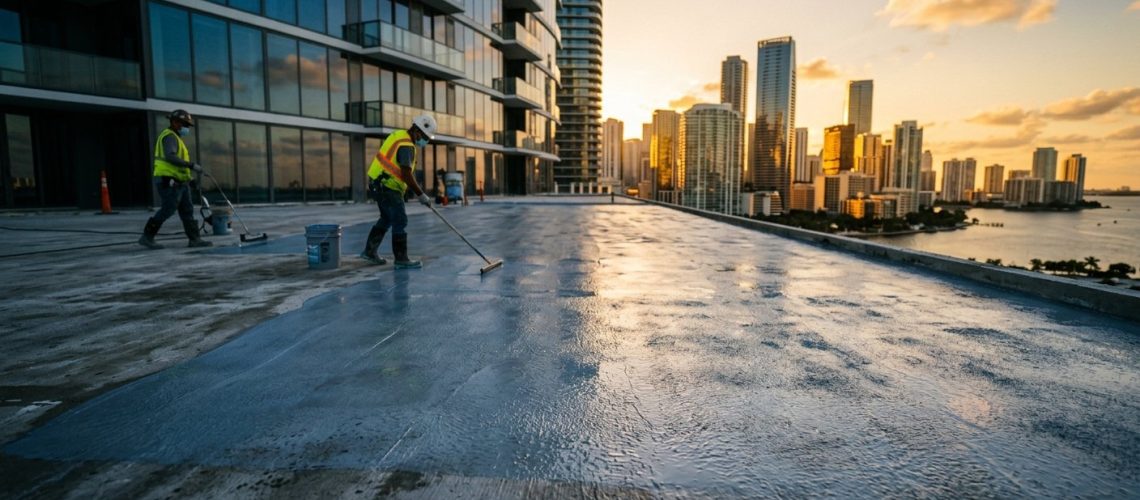
For existing commercial structures with active water intrusion, polyvinyl injection technology is the most effective waterproofing method in 2026. It seals leaks at their source without demolition, works in wet conditions, and creates a flexible permanent bond within the concrete — making it the preferred choice for occupied properties across Miami, Fort Lauderdale, and West Palm Beach.
- Three compounding forces — saltwater chloride exposure, hydrostatic pressure, and thermal cycling — accelerate South Florida slab deterioration faster than most other regions.
- Surface coatings and sheet membranes are better suited to new construction; for existing buildings with active leaks, they address the symptom rather than the source.
- Polyvinyl injection technology repairs from the inside out, requires no demolition, and allows tenant occupancy to continue during repairs.
- CL Wizard backs its polyvinyl injection repairs with a 5-year warranty, and all work is performed by a licensed and insured team.
- Every repair should begin with a professional on-site assessment to identify exactly where and why water is entering before any product is applied.
Why Commercial Slabs Fail in South Florida

Before evaluating methods, it’s worth understanding what makes South Florida concrete uniquely vulnerable. Three compounding factors accelerate deterioration here faster than most other regions:
- Saltwater exposure: Coastal air carries chloride ions that penetrate concrete pores, corroding embedded rebar and weakening the matrix over time. According to the Federal Highway Administration, chloride-induced corrosion is the leading cause of premature concrete deterioration in coastal structures.
- Humidity and hydrostatic pressure: South Florida’s water table sits remarkably high. Slabs — particularly in parking garages and ground-level commercial floors — face constant upward hydrostatic pressure that forces moisture through even hairline cracks.
- Thermal expansion: Daily temperature cycles cause concrete to expand and contract. Concrete has a thermal expansion coefficient of approximately 5.5 × 10⁻⁶ per °F. Over years of cycling, expansion joints widen, sealants fail, and gaps become water pathways.
These forces don’t operate independently — they compound each other. A slab weakened by chloride exposure develops micro-cracks faster, which then admit more moisture, which accelerates corrosion further. This is why surface-only treatments repeatedly underperform in this environment.
The Main Commercial Concrete Slab Waterproofing Methods
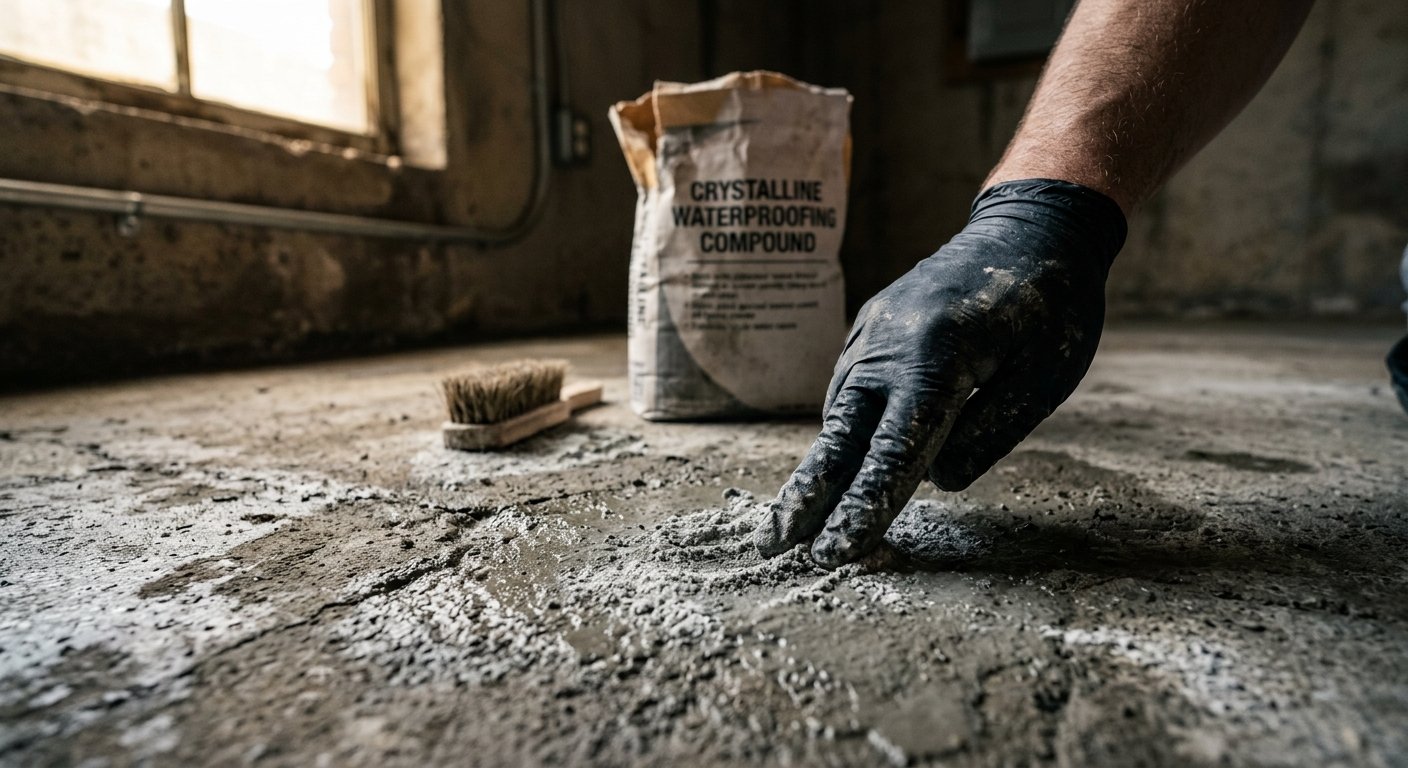
1. Crystalline Waterproofing
Crystalline technology works by introducing chemicals into the concrete mix or surface that react with moisture and unhydrated cement particles to form needle-like crystals within the pores. These crystals block water migration at a molecular level.
It’s a legitimate method for new construction and some surface applications, but it has a critical limitation: it requires active moisture to function. Once a slab is fully cured and water intrusion is occurring through joints or cracks rather than through the pore structure itself, crystalline treatments become far less effective. For existing commercial buildings with active leaks, this method rarely addresses the actual problem.
2. Sheet Membrane Waterproofing
Sheet membranes — typically bituminous, HDPE, or TPO — are installed beneath slabs during construction or adhered to the surface post-pour. When properly installed on new construction, they provide solid below-grade protection.
The problem for commercial property managers dealing with existing structures: retrofitting sheet membranes requires significant demolition. Tearing out flooring, excavating around structural elements, and displacing tenants makes this approach operationally impractical for occupied commercial buildings or active parking facilities. The disruption cost alone often exceeds the repair budget.
3. Liquid-Applied Waterproofing Coatings
Spray or roller-applied coatings create a flexible membrane over the slab surface. Products range from polyurethane to epoxy to acrylic systems. These coatings are cost-accessible and relatively quick to apply, which explains their popularity.
However, waterproofing a concrete slab with surface coatings alone addresses the symptom rather than the source. When water is entering through expansion joints, cracks, or from below, a coating applied to the top surface provides minimal protection against upward hydrostatic pressure. The American Concrete Institute consistently notes that surface coatings are insufficient as a standalone solution for below-grade or hydrostatically pressured slabs.
4. Polyvinyl Injection Technology
This is where 2026’s most significant advancement in commercial concrete slab waterproofing methods sits. Polyvinyl injection — the technology behind CL Wizard’s repair system — works from the inside out, targeting the exact pathways water uses to infiltrate the structure.
The process involves injecting a specialized polyvinyl resin formulation into cracks, voids, and expansion joints under controlled pressure. The resin bonds to the concrete matrix, expands to fill irregular voids, and cures into a flexible, watertight seal that moves with the structure. Because concrete never stops experiencing minor thermal movement, flexibility isn’t optional — it’s essential to longevity.
Because concrete never stops experiencing minor thermal movement, flexibility isn’t optional — it’s essential to longevity.
What distinguishes this approach for South Florida commercial properties:
- Non-disruptive application: Injection is performed from accessible surfaces without demolition, allowing commercial operations and tenant occupancy to continue during repairs.
- Addresses active leaks directly: The resin works in wet conditions, meaning repairs aren’t delayed waiting for a slab to dry — which in South Florida’s environment could mean waiting indefinitely.
- Permanent bond to the concrete substrate: Unlike surface sealers that peel and crack, the injected material becomes part of the slab assembly itself.
- Applicable to expansion joints: This is particularly important for high-rises and parking structures where expansion joint failure is among the most common water intrusion points. Learn more about how this applies to concrete expansion joint repair specifically.
| Comparison | Surface Coatings / Sheet Membranes | Polyvinyl Injection |
|---|---|---|
| Best suited for | New construction | Existing structures with active leaks |
| Demolition required | Yes (sheet membranes on existing slabs) | No |
| Works in wet conditions | No | Yes |
| Handles hydrostatic pressure | Limited (surface-only) | Yes (seals from within) |
| Accommodates thermal movement | Rigid sealers crack over time | Flexible permanent bond |
| Tenant displacement needed | Often yes | No |
| Typical longevity | 3–7 years (coatings) | 5-year warranty; designed for long-term performance |
Slab on Grade vs. Elevated Slabs: Different Challenges

Commercial concrete slab waterproofing strategy should account for where the slab sits in the building structure. Slab on grade waterproofing addresses a fundamentally different threat profile than elevated parking deck or podium slab protection.
Slab on grade installations face upward hydrostatic pressure from groundwater. In South Florida, water tables in Miami-Dade, Broward, and Palm Beach counties can sit within just a few feet of the surface, meaning the pressure is substantial and constant. Injection-based systems that create positive-side barriers within the slab itself are better suited to these conditions than negative-side coatings alone.
Elevated slabs in parking garages and multi-story commercial structures face downward water migration from rain, drainage failures, and compromised joint seals. A single failed joint on an upper deck can channel water through multiple levels — making expansion joint integrity paramount. Our detailed resource on concrete slab waterproofing covers both scenarios with greater technical depth.
What Property Managers Should Look for in a Repair Approach
Choosing the right concrete slab waterproofing method isn’t just a technical decision — it’s an operational one. Here’s what should factor into that decision for commercial and HOA properties in 2026:
Assess Disruption Tolerance
Can your property accommodate tenant displacement and demolition, or do operations need to continue? Most commercial properties cannot absorb weeks of downtime — prioritize methods that allow occupancy during repairs.
Require Long-Term Flexibility
South Florida’s thermal cycling means rigid materials will eventually crack. Confirm the repair system accommodates structural movement without failing at the bond.
Verify Warranty Coverage
A reputable provider should back their work. CL Wizard offers a 5-year warranty on all repairs — a meaningful commitment that reflects confidence in the system’s durability.
Insist on Assessment-Based Diagnosis
Every water intrusion situation has a specific source. Effective repair begins with a professional on-site assessment to identify exactly where and why water is entering before any product is applied.
Confirm Licensing and Insurance
Verify that any concrete repair contractor is licensed and insured. This protects your property and your liability as a building owner or HOA board member.
For properties experiencing persistent water intrusion through joints or cracks, the full range of water intrusion solutions available to commercial structures is worth reviewing as a framework for understanding your options.
Waterproofing without a professional diagnosis risks applying the wrong solution to the wrong problem. The source of water intrusion — whether through cracks, joints, porous concrete, or a combination — determines which method will actually work. Always begin with a licensed specialist’s on-site inspection before selecting or applying any repair system.
Frequently Asked Questions
What is the most effective method for waterproofing a concrete slab in 2026?
For existing commercial structures with active water intrusion, polyvinyl injection technology is currently the most effective approach. It addresses leaks at their source, works in wet conditions, requires no demolition, and creates a flexible permanent seal within the concrete. Surface coatings and sheet membranes are better suited to new construction scenarios.
How long does commercial concrete slab waterproofing last?
Longevity depends heavily on the method used and environmental conditions. Surface coatings typically last three to seven years before reapplication is needed. Injection-based systems that bond within the concrete matrix are designed for significantly longer performance — CL Wizard backs its polyvinyl injection repairs with a 5-year warranty, reflecting the durability of the system under South Florida conditions.
Can concrete slab waterproofing be done without disrupting tenants?
Yes, with the right method. Polyvinyl injection technology is inherently non-disruptive — it requires no demolition, no floor removal, and no extended operational shutdowns. Most repairs can be completed while the property remains occupied and operational, which is a primary reason this method is preferred for commercial and HOA properties.
What causes expansion joint leaks in commercial concrete slabs?
Expansion joints are intentional gaps that allow concrete sections to move without cracking. In South Florida, the combination of high humidity, salt exposure, and frequent thermal cycling degrades traditional sealants faster than in other climates. Once a joint sealant fails, water has a direct pathway through the slab — and hydrostatic pressure ensures it will find that path consistently.
Do I need a professional assessment before waterproofing a concrete slab?
Absolutely. Waterproofing without a professional diagnosis risks applying the wrong solution to the wrong problem. The source of water intrusion — whether through cracks, joints, porous concrete, or a combination — determines which method will actually work. A licensed specialist should inspect the affected area before any repair system is selected or applied.
Take the Next Step Toward a Permanent Fix
Concrete slab water intrusion doesn’t resolve itself, and temporary patches postpone an inevitable escalation in repair costs. For commercial property managers, HOA boards, and building owners across Miami, Fort Lauderdale, and West Palm Beach, 2026 offers better answers than the industry has historically provided — specifically, non-disruptive injection-based systems that address leaks permanently from within the structure.
CL Wizard’s licensed and insured team specializes in exactly these conditions, with proprietary polyvinyl injection technology designed for South Florida’s demanding environment and a 5-year warranty backing every repair. If your property is experiencing recurring concrete slab leaks, the right starting point is a professional on-site assessment.
Schedule Your Commercial Concrete Slab Assessment
Get a clear, honest picture of what permanent repair looks like for your property — with no demolition, no tenant displacement, and a 5-year warranty behind every fix.

About CL Wizard
CL Wizard provides permanent concrete leak repair solutions for South Florida commercial property managers, building owners, and HOAs using proprietary polyvinyl injection technology. Unlike traditional waterproofing methods that offer temporary fixes, CL Wizard's non-disruptive approach permanently seals concrete expansion joints and water intrusion points without requiring extensive demolition or tenant displacement. The company specializes in addressing South Florida's unique challenges including saltwater exposure, humidity, and thermal expansion in high-rises, condominiums, and parking structures. Visit clwizard.com →
