
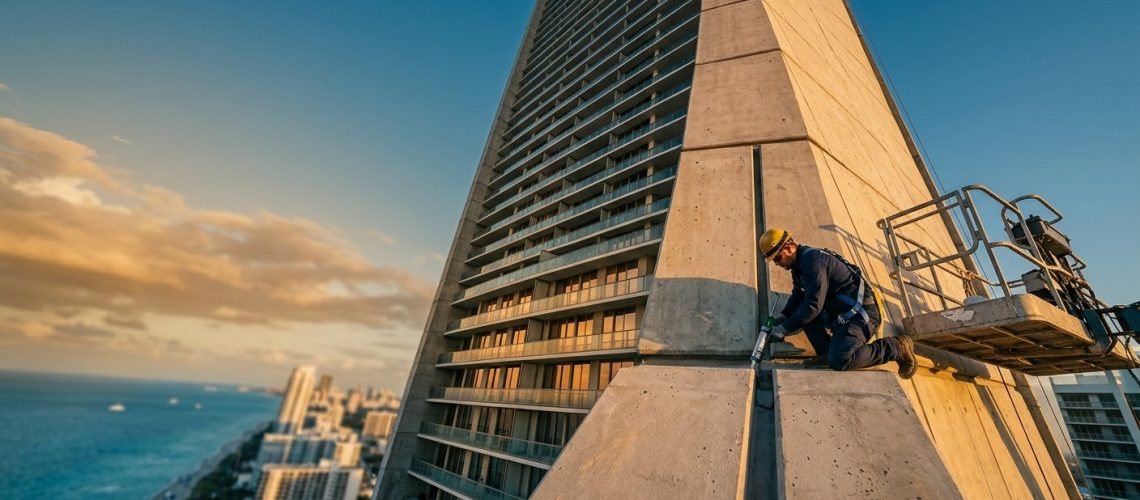
Failing expansion joints are a common cause of water intrusion in South Florida high-rises. If you manage a condominium tower, commercial building, or parking structure in Miami, Fort Lauderdale, or West Palm Beach, there’s a good chance you’ve already received the call — water streaking down interior walls, pooling on garage decks, or saturating lobby ceilings after a summer storm. The question isn’t whether your expansion joints will eventually leak. The question is whether you’ll address it permanently or keep patching the same problem every 18 months.
This guide breaks down everything property managers, HOA boards, and facility managers need to know about concrete expansion joint leak repair in 2026 — including why South Florida conditions accelerate joint failure, how modern polyvinyl injection technology outperforms traditional methods, and what a proper repair process actually looks like.
Why Expansion Joints Exist — and Why They Fail
Expansion joints are engineered intentionally. Concrete expands and contracts with temperature changes, and in South Florida’s climate, that thermal cycling is extreme. Concrete has a coefficient of thermal expansion of approximately 5.5 to 6.5 × 10⁻⁶ per °F. In a 400-foot high-rise, that means the structure can shift by more than half an inch across a single hot day. Without joints to accommodate that movement, the concrete would crack unpredictably throughout the structure.
The problem isn’t the joint design — it’s what fills those joints. Traditional elastomeric sealants, foam backer rods, and surface-applied membranes have a service life that rarely exceeds five to seven years under normal conditions. In South Florida, that lifespan shrinks further due to:
- Saltwater exposure: Airborne chlorides from the Atlantic and Gulf degrade polymer-based sealants and corrode the reinforcing steel adjacent to joints.
- UV degradation: Intense sun breaks down surface sealants, causing them to harden, crack, and lose adhesion.
- Hydrostatic pressure: South Florida’s high water table and heavy rainfall create persistent pressure against below-grade and deck-level joints.
- Thermal cycling: Daily temperature swings cause constant joint movement that fatigues sealant materials faster than in temperate climates.
According to the American Concrete Institute, improper joint sealing is among the leading causes of premature concrete deterioration in coastal structures — a finding that should concern every property manager in South Florida’s coastal corridor.
The Real Cost of Delayed Expansion Joint Repair
When expansion joint water intrusion goes unaddressed, the damage rarely stays contained to the joint itself. Water follows the path of least resistance through concrete’s natural porosity. Within months, chloride-laden moisture reaches reinforcing steel, initiating a corrosion cycle that causes rebar to expand at nearly eight times its original volume — fracturing the surrounding concrete from the inside out.
The downstream costs multiply quickly:
- Spalled concrete requiring structural patching
- Rebar replacement and epoxy injection into cracks
- Interior finishes damaged by moisture migration
- Liability exposure from water intrusion affecting tenants or parked vehicles
- Potential insurance claims that increase premium rates
The AMPP (formerly NACE International) has documented that corrosion-related concrete repair in coastal environments costs U.S. building owners billions annually — and early intervention at the joint level is consistently identified as the most cost-effective prevention strategy.
For HOA boards in particular, deferred joint maintenance can create reserve fund shortfalls that lead to special assessments — a scenario no board member wants to defend at an annual meeting.
Traditional Repair Methods: Why They Keep Failing
If you’ve managed a high-rise for more than a few years, you’ve likely seen the standard repair cycle: a contractor removes failed sealant, installs new backer rod, applies fresh elastomeric caulk, and the problem returns within two to three rainy seasons. This cycle isn’t a contractor failure — it’s a materials limitation.
Surface-applied sealants can only address the joint at its exterior face. They don’t penetrate into the joint substrate, they don’t bond with wet or contaminated concrete, and they can’t accommodate the ongoing movement of a live structure without eventually pulling away. For high-rise and commercial applications, where joints may span multiple floors and carry significant structural movement loads, surface sealants are fundamentally inadequate as a long-term solution.
Demolition-based approaches — cutting out and replacing joint assemblies — solve the material problem but introduce significant disruption. Tenant displacement, parking structure closures, noise, vibration, and debris make full replacement impractical for occupied buildings. The repair timeline stretches, costs escalate, and the disruption creates its own liability exposure.
Polyvinyl Injection Technology: How Permanent Repair Works
CL Wizard’s proprietary polyvinyl injection technology addresses expansion joint water intrusion from within the joint rather than at its surface. The approach is both technically superior and operationally practical for occupied buildings.
Here’s how the process works:
- Site assessment: Licensed technicians evaluate the joint condition, movement characteristics, water intrusion points, and substrate integrity before any work begins. No two joints are identical, and the repair approach is calibrated to the specific conditions found on-site.
- Port installation: Injection ports are placed at measured intervals along the joint — typically every 12 to 18 inches — to ensure complete coverage through the joint’s full depth.
- Polyvinyl injection: The proprietary compound is injected under controlled pressure. Unlike rigid epoxies that crack under movement, this flexible formulation cures to a resilient seal that accommodates ongoing thermal expansion and contraction without losing integrity.
- Penetration and cure: The material travels through voids, cracks, and the porous concrete adjacent to the joint, bonding to wet substrate where surface sealants fail entirely. Cure time is monitored to confirm complete fill.
- Surface finish: Once injection is complete and verified, ports are removed and the surface is finished to match the surrounding concrete.
The result is a seal that works with the structure’s movement rather than against it — and because the repair penetrates the full joint depth rather than sitting on the surface, it isn’t subject to the same UV and adhesion failure mechanisms that defeat traditional sealants.
CL Wizard backs every completed repair with a 5-year warranty, reflecting the company’s confidence in both the technology and the installation process. Learn more about the technical specifics of this approach on the polyvinyl injection technology page.
South Florida-Specific Considerations for High-Rise Joints
High-rises in Miami, Fort Lauderdale, and West Palm Beach face joint stress conditions that differ meaningfully from inland or northern structures. A few factors that should shape any repair strategy in this region:
- Marine environment corrosion: Buildings within a mile of the coast face significantly accelerated sealant degradation from salt-laden air. Repair materials must be specified for marine exposure resistance.
- Hurricane-season pressure cycles: Intense rain events create rapid hydrostatic pressure spikes that exploit any weakness in joint sealing. Joints that appear adequate during dry periods often reveal failures during storm season.
- Post-Surfside inspection requirements: Florida’s updated condominium inspection and reserve legislation has increased scrutiny of structural components including joints. Properties undergoing recertification need documented, warrantied repairs — not stopgap measures.
- Parking structure exposure: Multi-level garages experience the highest joint stress due to vehicular loading combined with thermal cycling on exposed decks. Expansion joint sealing in parking structures requires materials rated for dynamic load environments.
For a deeper look at how water intrusion affects concrete structures specifically in this environment, see our resource on water intrusion in concrete structures.
Frequently Asked Questions
How do I know if my high-rise has expansion joint leaks rather than another water intrusion source?
Expansion joint leaks typically appear as linear water staining that follows the joint path — often visible at ceiling transitions, wall-to-floor junctions, or along parking deck edges. A licensed assessment is the only reliable way to confirm the source, since water can travel significant distances from the actual intrusion point before becoming visible.
Will the repair require tenants to vacate or disrupt building operations?
CL Wizard’s non-disruptive repair technology is specifically designed for occupied buildings. Most repairs are completed without requiring tenant displacement, parking closures, or significant noise disruption. The assessment phase will identify any specific access requirements before work begins.
How long does a polyvinyl injection repair typically take?
Duration depends on the linear footage of joint being addressed and site access conditions. Most commercial expansion joint repair projects are completed in phases that minimize operational impact, with individual sections completed in one to two days. Your technician will outline a project timeline during the assessment.
Is this appropriate for both below-grade and elevated deck joints?
Yes. Polyvinyl injection technology is effective for concrete movement joint repair in below-grade applications, elevated parking decks, building perimeter joints, and interior structural joints. The approach is calibrated to the specific pressure and movement conditions at each location. Review our detailed coverage of concrete expansion joint repair for application-specific information.
Does Florida have specific code requirements for expansion joint repair in condominiums?
Florida’s Condominium Act and the structural integrity reserve study (SIRS) requirements introduced under Senate Bill 4D establish obligations for maintaining structural components including joints. The Florida Building Commission provides guidance on applicable standards. Licensed repairs with documented warranties support compliance documentation during building inspections and recertification.
Schedule Your Expansion Joint Assessment
Expansion joint failures don’t resolve on their own, and each South Florida storm season adds pressure to joints that are already compromised. The difference between a warrantied permanent repair and another round of surface patching is a professional assessment that identifies what’s actually failing and why.
CL Wizard serves commercial property managers, HOA boards, and building owners across Miami, Fort Lauderdale, and West Palm Beach with licensed, insured concrete leak repair services backed by a 5-year warranty. Our proprietary polyvinyl injection technology delivers permanent results without the disruption of demolition-based approaches.
Contact CL Wizard today to schedule your on-site expansion joint assessment and get a clear picture of what your building needs — and what it will take to fix it right the first time.
