
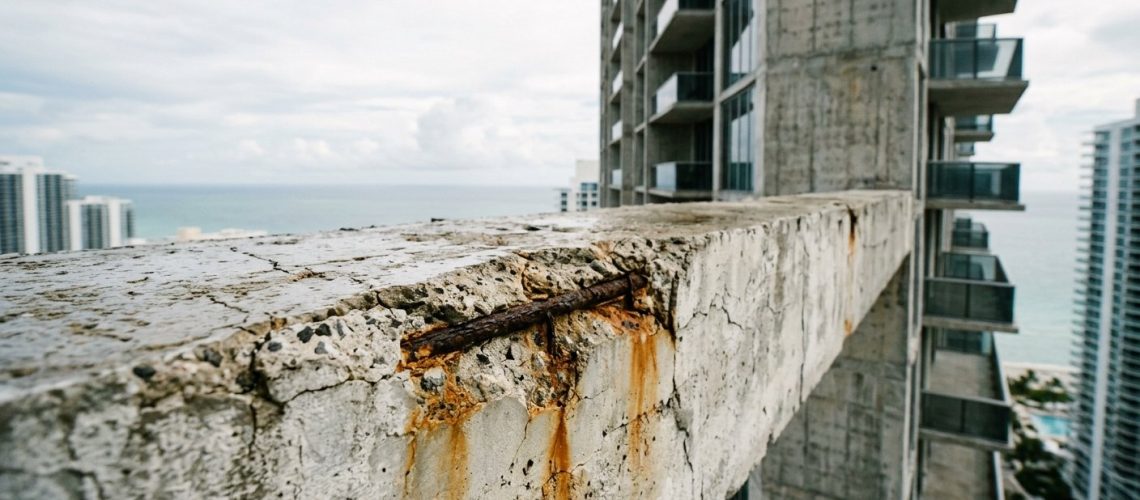
Concrete carbonation is a chemical process that gradually neutralizes the alkaline environment inside concrete, allowing moisture and oxygen to corrode reinforcing steel. For Miami’s high-rises, condominiums, and parking structures, it’s one of the primary drivers of long-term water intrusion and structural deterioration. Property managers need to recognize the signs early and act before carbonation enables serious concrete water damage repair scenarios.
- Carbonation is a slow, invisible chemical reaction — not a sudden event — that silently expands a building’s vulnerability to water intrusion in concrete.
- South Florida’s saltwater-laden air, humidity, and thermal expansion cycles dramatically accelerate the carbonation process in concrete structures.
- Traditional patching methods address surface symptoms; polyvinyl injection technology targets the source of moisture penetration permanently.
- Annual professional assessment is the most cost-effective strategy for Miami, Fort Lauderdale, and West Palm Beach commercial buildings.
- A 5-year warranty on repairs is achievable only when the underlying carbonation pathway is properly sealed, not just coated.
What Carbonation Actually Does to Concrete
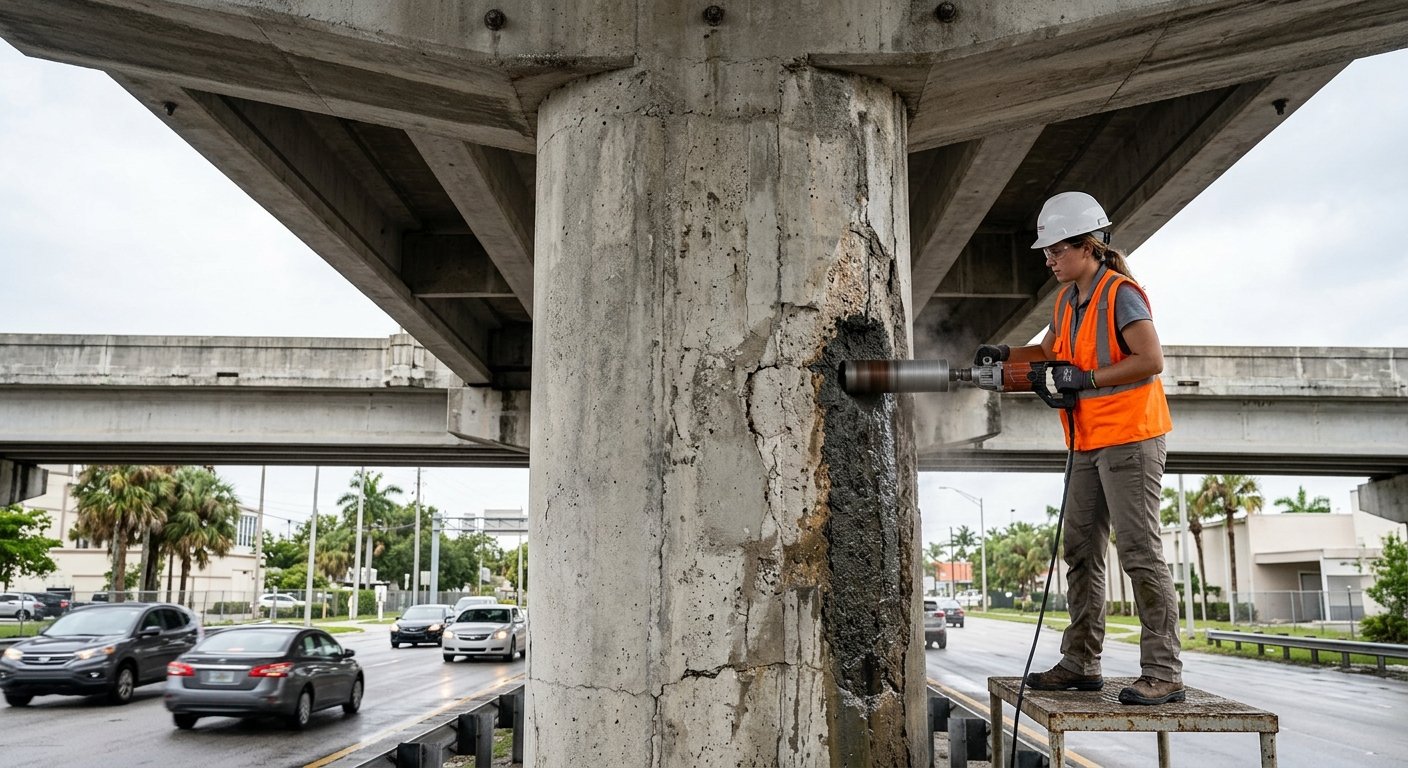
Concrete is naturally alkaline, with a pH above 12.5 when freshly cured. This high alkalinity creates a passive oxide layer around embedded steel reinforcement bars, protecting them from rust. When atmospheric carbon dioxide (CO₂) diffuses into the concrete and reacts with calcium hydroxide, it produces calcium carbonate — a process called carbonation. The result is a measurable drop in pH, often below 9, which destroys that protective layer entirely.
According to research published by the National Institute of Standards and Technology, carbonation depth in concrete progresses roughly in proportion to the square root of time under constant exposure conditions, meaning early intervention has an outsized effect on long-term structural integrity. Once the carbonation front reaches the rebar, corrosion begins. Rust expands in volume, cracking the surrounding concrete — creating the exact pathways through which water intrusion in concrete becomes an ongoing and escalating problem.
Carbonation is invisible until damage becomes visible. Spalling concrete, rust stains, and hairline cracks on your building’s exterior or parking deck surface are often late-stage indicators, not early ones. By the time cracks appear, the internal carbonation front may already be several millimeters deep.
Why Miami’s Environment Accelerates the Problem
Not all urban environments are equal when it comes to concrete carbonation. Miami, Fort Lauderdale, and West Palm Beach present a uniquely aggressive combination of factors that can compress what would normally be a decades-long process into a significantly shorter window.
Saltwater Chloride Exposure
Chloride ions from salt air do not cause carbonation directly, but they work synergistically with it. Once carbonation lowers the pH and the passive film around rebar deteriorates, chlorides from coastal air or parking deck de-icing residues (even in South Florida, chemical contaminants accumulate) penetrate to the steel and dramatically increase corrosion rates. The American Concrete Institute notes in its durability guidelines that chloride-induced corrosion is among the leading causes of concrete infrastructure deterioration in coastal environments.
Humidity and Thermal Cycling
South Florida’s relative humidity consistently exceeds 70% for large portions of the year. High humidity accelerates CO₂ diffusion when concrete moisture content is in a mid-range zone — not saturated (which blocks CO₂) and not bone dry (which slows electrochemical reactions). Additionally, concrete in Miami’s high-rises experiences daily thermal cycles; the coefficient of thermal expansion for concrete is approximately 10 microstrain per degree Celsius, meaning a 30°C daily temperature swing produces measurable expansion and contraction. Over time, this fatigues expansion joints and micro-cracks the concrete matrix, providing additional pathways for the carbonation reaction to penetrate deeper, faster.
In South Florida, carbonation doesn’t work alone — salt, humidity, and thermal cycling form a coalition that accelerates every stage of concrete deterioration.
High-Rise and Parking Structure Geometry
Exposed balconies, open-deck parking structures, and concrete columns near street level all face direct CO₂ exposure from vehicle exhaust and sea air simultaneously. Concrete expansion joints — the designed gaps that allow thermal movement — are especially vulnerable because they interrupt the continuous concrete matrix, accumulate debris and moisture, and are frequently the first location where carbonation-related water intrusion presents itself visibly. Understanding the scope of concrete expansion joint repair is essential context for any Miami building owner conducting a durability assessment.
Traditional Repair Methods vs. Polyvinyl Injection Technology
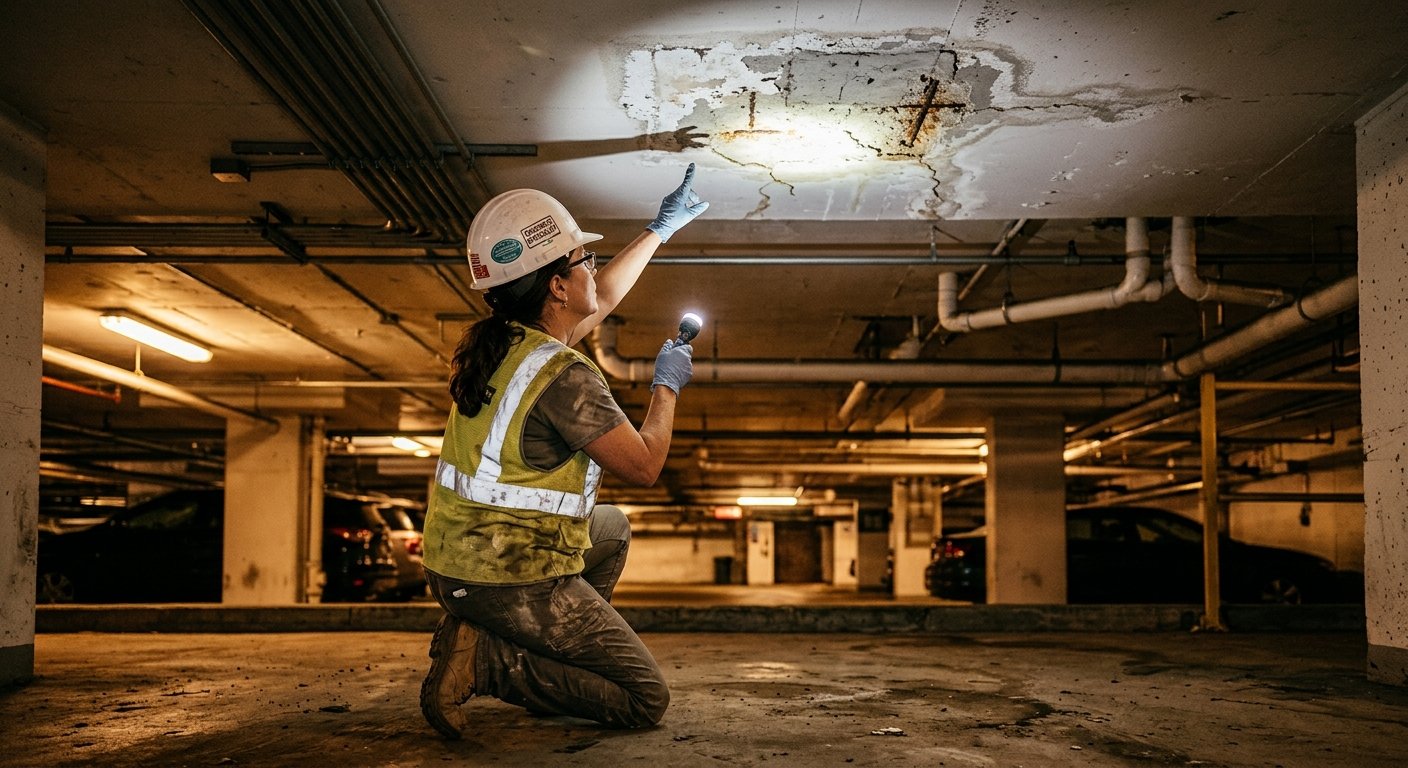
Most property managers encounter carbonation-related damage through its consequences: water stains on parking garage ceilings, rust streaks on concrete facades, or peeling sealant at expansion joints. The conventional response is to patch the spalled concrete, apply a surface coating, or re-caulk the joints. These approaches share a common limitation — they work at the surface while the underlying problem continues to advance from within.
| Criterion | Traditional Patching / Coating | Polyvinyl Injection Technology |
|---|---|---|
| Penetration depth | Surface only | Penetrates into the crack or joint pathway |
| Addresses root cause | No — seals surface while interior progresses | Yes — fills the intrusion pathway at the source |
| Disruption to tenants | Moderate to significant (grinding, demolition) | Minimal — non-disruptive technology |
| Longevity | Typically requires re-application within 1-3 years | Permanent seal with 5-year warranty on repairs |
| Suitable for active leaks | Limited — coatings fail under hydrostatic pressure | Yes — designed for active water intrusion scenarios |
CL Wizard’s proprietary polyvinyl injection technology is engineered specifically for the challenges South Florida buildings face. Rather than masking the surface manifestation of concrete moisture problems, the process delivers a flexible, bonding agent deep into cracks, joints, and voids — sealing the channel through which water and CO₂ continue to penetrate. The result is a permanent concrete leak solution that doesn’t require demolition, tenant relocation, or extended building closures. For a comprehensive overview of how this approach addresses water intrusion at the structural level, the water intrusion solutions resource provides detailed technical context.
Flexible injection materials are critical in South Florida because the thermal expansion and contraction cycle means rigid repair materials often re-crack at the interface within one to two seasons. A material that flexes with the concrete — rather than against it — maintains its seal through the full range of thermal movement the structure experiences.
How to Assess Your Building’s Carbonation Risk
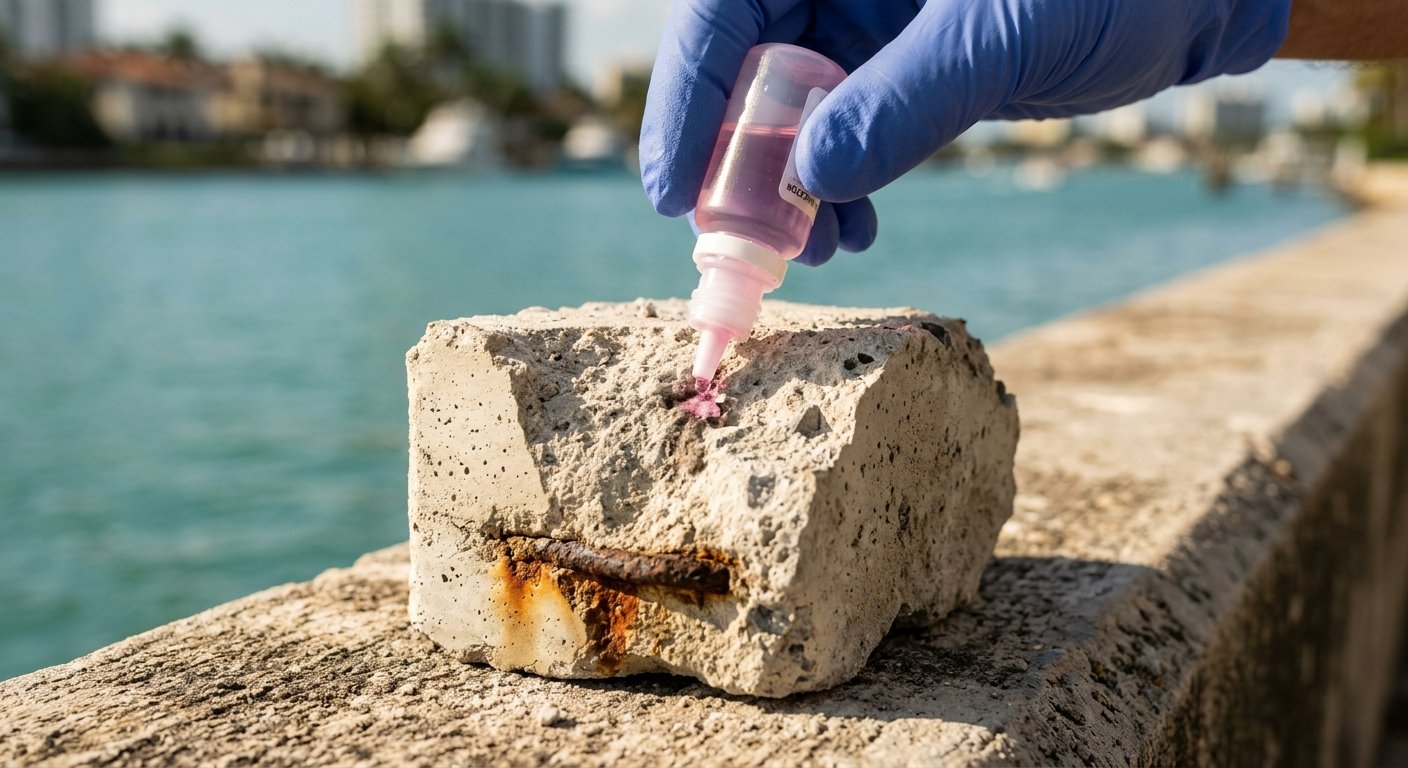
A reliable preliminary assessment doesn’t require laboratory testing, though phenolphthalein indicator testing on core samples remains the gold standard for measuring carbonation depth. Property managers can identify high-risk indicators through visual inspection:
- Rust staining on concrete surfaces, particularly below balconies or at column bases, suggests the carbonation front has already reached the rebar layer.
- Delaminating or spalling concrete — sections where the surface layer separates — indicates internal corrosion expansion has begun cracking the matrix.
- Water stains or efflorescence (white mineral deposits) at joints or cracks, indicating active moisture movement through the concrete.
- Joint sealant that is cracked, shrunk, or missing in sections, leaving expansion joints open to direct CO₂ and moisture exposure.
- Buildings over 15-20 years old in coastal Miami-Dade, Broward, or Palm Beach County that have not had a recent professional assessment.
Any combination of these signs warrants a professional evaluation. CL Wizard’s licensed and insured team serves Miami, Fort Lauderdale, and West Palm Beach commercial properties and can provide site-specific assessments that identify where carbonation-enabled water pathways exist before they become visible structural failures. The concrete slab waterproofing service page outlines how slab-level vulnerabilities fit into a broader durability strategy for multi-story buildings.
Visual inspection
Walk the structure and document rust stains, spalling, joint separation, and water staining. Photograph and date findings.
Professional assessment
A licensed specialist evaluates carbonation depth indicators, active leak points, and joint condition — no demolition required at this stage.
Targeted injection repair
Polyvinyl injection technology seals confirmed intrusion pathways from within, addressing the carbonation-enabled channel rather than just the surface.
Verification and warranty
Post-repair inspection confirms seal integrity. CL Wizard backs qualifying repairs with a 5-year warranty.
Frequently Asked Questions
Can concrete carbonation be reversed once it has occurred?
The carbonation reaction itself — the conversion of calcium hydroxide to calcium carbonate — cannot be chemically reversed without full concrete replacement. However, the consequences (moisture pathways, rebar corrosion initiation) can be halted and sealed. Polyvinyl injection stops further water and CO₂ penetration through the damaged zones, preventing additional deterioration even if existing carbonation depth remains.
How quickly does carbonation advance in Miami buildings compared to inland structures?
Carbonation rate depends on concrete porosity, cover depth, and environmental exposure. Coastal South Florida buildings face accelerated rates due to high humidity maintaining the moisture conditions that sustain the carbonation reaction, combined with salt-laden air that compounds the corrosion impact once the rebar’s passive protection layer is compromised. Buildings within several blocks of the ocean are at highest risk and should schedule assessments more frequently.
Does concrete carbonation water intrusion affect HOA liability?
Yes. Florida’s condominium statutes require HOAs to maintain common elements in good repair. Water intrusion that damages individual units as a result of deferred maintenance in common concrete elements can expose the association to liability. Documenting proactive inspections and repairs is important for both risk management and insurance purposes.
Is polyvinyl injection technology suitable for active leaks, or only preventive treatment?
CL Wizard’s technology is designed to work in both conditions. The injection material can seal actively leaking cracks and joints by bonding in the presence of moisture, making it appropriate for situations where water is currently entering the structure — not only as a preventive measure before visible leaking begins.
How do I know if my building’s expansion joints are the primary carbonation entry point?
Expansion joints are among the most common entry points in multi-story and parking structures because they are intentional breaks in the concrete matrix that concentrate movement stress. If water staining or leaking correlates with joint locations — especially on parking decks or at balcony perimeters — those joints are likely the primary carbonation and moisture pathway. A site assessment will confirm this and identify any secondary crack networks.
Schedule a Concrete Assessment for Your Building
Carbonation progresses silently — a professional evaluation identifies exactly where your Miami, Fort Lauderdale, or West Palm Beach property is vulnerable before damage becomes costly.

About CL Wizard
CL Wizard provides permanent concrete leak repair solutions for South Florida commercial property managers, building owners, and HOAs using proprietary polyvinyl injection technology. Unlike traditional waterproofing methods that offer temporary fixes, CL Wizard's non-disruptive approach permanently seals concrete expansion joints and water intrusion points without requiring extensive demolition or tenant displacement. The company specializes in addressing South Florida's unique challenges including saltwater exposure, humidity, and thermal expansion in high-rises, condominiums, and parking structures. Visit clwizard.com →
