
Water Coming Up Between Floor Tiles? Why It’s Probably Not a Plumbing Leak
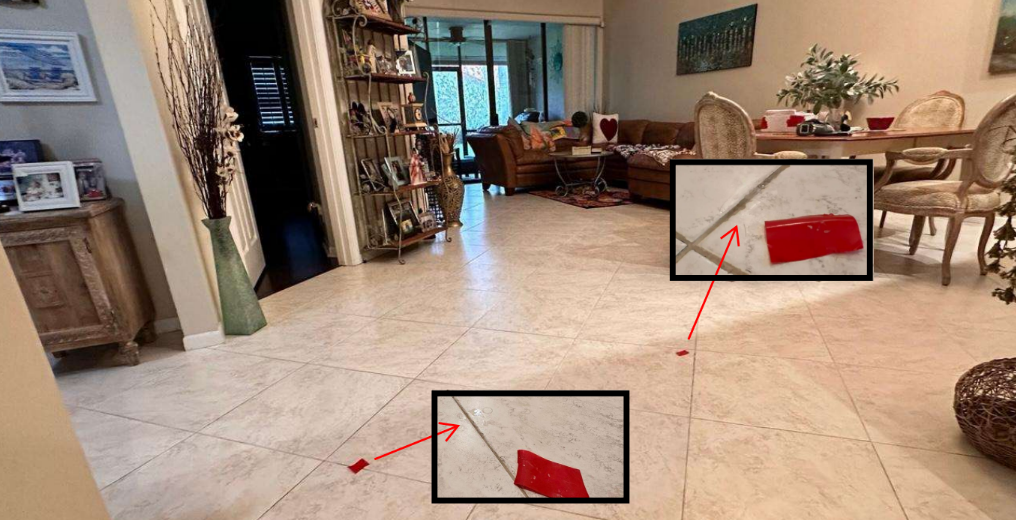
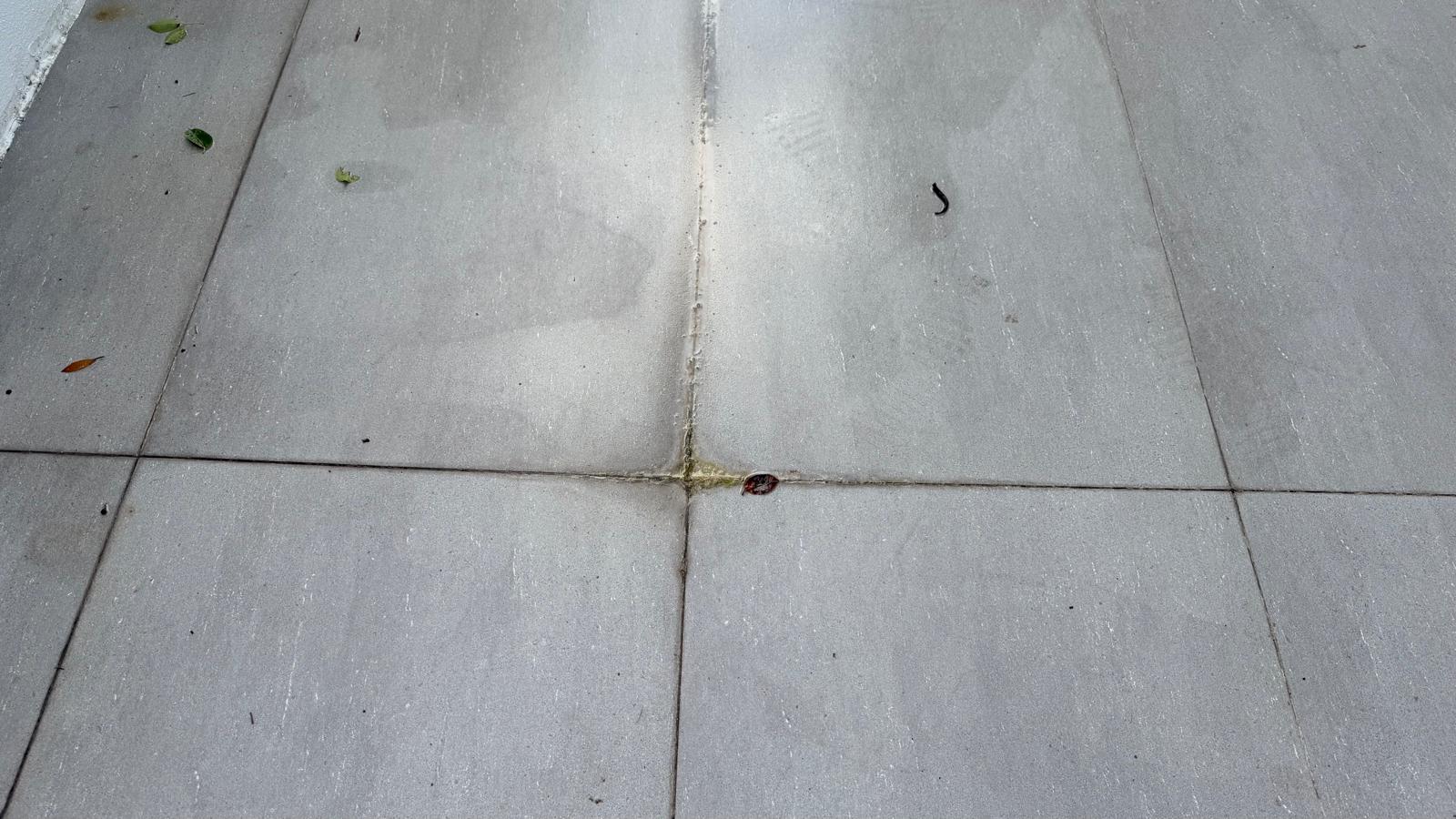
If you’ve noticed water coming up between floor tiles — or damp grout lines, or a chalky white crust forming along the joints — your first thought was almost certainly a broken pipe. In South Florida, it usually isn’t. More often, water coming up between floor tiles is a sign of hydrostatic pressure: groundwater beneath your slab pushing moisture up through the concrete.
This is one of the most common calls we get at CL Wizard, and it’s one of the most misdiagnosed problems in Florida homes. Understanding what’s actually happening beneath your floor can save you thousands of dollars in unnecessary plumbing work, leak detection, and flooring you’ll only have to pull up again. This guide walks through why the moisture appears, why it comes and goes, why several popular repairs don’t hold, and how the problem is actually solved at the source.
The calls we hear every week
The wording changes, but the story rarely does. Homeowners across Miami, Fort Lauderdale, Boca Raton, Delray Beach, and Margate call describing some version of the same thing:
“There’s water coming up between my floor tiles, but the plumber couldn’t find a leak.” — “White calcium keeps forming in the grout no matter how many times I clean it.” — “The floor gets damp after it rains, then dries out, then comes back.”
If any of that sounds like your home, you’re not dealing with something rare or mysterious. You’re dealing with one of the most predictable consequences of building slab-on-grade homes on South Florida’s water-rich ground — and the good news is that, in the large majority of these cases, there is no plumbing leak at all.
The biggest misconception: “it must be a broken pipe”
It’s a reasonable assumption. Water is on the floor, so water must be escaping from a pipe under the floor. But a plumbing leak and hydrostatic pressure behave very differently, and once you know the tells, they’re not hard to separate.
A broken supply line runs more or less constantly and doesn’t care what the weather is doing. It tends to get worse, not better, and it usually produces a meaningful volume of water. Hydrostatic moisture is the opposite: small, intermittent, often just a damp film or a slow weep at the grout, and frequently tied — loosely — to wet and dry seasons rather than to any single storm.
| What you notice | Plumbing leak | Hydrostatic pressure |
|---|---|---|
| Flow | Fairly constant, can be significant | Small, on and off, often just moisture |
| Weather | Independent of rain | Loosely tracks wet/dry cycles, with a lag |
| Trend over time | Usually worsens steadily | Comes and goes; may move to new spots |
| Volume | Can be a lot of water | Usually a little water or a damp patch |
| Where it shows up | Near fixtures and plumbing runs | Anywhere — mid-floor, edges, grout lines |
| White calcium (efflorescence) | Uncommon | Common |
| Leak-detection result | Often locates a source | Frequently “no leak found” |
If the right-hand column describes your home better than the left, the water almost certainly isn’t coming from a pipe. It’s coming from the ground.
What is hydrostatic pressure?
Hydrostatic pressure is simply the pressure that standing water exerts because of its own weight. When groundwater collects beneath your foundation and the water table rises, that water presses upward against the underside of your slab. Concrete looks solid, but it’s full of microscopic pores and capillaries, and under sustained pressure, water finds its way through them.
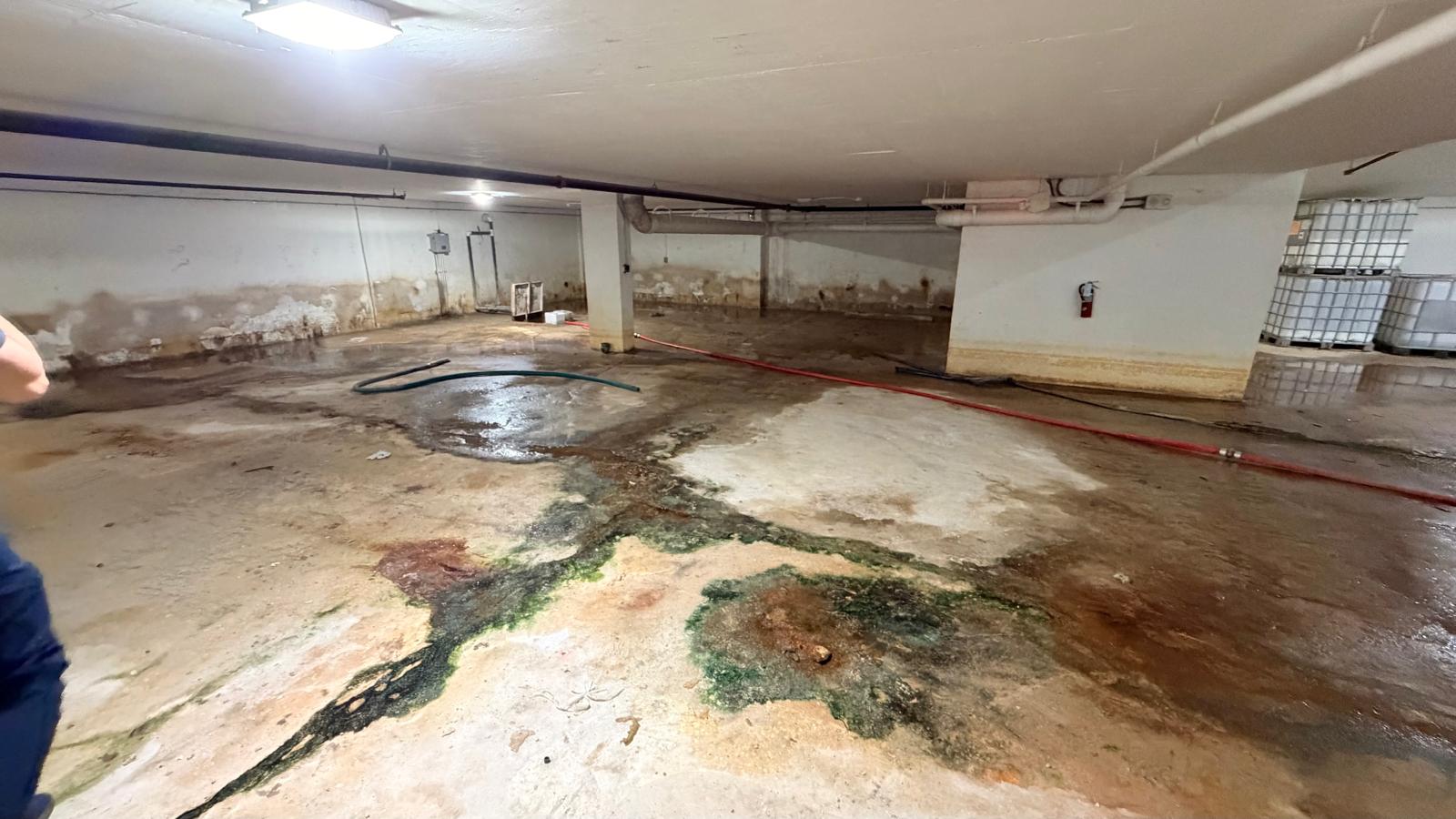
Once moisture reaches the surface, the first signs are usually subtle: damp grout, a slow weep between tiles, small blisters under vinyl, dark staining, or that telltale white powder. These are the classic symptoms of groundwater pushing up through the slab — not water leaking down from somewhere inside your home.
Why South Florida is built for this problem
Hydrostatic pressure isn’t equally likely everywhere. South Florida is close to a worst-case scenario for it, for a few reasons that have nothing to do with your plumbing and everything to do with what’s under your house.
First, the water table is high — often just a few feet below the surface, and higher still near the coast and along the canal networks that thread through east Fort Lauderdale, Delray, and much of Broward and Miami-Dade. Here’s the part that surprises people: the lake or canal behind your home can sit three, four, even five feet below your slab and still drive moisture up through your floor, because groundwater doesn’t need to be above your slab to press against it.
Second, many neighborhoods sit on fill rather than clean sand. When these communities were graded, the good draining material often went into the roadbeds, and organic soils, muck, and clay-heavy fill were pushed out to where the houses were later built. Unlike sand, that material drains slowly. Rainwater gets trapped around and beneath the home, effectively forming a slow-moving pond under your foundation that can take days or weeks to dissipate.
You didn’t do anything wrong, and neither did the builder, necessarily. A high water table plus slow-draining fill soil is simply the environment a lot of South Florida homes were built into. It’s a groundwater problem, and it needs a groundwater solution.
Why does it only happen sometimes?
This is the question that convinces most homeowners it can’t be groundwater: “If it were the water table, wouldn’t it happen every single time it rains?” It’s a fair point, and the answer is what makes hydrostatic pressure so confusing to diagnose.
Groundwater doesn’t respond to rain instantly. A short, light rain might only dampen the upper soil without raising the water table at all — so nothing shows up on your floor. But if a second rain follows a few days later, the soil is already saturated, and that rain can finally lift the water level enough to create pressure under the slab. Meanwhile, a single dramatic thunderstorm might drain away quickly and never build sustained pressure at all.
That’s why there’s rarely a clean cause-and-effect between one storm and one wet floor. The moisture is governed by how saturated the ground already is and how fast water moves through that particular soil — not by the rainfall you happened to notice.
Those white deposits: efflorescence
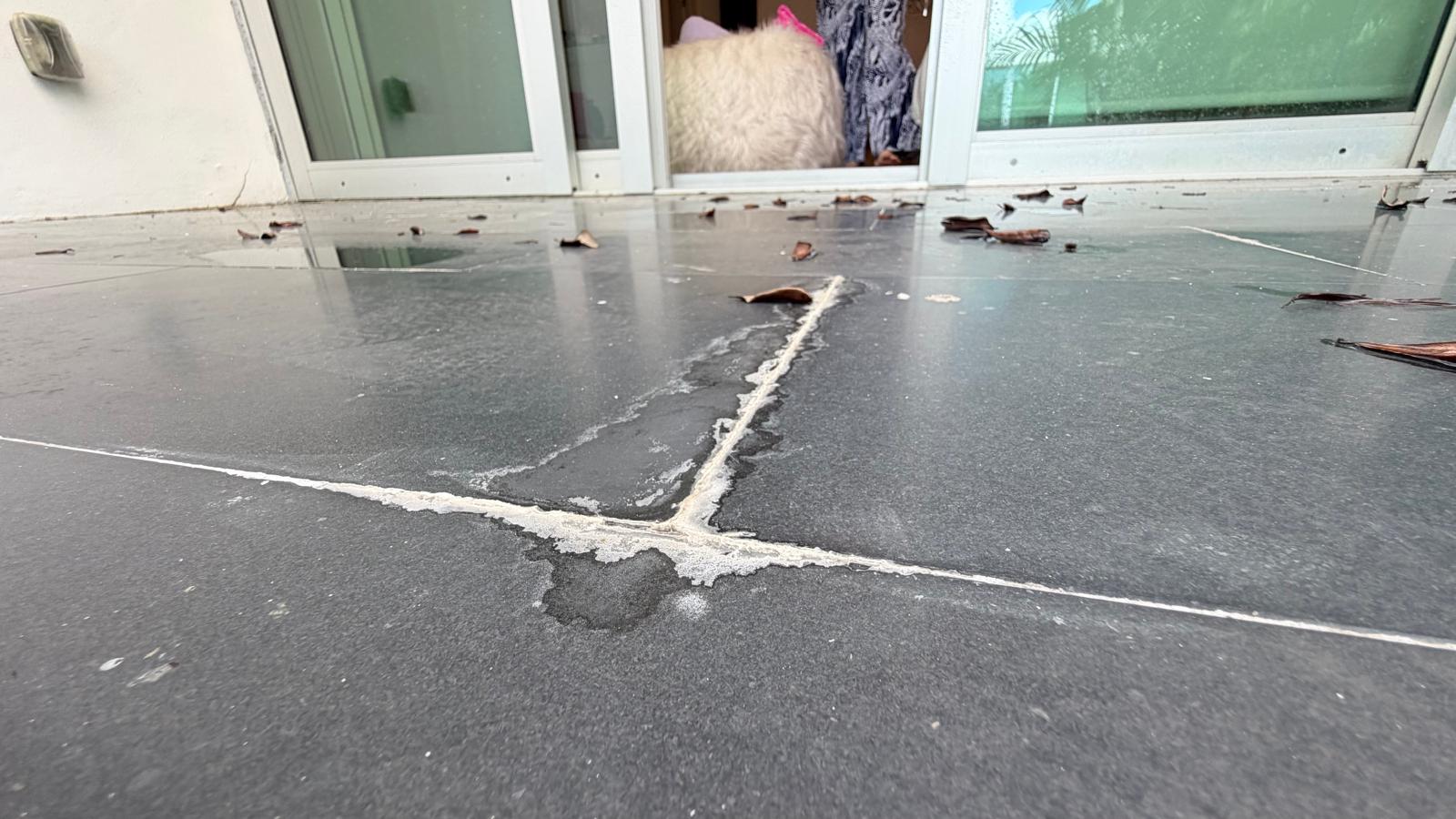
Those chalky white deposits between your tiles have a name: efflorescence. As groundwater moves through concrete, it dissolves naturally occurring mineral salts. When that water reaches the surface and evaporates, the water leaves but the minerals stay behind, building up as the white crust you keep wiping away.
Efflorescence is one of the earliest and most reliable signs that water is moving upward through your slab. Water dripping down from a pipe doesn’t typically leave it. If you’re seeing recurring calcium between the tiles, that’s a strong indicator the moisture is coming from below.
“We removed the tile and the water stopped — then it came back”
We hear this one constantly, and it’s the single most misleading thing about the whole problem. The story goes: a homeowner pulls up the tile during a renovation, the slab sits bare for weeks, and even through heavy rain, no water appears. Everyone concludes the problem is gone. New flooring goes down — and within weeks, the moisture is back.
It’s tempting to blame the new floor or the installer. But the floor didn’t cause it. Here’s what actually happened.
The amount of water arriving through hydrostatic pressure is usually very small — a slow seep, not a flood. When the slab is bare and exposed, your air conditioning is continuously pulling moisture out of the air, and the concrete dries almost as fast as water reaches the surface. So you never see standing water. The moment you install tile, vinyl, or wood over that slab, you cap it. Evaporation stops, the moisture has nowhere to go, and it collects underneath until it builds enough pressure to surface at the grout joints and seams.
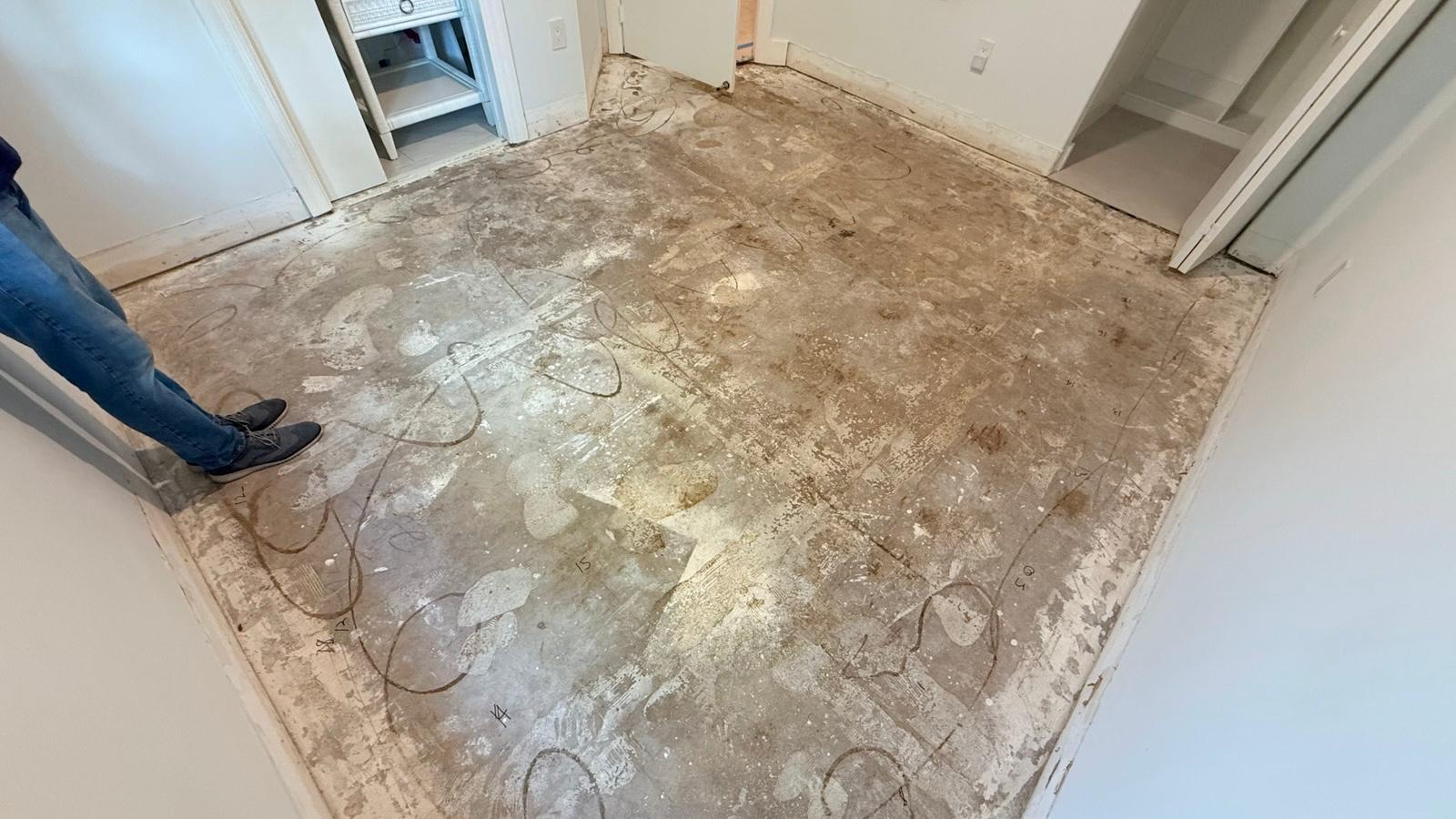
Removing the floor didn’t solve the problem. It only let the concrete breathe for a while.
Why water shows up along the baseboards
Groundwater doesn’t always come up through the middle of a room. In a lot of homes it appears along the perimeter, right where the floor slab meets the concrete block walls. That joint between the foundation slab and the wall is a natural pathway, and water under pressure follows the path of least resistance. It can travel sideways beneath the slab and surface at the wall line, soaking baseboards and the bottom of drywall.
Because the water can move laterally before it appears, the wet spot you see is often not directly above where the moisture entered. That single fact explains why so many spot repairs fail — and it’s worth keeping in mind for the sections ahead.
Why leak-detection companies often find nothing
Many homeowners start by calling a leak-detection company, which makes sense. They pressure-test the plumbing, run their equipment, and report back: “We couldn’t find any leaks.”
That’s not a failure on their part. There often isn’t a plumbing leak to find. Their tools are built to locate water escaping from a pressurized pipe, and they’re good at it. But hydrostatic moisture isn’t coming from your plumbing system — it’s coming from the ground beneath your slab, which is outside what a plumbing test is designed to detect. A clean leak-detection report is actually a useful data point: it helps rule the pipes out and points the investigation underground.
A simple test you can do this weekend
If you want a low-cost way to gather evidence before calling anyone, there’s a recognized method for it. It’s essentially the plastic sheet test described in the ASTM D4263 standard, and you can do a homeowner version of it yourself.
- Pick a suspect spot. Choose an area of bare concrete where you’ve seen moisture or efflorescence — a section of exposed slab, a closet, or a spot where you can lift the flooring.
- Tape down clear plastic. Seal a sheet of clear plastic (about 18×18 inches) tightly to the concrete on all four edges with strong tape, so no room air can get underneath.
- Wait two to three days. Leave it undisturbed. If possible, include a period after rain.
- Read the result. If moisture, droplets, or a foggy film form on the underside of the plastic, water vapor is migrating up through the slab. Dry plastic makes hydrostatic moisture less likely.
This test tells you moisture is moving through the slab, not how much or exactly where it’s entering — groundwater can travel a long way beneath the concrete before it surfaces. It’s a strong first clue, not a substitute for a professional diagnosis, but it’s a genuinely useful thing to check before you spend money.
Why some repairs only work for a while
Here’s where a lot of money gets spent for a little time. Several common approaches can reduce the symptoms briefly, but if groundwater is still sitting under the slab, the pressure is still there, and eventually the water finds another path. None of these methods is a scam — each does something useful in the right situation. The problem is that they’re aimed at a different problem than the one you have.
| Approach | What it’s genuinely good at | Why hydrostatic pressure gets past it |
|---|---|---|
| Sealing / injecting visible cracks | Fixing one identifiable, isolated crack | Moisture often migrates through pores with no visible crack; the entry point isn’t above the wet spot |
| French / trench drains | Lowering water where there’s grade to drain toward | On flat South Florida lots there’s nowhere lower to send it; it lowers water around the perimeter, not under the slab |
| Polyurethane foam injection | Filling voids and stabilizing soil | Its cellular structure isn’t a continuous barrier; under constant pressure water migrates around and between the cells |
| Exterior perimeter waterproofing | Protecting foundation walls from outside water | It can’t reach beneath the slab, and it can’t seamlessly tie into a membrane installed 20–30 years ago |
| Surface coatings / waterproof paint | Resisting water pushing from above | Here water pushes from below through microscopic pores; the coating is too thick to seal them and water travels underneath it |
Notice the pattern: every one of these treats the surface or the perimeter, and every one leaves the groundwater exactly where it was. If the water is still under the slab, you’ve redirected the symptom, not removed the cause.
The overlooked factor: viscosity
There’s one physical property that explains why so many waterproofing products fail against hydrostatic pressure, and why a specialized material succeeds: viscosity — how thick or thin a fluid is.
Water has an extremely low viscosity. That’s precisely why it can worm its way into the smallest pores and capillaries in concrete. To stop it permanently, the repair material has to be able to follow those same tiny pathways. Most waterproofing products are far too thick to do that. They sit on the surface and coat it, while groundwater simply travels through the concrete beneath the coating and re-emerges somewhere else. Sealing the surface isn’t enough when the water is moving inside the slab.
How CL Wizard stops it — at the source, beneath the slab
This is where CL Wizard’s approach is fundamentally different. Instead of coating the surface or draining the perimeter, we build a new waterproofing membrane beneath the slab, where the water actually is — using our proprietary Elastic Polyvinyl Liquid DWG Nano-Polymer ECO V® injection system.
The key is that Polyvinyl is engineered to be almost as fluid as water itself. When we inject it under the slab, it behaves the way groundwater behaves: it travels through the same channels, spreads under the concrete, and reaches the same hidden pathways the water was using. That’s what lets us seal the problem instead of chasing wet spots. Here’s how the process works:
- Rule out plumbing first. We confirm the moisture is groundwater, not a supply or drain line. Proper diagnosis before any repair is the whole point.
- Map the moisture. We evaluate where and how the water is surfacing, its relationship to rainfall, and the layout of the slab so the injection plan matches your home.
- Install precision ports through the slab. We drill small openings and set our exclusive open ports fitted with independent valves, which let us control and monitor the flow of material under the slab with precision.
- Inject Polyvinyl beneath the slab. Because it’s as fluid as water, the Polyvinyl travels under the concrete exactly the way groundwater does — reaching areas a thick coating never could.
- Follow it to the next port. As the material spreads, it surfaces at adjacent ports. We install new valves at those points and continue injecting from there, connecting one point to the next.
- Connect all the dots. Port by port, we build a continuous chemical waterproofing membrane across the full area beneath your foundation — verifying coverage so there are no gaps for water to exploit.
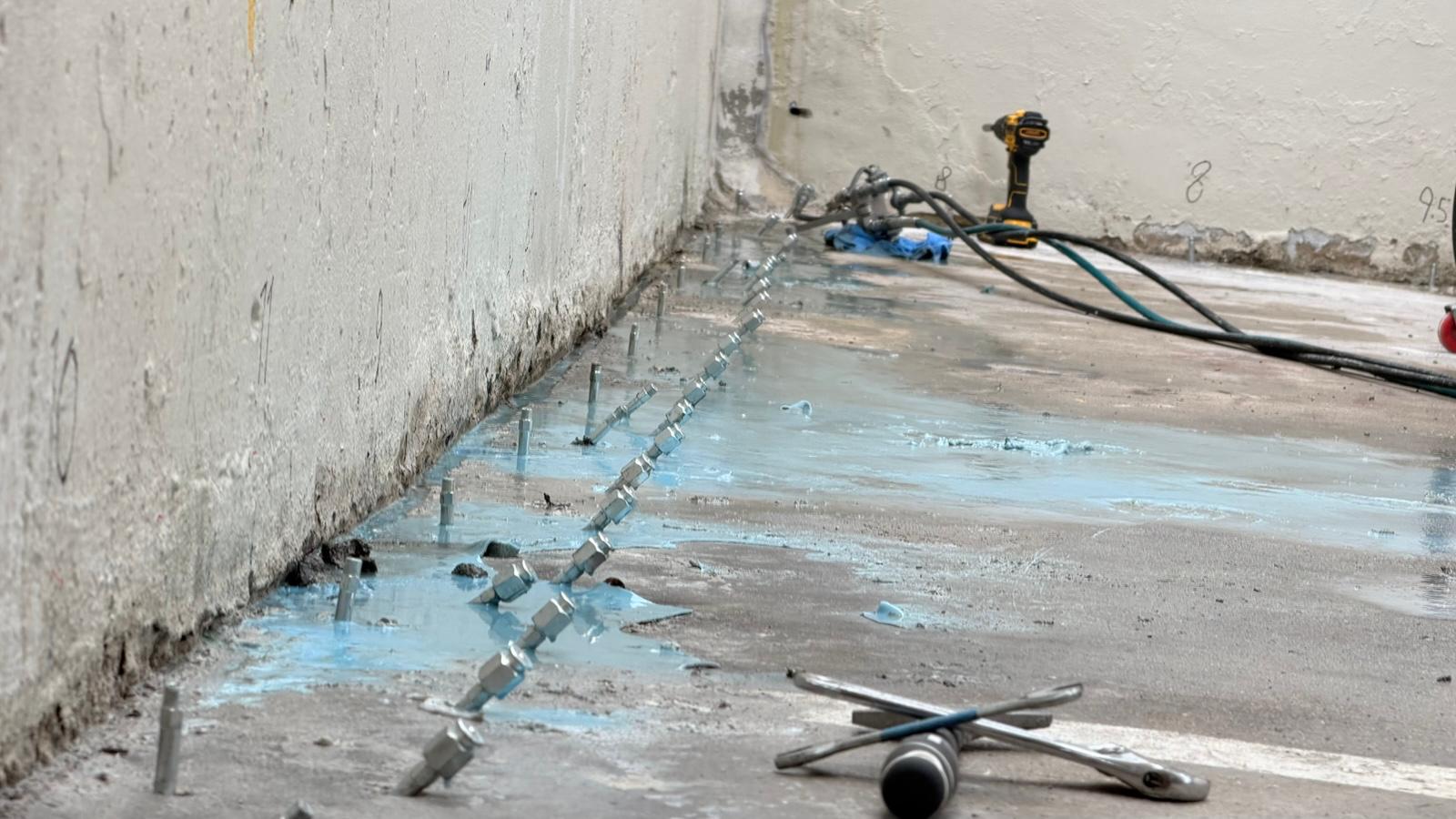
The goal is not to patch the one spot you can see. It’s to place a waterproof barrier across the area where the water is actually traveling, so the hydrostatic pressure has nothing left to push through. This is the approach we’ve used to solve some of the most stubborn below-slab water intrusion problems across South Florida, and CL Wizard backs the work with a 5-year warranty.
If you’ve tried other fixes and you’re skeptical — that’s normal
We completely understand the skepticism, because we see it on nearly every job. If you’ve already spent real money on repairs that didn’t hold, it’s only sensible to wonder whether anything will. Many of the homes we visit have a history behind them — a French drain in the yard, foam injected under the slab, exterior waterproofing around the foundation, flooring replaced more than once, a stack of leak-detection reports that all came back clean.
We’ve even worked on homes that passed through three different owners, each of whom fought the same wet floor, and in some cases each of whom received a proposal from us years apart. The common thread was always the same: the real cause was hydrostatic pressure beneath the slab, and until that was addressed, the moisture kept coming back no matter what was tried on the surface.
The reason it goes undiagnosed for so long isn’t that anyone is careless. It’s that below-slab water intrusion is a specialized corner of engineering. A flooring company, a plumber, and a leak-detection tech are each excellent at their own work — but this particular failure sits outside all of it. That’s why homeowners get different opinions, and why the honest answer often only surfaces when someone looks at the problem from the groundwater side.
We’d rather you understand the problem than simply hire us. The success of any repair depends entirely on identifying the true source of the water before choosing a method. If you know why the moisture appears, why it comes and goes, and why the ground — not a pipe — is driving it, you can make a decision based on physics instead of guesswork.
Quick self-check: is it hydrostatic pressure?
The more of these that match your home, the more likely you’re dealing with groundwater under the slab rather than a plumbing leak:
- Water coming up between floor tiles, or damp grout that keeps returning
- Recurring white calcium (efflorescence) in the grout lines
- Moisture that appears after wet periods, then dries, then comes back
- Damp spots along baseboards where the floor meets the walls
- A leak-detection company that tested the plumbing and found nothing
- Moisture that vanished when the slab was bare and returned after new flooring
- A home near a canal, lake, or low-lying area, or on filled ground
Frequently asked questions
Is water coming up between my floor tiles always a plumbing leak?
No. In South Florida it’s more often hydrostatic pressure — groundwater beneath the slab pushing moisture up through the concrete. A plumbing leak tends to run constantly and produce a lot of water; hydrostatic moisture is usually small, comes and goes, and often appears after wet periods with no pipe involved.
What exactly is hydrostatic pressure under a slab?
It’s the upward force created when groundwater collects beneath your foundation. When the water table rises, that water presses against the underside of the slab and can migrate up through the concrete’s microscopic pores, surfacing as damp grout, calcium deposits, or moisture between tiles.
Why does the moisture only appear sometimes, or after rain?
Groundwater doesn’t respond to rain instantly. On South Florida’s fill soils, water can take days to raise the level under a home. A light rain may only dampen the soil, while a later rain finally lifts the water table enough to create pressure — which is why there’s rarely a direct match between a specific storm and when the floor gets wet.
What are the white deposits between my tiles?
They’re efflorescence — mineral salts left behind when groundwater travels through concrete and then evaporates at the surface. It’s one of the earliest signs that moisture is moving upward through the slab rather than leaking down from inside the home.
Why did the water stop when we removed the tile, then come back?
The amount of water is usually small. With the slab exposed, air conditioning dries the concrete about as fast as moisture arrives, so you see nothing. Once tile or vinyl is installed, evaporation is blocked and moisture collects underneath until it surfaces at the grout joints. The source never left — evaporation simply hid it.
Do French drains or foam injection stop hydrostatic pressure?
They address a different problem. A French drain lowers water where there’s grade to drain toward; on flat lots it doesn’t lower the water table beneath the slab. Polyurethane foam fills voids, but its cellular structure isn’t a continuous barrier, so under sustained pressure water can migrate around it. Stopping hydrostatic pressure means sealing the pathways beneath the slab itself.
Do you have to break up my slab or excavate around my home?
No. There’s no jackhammering the slab apart and no digging around your foundation. To reach the bare concrete, the existing flooring is taken up first; from there we drill small injection ports and inject Polyvinyl beneath the slab, where it flows like water and surfaces at nearby ports to form a continuous membrane. It’s far less invasive than traditional approaches that excavate around the home or remove and replace the slab.
Which areas does CL Wizard serve?
We work throughout Florida, including Miami, Fort Lauderdale, Boca Raton, Delray Beach, Margate, the Naples area, and surrounding communities — with particular experience in the canal-adjacent and low-lying areas where hydrostatic pressure is most common.
Think you have hydrostatic pressure, not a plumbing leak?
If you’re seeing water coming up between floor tiles, recurring calcium, or moisture the plumbers couldn’t explain, CL Wizard can determine what’s really happening beneath your slab — and stop it at the source, where the water actually is.
About CLWizard
CLWizard is an engineering technology company specializing in customized concrete water intrusion solutions powered by proprietary technology. Founded by civil engineer Marco Aurelio, the company developed the proprietary Polyvinyl Liquid DWG Nano-Polymer Eco V Injection System, which creates waterproofing membranes beneath concrete slabs without demolition. Trusted by engineers when conventional materials and methods fall short, CLWizard delivers durable, long-lasting solutions backed by a 5-year warranty. Headquartered at 279 Goolsby Boulevard, Deerfield Beach, FL 33442, CLWizard serves residential, commercial, and industrial projects. Request an inspection →
This article is for general education and doesn’t replace an on-site inspection. Every home and soil condition is different; a professional diagnosis is the only way to confirm the true source of water intrusion in your specific case.
