
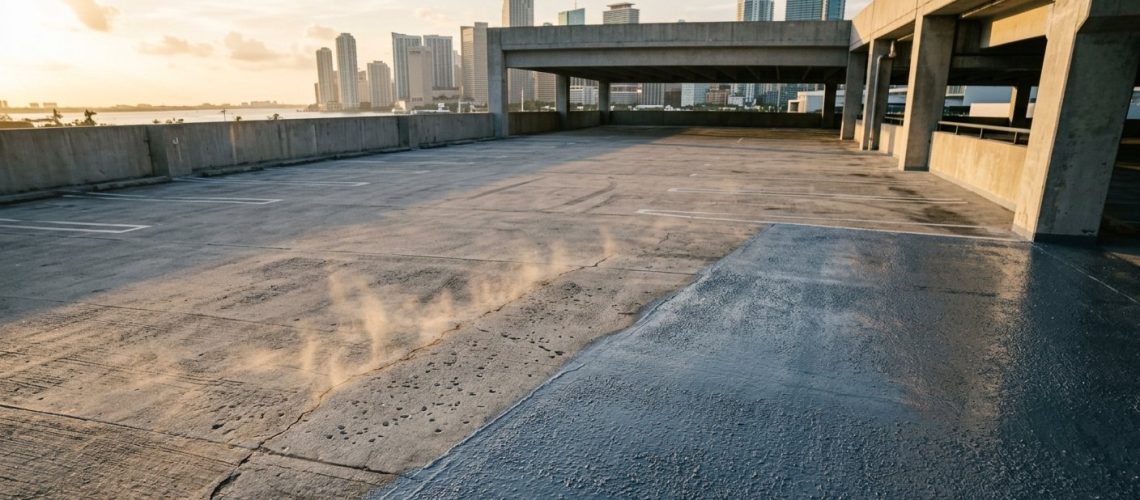
South Florida’s concrete slabs face a punishment that most of the country never sees. Saltwater-laden air attacks reinforcing steel from the outside while moisture vapor pressure pushes up from the ground below. Thermal expansion cycles occur almost daily, widening joints by fractions of millimeters with every temperature swing. And when a concrete slab leak finally announces itself—usually through a water stain on a ceiling below, or pooling on a parking deck—the damage has already been spreading for weeks or months.
For commercial property managers, HOA boards, and building owners in Miami, Fort Lauderdale, and West Palm Beach, understanding concrete slab waterproofing isn’t optional anymore. It’s core property stewardship. This guide covers what works in 2026, what doesn’t, and why the technology behind the repair matters as much as the repair itself.
Why South Florida Slabs Fail Faster
Concrete is porous by nature. According to the National Ready Mixed Concrete Association, standard concrete mixes have a water-to-cement ratio that, when cured, leaves a network of capillary channels throughout the slab. In a dry environment, those channels remain relatively inert. In South Florida, they act as pathways for aggressive chloride ions, humidity, and hydrostatic pressure.
Three factors accelerate deterioration here specifically:
- Thermal expansion: Concrete expands and contracts with temperature. South Florida’s concrete slabs regularly cycle between 65°F nights and 92°F afternoons, generating movement of approximately 0.0000055 inches per inch of slab per degree Fahrenheit. Over a 200-foot parking deck, that’s measurable joint movement every single day.
- Saltwater chloride exposure: Marine-grade air carries chloride ions that penetrate concrete, reach the steel rebar, and initiate corrosion. Corroding rebar expands—up to four times its original volume—cracking the slab from the inside out.
- Hydrostatic pressure: South Florida’s high water table means slabs on grade face upward water pressure year-round, not just during heavy rains. That pressure exploits every micro-crack and expansion joint gap.
These aren’t worst-case scenarios. They’re the baseline operating conditions for any concrete structure within 50 miles of the coast.
Concrete Slab Waterproofing Methods: What’s Available in 2026
The market offers several concrete slab waterproofing methods, each with different performance profiles in South Florida’s environment.
Surface-Applied Coatings and Sealers
Topical sealers—acrylics, epoxies, polyurethanes—create a surface barrier that blocks moisture entry from above. They’re relatively inexpensive to apply and work reasonably well on new construction or minimally damaged slabs. The limitation is durability: most surface coatings in South Florida’s UV-intense, high-traffic environments require reapplication every two to five years. They also do nothing to address water intrusion already traveling through existing cracks or expansion joints. For parking decks or elevated slabs where water enters from below or through joint failures, surface coatings are an incomplete solution.
Crystalline Waterproofing Admixtures
Crystalline technology works by introducing compounds that react with water and cement particles to form insoluble crystals within the concrete matrix, blocking capillary channels. Per research published through the American Concrete Institute, crystalline admixtures are most effective when incorporated into the original mix design or applied to freshly poured concrete. Retrofitting existing slabs with surface-applied crystalline products yields inconsistent results, particularly where active leaks or open joints are present.
Sheet Membrane Systems
Sheet membranes—modified bitumen or thermoplastic varieties—are installed beneath the slab during original construction. They provide excellent moisture barriers for slab-on-grade applications. The challenge: they cannot be retrofitted without demolition of existing slabs, making them impractical for commercial concrete slab leak repair in occupied buildings.
Polyvinyl Injection Technology
For existing structures with active leaks, failing expansion joints, or confirmed water intrusion pathways, injection-based repair offers the most targeted and effective solution. Polyvinyl injection technology works by introducing a specialized compound directly into the leak pathway—whether that’s a crack, joint, or void—where it expands, bonds to the surrounding concrete, and creates a permanent flexible seal.
Unlike surface methods, injection addresses the intrusion point directly, not just the surface symptom. Unlike demolition-based approaches, it requires no removal of existing concrete, no tenant displacement, and no extended facility closure. For South Florida commercial properties and condominiums, this combination of permanence and minimal disruption is difficult to match.
How Polyvinyl Injection Works on Concrete Slabs
The process begins with a professional assessment to map the leak pathways—where water is entering, which direction it’s traveling, and what pressure it’s under. This step is non-negotiable; effective concrete slab waterproofing cannot be designed without understanding the specific failure points in that structure.
Once the intrusion pathways are identified, injection ports are installed at calculated intervals along the crack or joint. The polyvinyl compound is then introduced under controlled pressure. The material migrates through the existing void, displacing standing water, and reacts upon contact with moisture to expand and bond. The result is a flexible, watertight seal that accommodates the ongoing thermal expansion movement that South Florida slabs experience daily—rather than cracking under it the way rigid fillers do.
The non-disruptive nature of this method is significant for occupied buildings. Work proceeds section by section, and there’s no requirement for heavy equipment, jackhammering, or waterproofing membranes applied to freshly demolished surfaces. For concrete expansion joint leak repair in high-rises and parking garages, this distinction separates a manageable maintenance event from a multi-month construction project.
Slab on Grade vs. Elevated Deck: Does the Method Change?
Yes, meaningfully. Slab-on-grade waterproofing primarily addresses upward hydrostatic pressure and ground moisture vapor transmission. Elevated parking decks and podium slabs face downward water penetration from rain and vehicle drainage, plus the full thermal expansion load of an exposed structure.
For water intrusion in concrete on elevated decks, the injection approach is particularly well-suited because it can be applied from below—sealing the intrusion point from the water-entry side without disrupting the deck surface above. This is critical for parking structures where the deck surface must remain operational during repairs.
Ground-level slabs may benefit from a combination of injection at active intrusion points and surface-applied concrete moisture barrier treatments as a secondary layer, depending on the structure’s age, condition, and water table exposure.
The Cost of Delaying Concrete Slab Leak Repair
Water intrusion in commercial concrete structures follows a predictable cost escalation curve. Early-stage leaks—before rebar corrosion sets in—are significantly less expensive to address than late-stage failures where spalling, delamination, and structural compromise have occurred. The Federal Highway Administration has documented that corrosion-related concrete repair in infrastructure costs many times more when deferred, a principle that applies directly to private commercial structures.
For property managers and HOA boards facing budget constraints, the calculation is straightforward: the assessment and injection repair today is a fraction of the cost of slab replacement, tenant litigation from water damage to units below, or emergency remediation after a ceiling failure.
Frequently Asked Questions
How do I know if my concrete slab needs waterproofing or repair?
Common indicators include water stains on ceilings below a slab, visible efflorescence (white mineral deposits) on concrete surfaces, standing water that doesn’t drain, rust stains indicating corroding rebar, or visible cracks at expansion joints. A professional assessment is required to determine whether the issue is surface moisture or active water intrusion through a specific pathway.
Is polyvinyl injection waterproofing permanent?
CL Wizard’s polyvinyl injection repairs are backed by a 5-year warranty and are designed to provide long-term, durable sealing that accommodates ongoing thermal movement—unlike rigid fillers or temporary patches that crack under South Florida’s daily temperature cycling. The flexibility of the cured material is what distinguishes it from short-term solutions.
How disruptive is the repair process for occupied buildings?
The injection method is specifically designed to minimize disruption. Most repairs do not require tenant displacement, demolition, or extended facility closure. Work is staged in sections, and parking decks or commercial spaces can typically remain operational during the process. Each project is assessed individually before a repair plan is proposed.
Does commercial concrete slab waterproofing work on older buildings?
Yes. Older structures in Miami, Fort Lauderdale, and West Palm Beach are actually among the most common candidates for injection-based repair, precisely because their original waterproofing systems have aged past their effective service life. The injection approach doesn’t require removal of existing materials—it works within the existing structure to seal active intrusion pathways.
What’s the difference between waterproofing a new slab and repairing an existing one?
New construction waterproofing can incorporate admixtures, below-slab membranes, and optimized mix designs from the start. Existing structures require a diagnostic-first approach that identifies specific failure points and uses injection or targeted treatments to address them without demolition. The two scenarios call for different strategies, materials, and timelines.
Schedule a Professional Assessment
South Florida’s environment doesn’t give concrete slabs a grace period. The combination of hydrostatic pressure, saltwater chloride exposure, and daily thermal cycling means that what starts as a small joint failure or hairline crack can become a significant water intrusion problem within one rainy season.
CL Wizard specializes in permanent concrete leak repair for commercial properties, condominiums, HOAs, and parking structures across Miami, Fort Lauderdale, and West Palm Beach. As licensed and insured South Florida concrete leak specialists, we use proprietary polyvinyl injection technology to seal intrusion points without demolition, displacement, or disruption—backed by a 5-year warranty on all repairs.
If you’re managing a property with an active leak, visible joint deterioration, or water stains that keep coming back despite previous repairs, the next step is a professional on-site assessment. Contact CL Wizard to schedule your evaluation and get a clear picture of what’s happening inside your slab—and what it will take to fix it permanently.
