
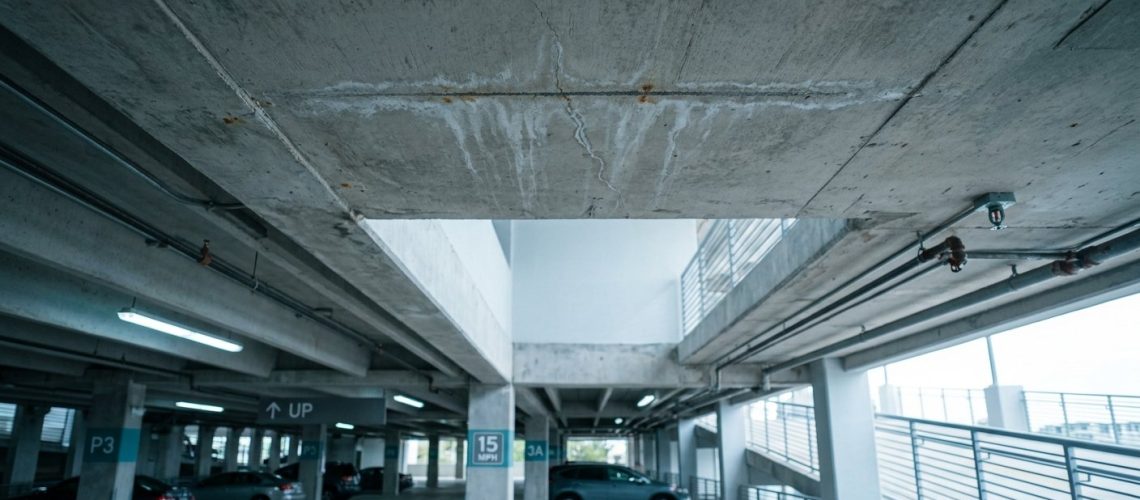
By the time water is visibly dripping through a parking garage ceiling or pooling in a ground-floor lobby, the damage has already been building for months — sometimes years. Concrete leak detection is not about responding to crises. It’s about recognizing the subtle signals that precede them. For commercial property managers, HOA board members, and building owners across Miami, Fort Lauderdale, and West Palm Beach, those early signals are frequently overlooked, misidentified, or dismissed as cosmetic issues.
That misidentification is expensive. According to the Federal Emergency Management Agency, water damage is among the most financially destructive issues affecting commercial buildings — and the costs compound the longer the source goes unaddressed. In South Florida’s environment, where saltwater air, high humidity, and thermal cycling stress concrete structures year-round, the timeline from early warning sign to serious structural compromise is significantly compressed compared to more temperate regions.
This guide walks through the concrete moisture problems that go undetected most often, explains why they’re easy to misread, and outlines what professional concrete leak detection actually involves.
Why South Florida Buildings Are Especially Vulnerable
Concrete is not impermeable. It is a porous material with a natural coefficient of thermal expansion of approximately 5.5 × 10⁻⁶ per °F. In South Florida, where surface temperatures on sun-exposed concrete can swing 40–60°F between night and early afternoon, that expansion and contraction is relentless. Over time, it widens micro-cracks, stresses expansion joints, and creates pathways for water seepage through concrete.
Add saltwater-laden air from coastal exposure, which accelerates chloride-induced corrosion of embedded rebar, and humidity levels that regularly exceed 80%, and the conditions for water intrusion in concrete become nearly constant. High-rise condominiums, multi-story parking structures, and commercial buildings with exposed concrete decks face these stressors simultaneously — often without the inspection frequency those conditions demand.
The Early Warning Signs Most Managers Overlook
1. Efflorescence — The White Residue Nobody Investigates
Efflorescence appears as a white, chalky, or crystalline deposit on concrete surfaces, walls, or ceilings. It forms when water moves through concrete, dissolves soluble salts, and carries them to the surface where moisture evaporates. Most property managers recognize the residue but assume it’s a cosmetic nuisance.
It is not. Efflorescence is a reliable indicator of active water movement through the concrete matrix. The water has to be coming from somewhere — whether an unsealed expansion joint, a hairline crack, or a compromised connection between concrete sections. Treating efflorescence without identifying its moisture source is like painting over rust: the structural problem continues underneath.
2. Hairline Cracks in Concrete Decks and Walls
Hairline cracks — those under 0.3 mm in width — are dismissed routinely as normal settlement or shrinkage. In many cases, they are initially benign. But in South Florida’s environment, hairline cracks are active pathways. Thermal cycling widens them incrementally every season. Chloride ions enter through them, initiating rebar corrosion. And once rebar begins to corrode, it expands at a rate that can fracture surrounding concrete from the inside out.
A hairline crack observed in January that shows no change in February does not mean the crack is stable. It means the crack hasn’t yet reached the threshold of visible change — a threshold that arrives faster in coastal environments.
3. Rust Staining on Concrete Surfaces
Brown or orange streaking running vertically down concrete columns, beams, or walls is frequently attributed to mechanical sources — a rust-prone metal fixture, a corroded drain pipe. Sometimes that attribution is correct. Often it is not.
Rust staining that originates from within the concrete itself is a sign that embedded rebar has been compromised by chloride penetration. The National Institute of Standards and Technology has documented that chloride-induced rebar corrosion is one of the leading causes of concrete deterioration in coastal infrastructure. When rust stains appear without an obvious external metal source, that’s a concrete water damage repair conversation — not a cleaning task.
4. Spalling and Surface Delamination
Spalling — the flaking, chipping, or breaking away of the concrete surface — is almost never a primary problem. It is the result of something else: usually moisture freeze-thaw cycling (less relevant in South Florida), rebar expansion due to corrosion, or alkali-silica reaction accelerated by water intrusion. In parking garage structures, spalling on ceiling surfaces or overhead beams is a direct indicator that water seepage through concrete above has been occurring long enough to corrode rebar and fracture the surrounding matrix.
When property managers see spalling, the structural conversation has already started. The concrete moisture problem that caused it began much earlier.
5. Damp Spots, Tide Marks, and Inconsistent Concrete Coloration
Concrete that shows irregular darkening, tide-mark lines, or persistent damp spots after rain events — but dries unevenly — is communicating active moisture movement. These patterns often appear on below-grade walls, parking garage levels, and basement-adjacent slabs. They’re regularly written off as poor drainage or condensation.
The distinction matters: condensation forms when warm humid air contacts a cool surface and evaporates completely as conditions change. Water seepage through concrete leaves residual moisture and typically worsens progressively. If a damp spot recurs in the same location after multiple rain events, the source is below the surface, not above it.
6. Expansion Joint Deterioration
Expansion joints in concrete structures serve a critical mechanical function — they allow controlled movement between concrete sections and prevent cracking under thermal and load stress. When joint sealants age, dry out, or fail, the joint becomes an open channel for water intrusion. This is one of the most common — and most underestimated — entry points for water in South Florida high-rises and parking structures.
Visual inspection of expansion joints should be a scheduled maintenance item, not an afterthought. Signs of joint failure include cracking or separation of the sealant bead, visible gaps, staining at the joint edges, and any evidence of water tracking from joint locations. For a detailed breakdown of how expansion joint failures develop and what effective repair involves, see our resource on concrete expansion joint repair.
What Professional Concrete Leak Detection Actually Involves
Effective concrete leak detection requires more than a walk-through. Qualified specialists use a combination of visual inspection, moisture mapping, infrared thermography, and probing techniques to trace water intrusion pathways from their visible effects back to their actual entry points. This distinction is critical: treating where water appears is rarely the same as treating where water enters.
In South Florida buildings, the entry point is frequently an expansion joint, a cold joint between poured sections, or a hairline crack that has been open long enough to develop a channeled flow path. Identifying which of these is active — and under what moisture and pressure conditions — determines the appropriate repair methodology.
CL Wizard’s licensed and insured specialists conduct on-site assessments before any repair recommendation is made. There is no remote diagnosis of concrete moisture problems; the conditions inside a specific structure, its construction history, its exposure conditions, and the nature of observed symptoms all factor into an accurate assessment.
Why Early Detection Changes the Repair Equation
When water intrusion in concrete is caught at the efflorescence or hairline crack stage, the repair scope is typically contained. A sealed entry point, a properly treated expansion joint, and a confirmed-dry substrate are manageable. When the same intrusion point is identified after rebar corrosion has begun — or after spalling has compromised structural concrete — the scope, cost, and disruption grow substantially.
CL Wizard’s proprietary polyvinyl injection technology is specifically designed to address intrusion points permanently, at the source, without requiring extensive demolition or tenant displacement. The non-disruptive approach is particularly significant for occupied condominiums and active commercial buildings where operational continuity is a priority. All repairs are backed by a 5-year warranty. You can learn more about how the technology works at the proprietary concrete leak repair method page.
The International Concrete Repair Institute emphasizes that early-stage concrete repair consistently delivers better long-term outcomes than deferred intervention — both structurally and economically. That principle applies directly to the water intrusion problems common in South Florida’s built environment.
Frequently Asked Questions
What is the earliest sign of water intrusion in concrete?
Efflorescence — white crystalline deposits on concrete surfaces — is typically the first visible indicator. It signals active water movement through the concrete matrix before visible cracks or damage become apparent.
Can hairline cracks in concrete cause serious water damage?
Yes. In South Florida’s coastal environment, hairline cracks are active pathways for chloride ions and moisture. Thermal cycling widens them over time, accelerating rebar corrosion and eventual structural deterioration if left unaddressed.
How is concrete leak detection different from a standard building inspection?
Standard inspections identify visible symptoms. Concrete leak detection traces moisture pathways back to their actual entry points using moisture mapping, probing, and thermographic techniques. Treating symptoms without identifying the source produces temporary results at best.
How disruptive is professional concrete leak repair for occupied buildings?
CL Wizard’s polyvinyl injection technology is specifically engineered for occupied buildings. The non-disruptive repair process does not require demolition, tenant relocation, or extended operational downtime — making it practical for active condominiums and commercial properties in Miami, Fort Lauderdale, and West Palm Beach.
Does a 5-year warranty mean repairs need to be redone after five years?
No. The 5-year warranty reflects CL Wizard’s confidence in the permanence of the repair. It is a guarantee of performance — not a scheduled replacement interval. Post-warranty maintenance inspection is always advisable, but the repair itself is designed as a long-term solution.
Schedule a Professional Assessment
If you’re managing a condominium, commercial building, or parking structure in Miami, Fort Lauderdale, or West Palm Beach and you’ve noticed any of the early warning signs described here — efflorescence, rust staining, expansion joint deterioration, or persistent damp spots — the right next step is an on-site assessment by a qualified Miami concrete leak specialist.
CL Wizard provides professional concrete water damage repair consultations for South Florida commercial properties. Contact us to schedule your assessment and get a clear picture of what’s actually happening inside your building’s concrete — before a manageable problem becomes a major one.
