
Water stains on your parking garage ceiling. Efflorescence creeping across your condominium’s ground-floor slab. A persistent drip in the elevator pit. These aren’t cosmetic inconveniences—they’re early signals that your concrete slab is actively losing its structural integrity. For commercial property managers, HOA boards, and building owners across Miami, Fort Lauderdale, and West Palm Beach, understanding concrete slab leak repair in 2026 means navigating new material science, stricter Florida building codes, and an environment that is uniquely punishing to concrete.
This guide breaks down why South Florida slabs fail, which waterproofing methods actually work, and how proprietary polyvinyl injection technology is changing the economics of permanent leak repair—without shutting down your building or displacing tenants.
Why South Florida Slabs Fail Faster Than Anywhere Else
Concrete is porous by nature. A standard mix contains roughly 6–8% air voids by volume, and water—particularly chloride-laden saltwater—exploits every one of them. In South Florida, that problem is compounded by three converging forces:
- Saltwater exposure: Coastal high-rises and condominiums face chloride concentrations that accelerate steel rebar corrosion. According to the Federal Highway Administration, chloride-induced corrosion is the leading cause of reinforced concrete deterioration in coastal environments. Corroding rebar expands up to four times its original diameter, fracturing the surrounding concrete from the inside out.
- Thermal expansion: South Florida’s average temperature swings between 59°F in January and 91°F in August. Concrete has a coefficient of thermal expansion of approximately 5.5 × 10⁻⁶ per °F. Over a 200-foot parking garage deck, that translates to nearly half an inch of seasonal movement—movement that expansion joints are designed to accommodate, but only when properly sealed.
- Hydrostatic pressure: South Florida’s water table sits between 2 and 4 feet below grade in many areas. Subsurface hydrostatic pressure pushes water upward through cracks, cold joints, and construction voids with persistent force—particularly during heavy rainfall events.
The result: slabs that might last 40–50 years in drier climates routinely show significant water intrusion within 10–15 years in South Florida without proactive intervention.
The Limits of Traditional Concrete Slab Waterproofing Methods
Property managers often encounter three conventional approaches to waterproofing a concrete slab, each with meaningful limitations in a South Florida context:
Surface-Applied Coatings
Crystalline coatings, elastomeric membranes, and epoxy sealers work by creating a barrier on the slab’s exterior. They are effective when applied to dry, clean concrete before water infiltration begins. Once active leaks are present, surface coatings cannot address the hydrostatic pressure pushing water through from below. They also require surface preparation that can disrupt operations and have average service lives of 5–10 years before reapplication.
Cementitious Injection Grouting
Injecting cementitious or polyurethane grout into cracks fills voids but remains rigid. Because South Florida slabs experience continuous thermal movement and vibration from traffic loads, rigid grout injections frequently crack again within 2–5 years, requiring repeat treatments. This cycle creates a maintenance cost spiral that many property managers recognize all too well.
Demolition and Replacement
The most invasive approach—sawcutting and replacing sections of the slab—addresses the symptom but creates significant disruption. In an occupied condominium or active parking garage, demolition means temporary closure of revenue-generating spaces, noise and debris affecting residents, and construction timelines measured in weeks rather than days. Costs also escalate quickly when structural engineers, permits, and concrete disposal are factored in.
For a deeper look at how expansion joint failures specifically drive water intrusion in these structures, the concrete expansion joint repair pillar page provides a detailed technical breakdown.
Polyvinyl Injection: A Permanent Approach to Concrete Slab Leak Repair
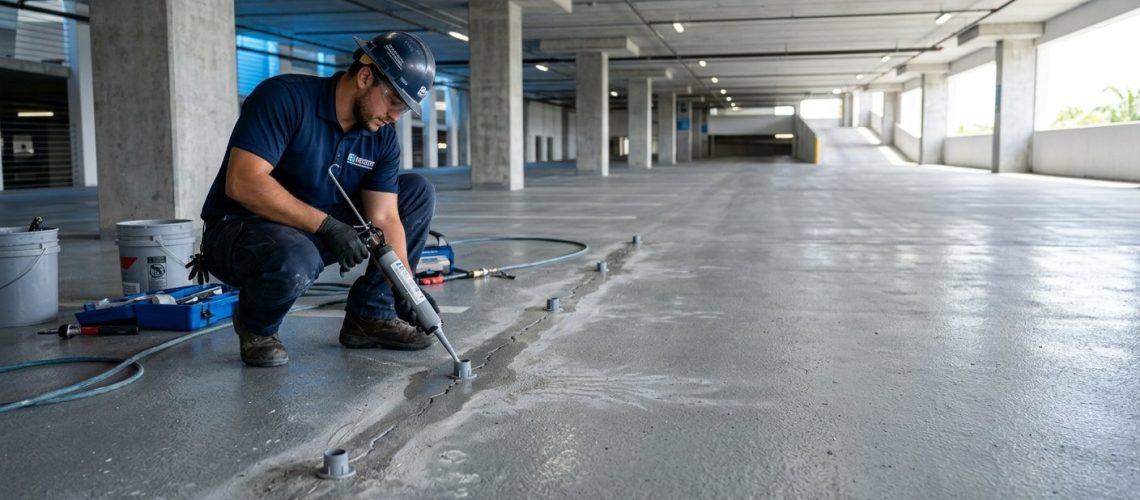
CL Wizard’s proprietary polyvinyl injection technology represents a fundamentally different engineering philosophy. Rather than sealing the surface or filling cracks with brittle material, polyvinyl injection addresses water intrusion at its source—within the concrete matrix itself—using a flexible, chemically bonded compound that moves with the slab.
How the Technology Works
The process begins with a thorough on-site assessment to map active leak points, crack networks, and expansion joint failures. Injection ports are then installed at calculated intervals along the leak path—typically every 8 to 12 inches depending on crack width and slab thickness. The proprietary polyvinyl compound is injected under controlled pressure, typically between 1,500 and 3,000 PSI, allowing it to permeate the crack network, displace residual moisture, and chemically bond to the concrete substrate.
Once cured, the injected material remains flexible—accommodating the thermal expansion cycles and minor structural movement inherent to South Florida concrete construction. Unlike rigid epoxy or cementitious grouts, the polyvinyl compound does not re-crack under normal building movement. The result is a sealed system that functions as part of the concrete structure rather than a patch applied over it.
For a complete technical overview of this method, visit the proprietary concrete leak repair method page.
Why Non-Disruptive Repair Matters to Property Managers
The polyvinyl injection process requires no jackhammering, no extensive demolition, and no large crews generating construction debris. In practical terms, this means:
- Parking levels remain operational during treatment
- Residential units and commercial tenants are not displaced
- Repair timelines are measured in hours to days, not weeks
- No structural engineering oversight required for the repair itself
- Minimal permitting burden compared to demolition-based alternatives
For HOA boards and commercial property managers navigating tenant relationships and lease obligations, the non-disruptive nature of this approach is not a luxury—it is a core operational requirement.
Commercial Concrete Slab Waterproofing: What 2026 Compliance Looks Like
Florida’s building inspection requirements have evolved significantly following high-profile structural events. The Florida Building Commission continues to update mandatory inspection and recertification timelines for condominiums and multi-story structures, particularly those within three miles of the coastline. Property managers in Miami-Dade, Broward, and Palm Beach counties should be aware that deferred maintenance on concrete slab leaks can now directly impact milestone inspection outcomes and structural integrity reports.
Documented, warrantied repairs—such as the 5-year warranty provided on all CL Wizard polyvinyl injection work—carry weight in these inspections by demonstrating proactive, engineered responses to identified deficiencies. Surface patches or temporary caulking applications typically do not satisfy inspectors looking for evidence of permanent remediation.
Recognizing When Your Slab Needs Professional Assessment
Early intervention consistently produces better outcomes and lower total repair costs than waiting for leaks to migrate or worsen. Watch for these indicators across your property:
- Active water drips or seepage through slab ceilings in parking structures
- White mineral deposits (efflorescence) along cracks or construction joints
- Rust staining on concrete surfaces indicating rebar corrosion below
- Soft or hollow-sounding concrete when tapped (delamination)
- Wet spots or standing water in below-grade mechanical rooms or elevator pits
- Expansion joint sealant that has cracked, shrunk, or pulled away from concrete edges
None of these conditions resolves on its own. Water intrusion into concrete follows the path of least resistance, and over time that path widens. What begins as a hairline crack admitting minor seepage can evolve into a structural concern within a single rainy season if unaddressed.
For properties dealing specifically with below-grade water intrusion at the slab level, the concrete slab waterproofing overview provides additional context on assessment and treatment options.
Frequently Asked Questions
How long does polyvinyl injection concrete slab repair take?
Most commercial concrete slab leak repairs using polyvinyl injection are completed within one to three days, depending on the extent of the affected area. Unlike demolition-based methods, injection work does not require extended cure periods before the area returns to service. A licensed CL Wizard specialist will provide a realistic timeline following the on-site assessment.
Is a concrete crack injection repair truly permanent?
Polyvinyl injection repairs are engineered to be long-term solutions, not temporary patches. CL Wizard backs every repair with a 5-year warranty. The flexible, chemically bonded nature of the polyvinyl compound allows it to accommodate normal building movement without re-cracking—a critical advantage over rigid epoxy or cementitious alternatives in South Florida’s thermally active environment.
Can water intrusion concrete repairs be done without closing the building?
Yes. CL Wizard’s non-disruptive repair technology is specifically designed for occupied commercial buildings, condominiums, and active parking structures. Repairs are performed with minimal equipment and no demolition, allowing property operations to continue normally in most cases.
What causes concrete slab leaks in South Florida high-rises specifically?
High-rises in Miami, Fort Lauderdale, and West Palm Beach face a combination of chloride exposure from salt air, thermal expansion joint movement, and high hydrostatic pressure from the shallow water table. Construction joint failures, aging expansion joint sealants, and post-tension cable corrosion are also common entry points for water intrusion in multi-story structures.
Do I need a structural engineer before scheduling a concrete slab leak repair?
Not necessarily for the repair itself. CL Wizard conducts on-site assessments to evaluate the scope and source of water intrusion before any work begins. If the assessment identifies conditions that warrant structural engineering review—such as significant rebar corrosion or load-bearing concerns—that recommendation will be made clearly and honestly. Most isolated slab leaks and expansion joint failures are addressable through injection repair alone.
Get a Professional Assessment for Your South Florida Property
Water intrusion does not pause between inspection cycles. If your building in Miami, Fort Lauderdale, or West Palm Beach is showing signs of concrete slab leaks—whether in a parking structure, podium deck, or below-grade mechanical space—the time to act is before conditions escalate.
CL Wizard is a licensed and insured South Florida concrete leak specialist offering permanent polyvinyl injection repairs backed by a 5-year warranty. Our non-disruptive approach means your tenants, residents, and operations stay in place while we solve the problem at its source.
Contact CL Wizard today to schedule your on-site assessment and take the first step toward a permanent concrete leak solution.
