
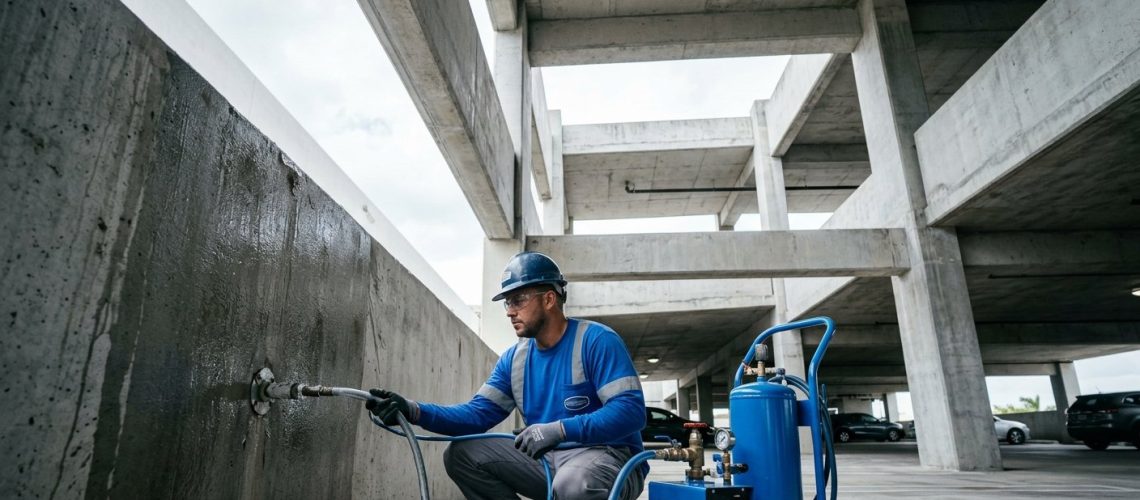
Every year, South Florida property managers spend thousands of dollars patching the same leaks. The parking garage floods again. The expansion joint gives way again. The waterproofing membrane peels back again. If that cycle sounds familiar, the problem isn’t your maintenance budget—it’s the repair method.
Traditional approaches to concrete water intrusion treat the symptom, not the source. Polyvinyl injection technology takes a fundamentally different approach, targeting the exact failure point inside the concrete structure and creating a flexible, permanent seal that moves with the building. Here’s how it works, why it outperforms conventional methods, and why it’s especially well-suited to the environmental demands of Miami, Fort Lauderdale, and West Palm Beach.
Why Concrete Leaks Are a South Florida Specialty Problem
Concrete is not a static material. It expands and contracts with temperature changes, shifts slightly with structural loads, and degrades when exposed to moisture and salt air. In South Florida, all three stressors operate at an elevated level simultaneously.
Thermal expansion alone is significant. Concrete has a coefficient of thermal expansion of approximately 5.5 × 10⁻⁶ per °F. A 100-foot concrete slab exposed to a 60°F daily temperature swing—not unusual on a sun-exposed Miami parking deck—can expand and contract by nearly 0.4 inches. Multiply that movement across hundreds of linear feet of expansion joints, and you understand why surface-applied sealants crack and fail within months.
Saltwater exposure compounds the problem. Chloride ions from ocean air penetrate concrete, accelerating corrosion of embedded rebar and causing internal cracking that isn’t visible on the surface. According to the Federal Highway Administration’s concrete bridge preservation guidelines, chloride-induced deterioration is one of the leading causes of structural concrete degradation in coastal environments—a challenge that’s just as relevant to high-rise condominiums and parking structures as it is to bridges.
Humidity plays a third role. South Florida’s average relative humidity regularly exceeds 75%, meaning concrete surfaces rarely fully dry. Water that penetrates through cracks or failed joints carries dissolved salts deeper into the slab with each wet-dry cycle, progressively widening the intrusion pathway.
What Polyvinyl Injection Technology Actually Does
Polyvinyl injection is not a surface coating or a caulk-over repair. It is a pressure-injection process that delivers a proprietary polyvinyl compound directly into the crack, joint, or void inside the concrete matrix.
The process works in several distinct stages:
- Assessment and mapping: A licensed specialist evaluates the affected area, identifying the full extent of the intrusion pathway—not just the visible wet spot. Water travels, and surface evidence rarely marks the actual entry point.
- Port installation: Injection ports are installed at measured intervals along the crack or joint—typically every 8 to 12 inches, depending on crack depth and geometry.
- Pressure injection: The polyvinyl compound is injected under controlled pressure. It flows into the void, displacing water and filling the crack from the inside out.
- Chemical reaction and cure: The compound reacts with residual moisture and cures into a flexible, hydrophobic seal that bonds to the surrounding concrete. Unlike rigid epoxies that can fracture when the structure moves, the cured polyvinyl material accommodates ongoing thermal expansion and contraction.
- Verification: The repair is tested to confirm the intrusion pathway is fully sealed before the job is complete.
The result is a repair that works from within the concrete structure rather than relying on an exterior barrier that the building’s own movement will eventually compromise. You can read more about the mechanics of this approach on CL Wizard’s polyvinyl injection technology page.
Concrete Crack Injection vs. Traditional Waterproofing Methods
The waterproofing industry has historically offered two main options for leaking concrete: surface-applied membranes and demolition-and-replacement. Both have significant drawbacks in a South Florida high-rise or commercial parking structure context.
Surface Membranes
Topical waterproofing membranes are applied to the exterior surface of the concrete. They work—until the concrete moves. In a coastal thermal environment, the membrane delaminates at expansion joints within one to three years, creating a false sense of security. Water infiltrates behind the membrane and now has no exit path, accelerating interior damage.
Demolition and Replacement
Full removal and repour of affected slabs or joint systems is structurally sound but operationally disruptive and expensive. In an occupied condominium or active parking garage, jackhammering, debris removal, curing time, and lane or floor closures may last weeks. Tenant complaints, lost revenue, and liability exposure follow.
Polyvinyl Injection: The Structural Advantage
Polyvinyl injection addresses both failure modes. Because the repair material is delivered inside the crack, it doesn’t depend on surface adhesion—so thermal movement doesn’t cause delamination. And because the process requires only small injection ports and no heavy equipment, it is genuinely non-disruptive. Parking structures remain operational. Residents are not displaced. The repair is completed in hours, not weeks.
For a detailed breakdown of how this applies specifically to expansion joints—one of the most common failure points in South Florida concrete structures—see CL Wizard’s concrete expansion joint repair resource.
Why Permanent Matters More Than Cheap
Property managers frequently evaluate repair bids on upfront cost. That’s understandable, but it creates a misleading comparison when one method requires re-treatment every 18 to 36 months and another carries a 5-year warranty.
Consider a parking garage with 200 linear feet of failing expansion joints. A surface sealant application might cost less initially, but if it requires reapplication three times over a five-year period—plus the labor disruption and potential liability from water damage in between—the total cost significantly exceeds a single permanent concrete leak solution delivered at the outset.
The International Concrete Repair Institute emphasizes that life-cycle cost analysis, not initial bid price, is the appropriate framework for evaluating concrete repair strategies. A repair that lasts is always more economical than a repair that needs to be repeated.
CL Wizard backs every polyvinyl injection repair with a 5-year warranty—a concrete expression of confidence in the long-term performance of the technology.
Real-World Applications in South Florida Buildings
Polyvinyl injection is particularly effective in the building types that define South Florida’s commercial real estate landscape:
- High-rise condominiums: Balcony slabs, planter boxes, and podium decks are constant moisture intrusion points. Injection repairs seal these without requiring tenant relocation or visible exterior work.
- Multi-level parking garages: Expansion joints on vehicle decks carry both thermal stress and dynamic load. Polyvinyl injection restores the joint seal without closing lanes for extended periods.
- Commercial buildings with below-grade construction: Hydrostatic pressure drives water through cracks in basement walls and elevator pits. Injection from the interior eliminates the need to excavate exterior walls.
- HOA-managed communities: Common area concrete—pool decks, walkways, entry structures—benefits from a repair method that doesn’t require staging heavy equipment in occupied residential spaces.
For a broader overview of how water intrusion manifests in different concrete structures, CL Wizard’s water intrusion solutions resource covers the full spectrum of failure patterns and diagnostic approaches.
Frequently Asked Questions
How long does a polyvinyl injection repair take?
Most polyvinyl injection repairs on expansion joints or isolated concrete cracks are completed within a single work session. The exact timeline depends on the linear footage affected and the complexity of the intrusion pathway. Unlike demolition-based repairs, there is no extended cure or re-opening period required before the area resumes normal use.
Does the repair work while water is actively leaking?
Yes. Polyvinyl injection compounds are specifically formulated to react with and displace water during the curing process. Active leaks do not prevent the repair from proceeding—in fact, the presence of moisture helps activate the chemical reaction that creates the hydrophobic seal.
Is polyvinyl injection appropriate for all concrete crack types?
Polyvinyl injection is highly effective for water-bearing cracks, failed expansion joints, cold joints, and construction voids—the most common sources of concrete water intrusion in South Florida structures. A professional assessment is required to determine the appropriate approach for any specific situation, as some structural or load-bearing crack conditions may require engineering evaluation before repair.
How does the 5-year warranty work?
CL Wizard provides a 5-year warranty on all polyvinyl injection repairs. This covers the integrity of the injected seal against recurrent water intrusion through the treated joint or crack. The warranty reflects the long-term performance characteristics of the polyvinyl compound and CL Wizard’s confidence in the installation process.
What is the first step for a building with multiple leaking joints?
The first step is a professional on-site assessment. Water intrusion in concrete structures is rarely limited to the visible wet area—pressure and capillary action distribute moisture throughout the slab matrix. An assessment maps the full extent of the intrusion system and identifies all active and at-risk failure points before a repair scope is defined.
Schedule a Professional Concrete Assessment
If your South Florida building has recurring concrete leaks, the repair method you’ve been using is likely the reason the problem keeps coming back. CL Wizard’s proprietary polyvinyl injection technology delivers a permanent concrete leak solution designed specifically for the thermal, saltwater, and humidity demands of Miami, Fort Lauderdale, and West Palm Beach properties.
CL Wizard is licensed, insured, and backs every repair with a 5-year warranty. The first step is an on-site assessment—contact CL Wizard today to schedule an evaluation of your structure and find out whether polyvinyl injection is the permanent answer your building needs.
