
Meta Title: Saltwater Concrete Damage: What Miami Buildings Face in 2026
Meta Description: Miami’s coastal environment accelerates concrete deterioration faster than most property managers realize. Learn how saltwater exposure causes water intrusion in concrete structures and what permanent repair solutions exist for South Florida buildings.
The Silent Threat Beneath Miami’s Skyline
Concrete structures within one mile of Miami’s coastline deteriorate up to four times faster than equivalent inland buildings. That’s not a hypothetical—it’s a measurable reality documented by corrosion engineers monitoring South Florida’s built environment. For property managers overseeing high-rises, condominiums, and commercial parking structures between Miami and West Palm Beach, understanding the mechanism behind saltwater concrete damage isn’t academic. It’s a financial necessity.
In 2026, Miami-Dade County’s building inspection requirements have tightened following post-2021 legislative reforms to Florida’s condominium inspection statutes. The increased scrutiny means water intrusion in concrete—once deferred season after season—now carries real regulatory consequences alongside the structural ones. The question isn’t whether your building is absorbing saltwater; it’s how far the deterioration has progressed.
How Saltwater Actually Damages Concrete
The chemistry is straightforward, but the damage compounds quickly. Concrete is a porous material. Despite its apparent solidity, standard concrete contains microscopic capillary channels through which liquid and vapor migrate continuously. In Miami’s coastal environment, that liquid carries chloride ions—the primary aggressive agent in seawater.
Chloride-Induced Corrosion
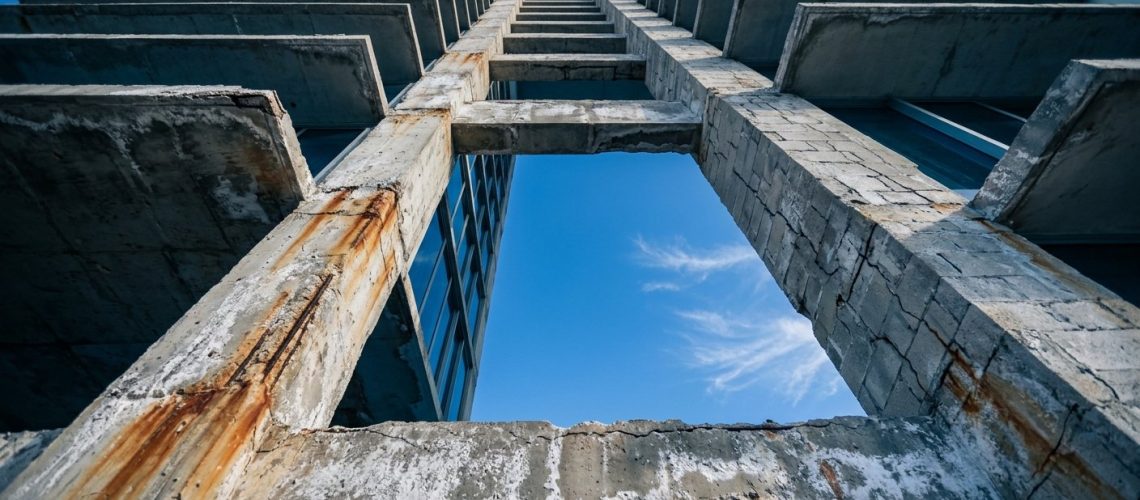
When chloride ions penetrate concrete and reach embedded steel reinforcement, they disrupt the passive oxide layer that normally protects rebar from rust. Once that protection breaks down, corrosion begins. Rust occupies roughly three to four times the volume of the original steel, creating internal expansive pressure that fractures concrete from within. The result: spalling, cracking, and ultimately structural compromise.
According to research published by the Federal Highway Administration, chloride-induced corrosion of reinforcing steel is the leading cause of concrete deterioration in coastal infrastructure, costing the United States billions annually. South Florida bears a disproportionate share of that burden.
Thermal Expansion in High-Rise Structures
Saltwater damage doesn’t operate in isolation. Miami’s thermal environment compounds the problem significantly. Concrete has a coefficient of thermal expansion of approximately 5.5 to 6.5 millionths per degree Fahrenheit. In a 20-story parking structure exposed to South Florida’s temperature swings—from roughly 65°F overnight in winter to 95°F surface temperatures in summer sun—that means expansion joints are cycling through meaningful dimensional changes repeatedly throughout the year.
When expansion joints fail or are improperly sealed, they become primary entry points for saltwater intrusion. The moisture carries chlorides deeper into the slab, and the cycle of deterioration accelerates. This is precisely why concrete expansion joint repair is not a cosmetic issue—it’s the front line of structural protection. You can learn more about the mechanics of this vulnerability through our detailed resource on concrete expansion joint repair.
Humidity and Carbonation
South Florida’s relative humidity—averaging above 70% year-round—facilitates a secondary degradation process called carbonation. Atmospheric carbon dioxide reacts with calcium hydroxide in the concrete’s cement paste, gradually lowering the pH of the concrete matrix. As pH drops from the protective range above 12.5 toward neutrality, the passive protection on steel reinforcement weakens even without chloride involvement. Combined with saltwater exposure, carbonation accelerates the timeline from intact structure to visible damage significantly.
What Water Intrusion Looks Like in Real Buildings
Property managers often misread the early signals. Water intrusion in concrete doesn’t announce itself dramatically at the outset. The progression typically follows a recognizable pattern:
- Stage 1 — Efflorescence: White calcium salt deposits appear on concrete surfaces where water has migrated through and evaporated. Often dismissed as aesthetic.
- Stage 2 — Hairline cracks: Thermal cycling and minor settlement open small fractures. Each crack is a new chloride pathway.
- Stage 3 — Active seepage: Visible moisture, dripping, or pooling in parking decks, planter boxes, or below-grade areas. Tenants begin reporting.
- Stage 4 — Spalling and delamination: Concrete surface fractures and separates as corroding rebar expands internally. Structural assessment becomes mandatory.
The challenge is that stages one and two often span years, during which property managers are managing budgets, tenant relations, and regulatory compliance simultaneously. By the time stage three arrives, the remediation cost has multiplied several times over what early intervention would have required.
Why Traditional Repairs Fall Short in South Florida
The conventional approach to concrete water intrusion—surface-applied sealants, cementitious patching, or membrane overlays—shares a common limitation: it addresses the symptom rather than the source. In South Florida’s environment, surface sealants degrade under UV exposure, thermal cycling, and the hydrostatic pressure generated by groundwater that sits at near-surface elevations throughout Miami-Dade and Broward counties.
Cementitious patches fail at the bond interface because they cannot accommodate the same thermal movement as the surrounding concrete. A patch that’s rigid in a structure that’s flexing will crack within one to three seasonal cycles, reopening the intrusion point—sometimes in a slightly different location that’s harder to detect.
For a comprehensive look at why surface-level approaches consistently underperform in coastal concrete environments, our resource on water intrusion solutions for concrete covers the technical reasoning in depth.
Polyvinyl Injection: A Permanent Approach
CL Wizard’s proprietary polyvinyl injection technology was developed specifically to address the limitations of traditional methods in high-stress coastal environments. Rather than treating the surface, the process delivers flexible, waterproofing material directly into the crack or joint from within the concrete substrate.
How the Process Works
Injection ports are positioned at calculated intervals along the affected joint or crack. Polyvinyl material is introduced under controlled pressure, migrating through the capillary network to fill voids that surface products never reach. The injected material bonds to the concrete walls of the fracture and cures to form a flexible seal that moves with the structure during thermal cycling—rather than resisting it and failing.
This flexibility is critical. A sealant that cannot accommodate the 0.02 to 0.04 inch of movement typical in a South Florida high-rise expansion joint during seasonal temperature variation will fail in compression. CL Wizard’s polyvinyl formulation maintains its integrity through this range of movement, which is why the company backs completed repairs with a 5-year warranty—a commitment traditional methods cannot support.
Non-Disruptive for Occupied Buildings
One of the most significant operational advantages for property managers and HOA boards is the non-disruptive nature of the repair process. There is no demolition, no jackhammering, no extended closure of parking levels or common areas. Residents and commercial tenants experience minimal interruption. This matters practically when managing an occupied condominium tower or a commercial building with active retail or office tenants in Fort Lauderdale or West Palm Beach.
The contrast with membrane replacement or full joint excavation is substantial—traditional approaches can require weeks of disruption and temporary displacement. For a technical overview of concrete slab waterproofing considerations relevant to your building type, visit our resource on waterproofing concrete slabs.
Regulatory Context for 2026
Florida’s Structural Integrity Reserve Study requirements, expanded through legislative action following the 2021 Surfside tragedy, now mandate that condominium associations three stories or higher maintain reserves for structural components including waterproofing systems. The Florida Bar has published guidance on milestone inspection requirements that directly implicate concrete water intrusion management.
For HOA boards and property managers in Miami, Fort Lauderdale, and West Palm Beach, documented repair histories using warranty-backed, licensed and insured contractors now carry weight not just operationally, but in fulfilling fiduciary obligations under these statutes. A 5-year warranted repair from a licensed specialist creates a documented record that amateur patch work cannot.
Frequently Asked Questions
How quickly does saltwater damage concrete in South Florida?
Chloride penetration rates in Miami’s coastal environment can advance at 0.5 to 1.5 millimeters per year under typical conditions, depending on concrete quality, cover depth over reinforcement, and exposure intensity. Structures within two blocks of the ocean or bay often show measurable corrosion initiation within 10 to 15 years of construction without protective intervention.
Is concrete crack injection a permanent fix or a temporary repair?
The answer depends entirely on the method and material used. Surface-applied patches are temporary by nature. Polyvinyl injection delivered into the concrete substrate creates a flexible, bonded seal within the crack network itself. CL Wizard’s approach is warranted for five years and designed to move with the structure, addressing the root mechanism of intrusion rather than masking it.
Can water intrusion repairs be done without disrupting tenants?
Yes—this is one of the primary advantages of injection-based repair technology. Unlike methods that require concrete removal or membrane installation, the polyvinyl injection process is performed with minimal noise, no demolition, and targeted access points. Most commercial building and condominium repairs proceed without requiring tenant displacement or area closure beyond brief, localized access restrictions.
What’s the difference between waterproofing and concrete leak repair?
Waterproofing typically refers to surface or membrane systems applied preventively to new or prepared concrete. Concrete leak repair addresses active intrusion points in existing structures—cracks, failed joints, and compromised interfaces where water is already entering. CL Wizard specializes in the latter: diagnosing and permanently sealing active water intrusion in occupied South Florida buildings.
How do I know if my building needs a professional assessment?
Any visible efflorescence, staining, active moisture, or crack progression in structural concrete—particularly near expansion joints, balcony slab edges, parking deck surfaces, or below-grade walls—warrants a professional inspection. Delaying assessment while visible symptoms are present allows chloride penetration to continue and corrosion to advance. An on-site evaluation is the only reliable way to diagnose the severity and appropriate repair scope for your specific structure.
Schedule a Professional Assessment
Saltwater concrete damage is measurable, manageable, and—when addressed with the right technology—stoppable. Miami, Fort Lauderdale, and West Palm Beach building owners and property managers who act on early-stage intrusion consistently see lower total remediation costs and longer repair intervals than those who defer until visible structural damage forces action.
CL Wizard’s licensed and insured team of South Florida concrete leak specialists conducts thorough on-site assessments to evaluate the extent of water intrusion, identify the failure points within your structure, and recommend the appropriate scope of polyvinyl injection repair. Every completed repair is backed by a 5-year warranty.
Contact CL Wizard today to schedule your assessment and get a clear, expert diagnosis of your building’s concrete water intrusion challenges.
