
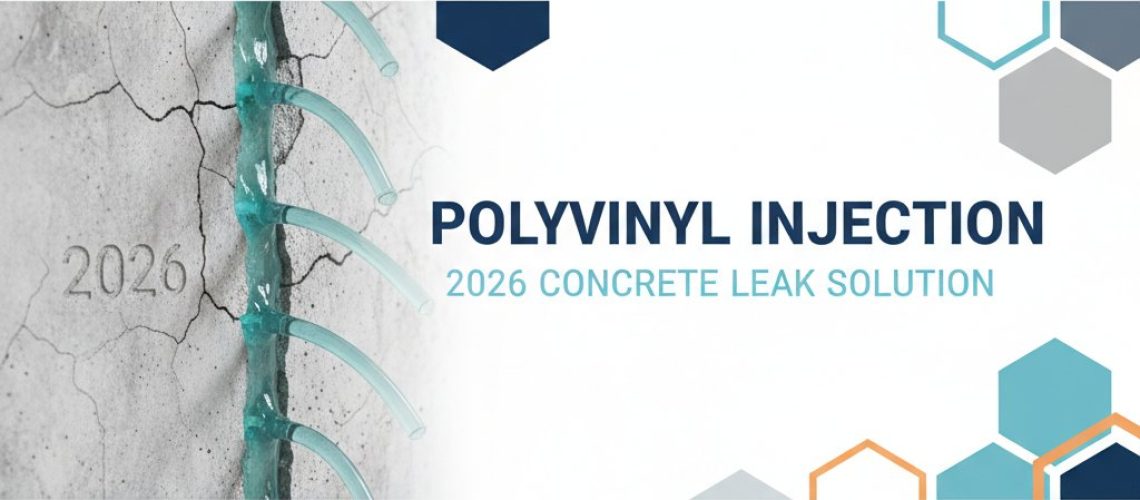
The concrete waterproofing industry has witnessed a fundamental transformation in 2026, with advanced polyvinyl injection technology emerging as the definitive solution for commercial property water intrusion challenges. Unlike traditional repair methods that offer temporary fixes requiring repeated maintenance cycles, this proprietary concrete leak repair method delivers permanent waterproofing through chemical injection that creates an impermeable barrier at the molecular level.
For South Florida property managers facing the unique challenges of saltwater exposure, extreme humidity fluctuations, and continuous thermal expansion cycles, understanding how this cutting-edge water intrusion solution works represents the difference between endless repair costs and a one-time permanent investment.
How Advanced Polyvinyl Injection Technology Works
The science behind this innovative concrete leak repair methodology centers on hydrophobic polyvinyl resin chemistry. When injected into concrete cracks and joints under precisely controlled pressure, the liquid resin penetrates the concrete matrix, filling microscopic voids and fractures that traditional sealants cannot reach.
The polyvinyl material exhibits a viscosity coefficient between 150-250 centipoise at application temperature, allowing penetration into cracks as narrow as 0.002 inches while maintaining structural integrity. Upon contact with moisture present within the concrete substrate, the resin undergoes polymerization, expanding to approximately 400% of its original volume and creating a flexible, waterproof seal that moves with the concrete during thermal expansion cycles.
The Injection Process Parameters
Successful application requires specific technical parameters that differentiate professional-grade systems from inferior alternatives:
- Injection Pressure: Maintained between 40-100 PSI depending on crack width and concrete density
- Cure Time: Initial polymerization occurs within 15-30 minutes, full cure achieved in 24 hours
- Temperature Range: Effective application between 40°F-95°F, ideal for South Florida’s climate
- Penetration Depth: Achieves full concrete thickness penetration, typically 6-12 inches in standard applications
- Bond Strength: Creates adhesion exceeding 2,500 PSI to concrete substrates
Why Traditional Methods Fail in South Florida Conditions
South Florida’s environmental conditions create a particularly hostile environment for conventional concrete waterproofing approaches. The combination of saltwater aerosol exposure, humidity levels consistently above 70%, and daily temperature variations of 20-30 degrees creates concrete expansion-contraction cycles that fracture rigid sealants within months.
Epoxy coatings, commonly applied to parking garage surfaces and expansion joints, exhibit a thermal expansion coefficient of approximately 30-50 x 10⁻⁶ per degree Fahrenheit. Concrete’s coefficient measures 5-7 x 10⁻⁶ per degree Fahrenheit. This differential means that during typical South Florida temperature swings, the epoxy expands and contracts at nearly seven times the rate of the underlying concrete, creating mechanical stress that inevitably leads to adhesion failure.
Cementitious waterproofing compounds face similar challenges. While they bond well initially, their rigid nature cannot accommodate structural movement. A typical high-rise building experiences seasonal movement of 0.25-0.75 inches due to thermal expansion alone, not accounting for wind load deflection or settlement. Rigid repairs crack under these stress cycles, reopening pathways for water intrusion.
The Permanent Solution: Proprietary Polyvinyl Chemistry
Advanced polyvinyl injection technology solves these failure modes through engineered flexibility. The cured polymer maintains elasticity across temperature ranges from -40°F to 180°F, well beyond South Florida’s environmental extremes. With an elongation capacity exceeding 300%, the material stretches and compresses with concrete movement rather than resisting it.
The hydrophobic nature of the polyvinyl formulation provides another critical advantage. Unlike hydrophilic polyurethane foams that absorb water to initiate expansion, hydrophobic polyvinyl resins actively repel water molecules while maintaining permanent structural integrity. This characteristic proves essential in below-grade applications where continuous hydrostatic pressure exists.
Molecular-Level Penetration
The proprietary formulation achieves penetration that surface-applied membranes cannot match. Standard concrete contains capillary voids between 0.0004-0.004 inches in diameter. The low-viscosity polyvinyl resin flows into these microscopic spaces, creating a three-dimensional waterproof matrix throughout the concrete thickness rather than simply coating the surface.
Laboratory testing demonstrates that this molecular-level penetration creates a waterproof barrier capable of withstanding hydrostatic pressure exceeding 230 feet of water head—far beyond the pressure encountered in typical below-grade parking structures or foundation walls.
Real-World Performance: South Florida Case Studies
A 22-story condominium in Sunny Isles Beach faced chronic water intrusion through cold joints in its seven-level parking structure. Previous repairs using epoxy injection had failed within 18 months. Polyvinyl injection treatment completed in March 2024 has maintained complete water stoppage through two full hurricane seasons and 26 months of service as of April 2026, with no signs of degradation.
The project required 47 injection points across 185 linear feet of compromised cold joints. Total completion time measured 11 hours of actual injection work, performed during overnight shifts to avoid disrupting resident parking. No demolition, excavation, or tenant relocation occurred. The building remained fully operational throughout the repair process, exemplifying the non-disruptive leak repair advantage this technology provides.
A commercial office complex in Fort Lauderdale experienced persistent leaking through expansion joints in its plaza deck, causing water damage to retail spaces below. Traditional routing-and-sealing repairs had been performed three times over six years at cumulative costs exceeding $89,000. Polyvinyl injection treatment completed in January 2025 has eliminated all water intrusion for 15 months at a one-time cost of $31,400, including the comprehensive 5-year warranty.
Cost Analysis: Long-Term Value Proposition
Property managers evaluating concrete leak repair options must consider lifecycle costs rather than initial expense alone. Traditional surface sealants typically cost $15-35 per linear foot for expansion joint treatment, with expected service life of 2-4 years in South Florida conditions. Over a 10-year period, repeated applications total $45-140 per linear foot, plus associated costs for water damage remediation between repair cycles.
Advanced polyvinyl injection technology typically costs $55-85 per linear foot for comprehensive treatment, backed by a 5-year warranty and realistic service life exceeding 20 years based on accelerated aging studies. The 10-year cost remains $55-85 per linear foot—a savings of 40-65% compared to repeated traditional repairs.
This calculation excludes the significant costs associated with repeated tenant disruptions, emergency water damage remediation, and the deteriorating building reputation that accompanies chronic water intrusion problems. When these factors enter the equation, the value proposition becomes overwhelming.
Technical Advantages for Commercial Applications
Commercial property environments demand waterproofing solutions that accommodate operational realities. The non-disruptive nature of polyvinyl injection technology addresses multiple practical concerns:
- No Tenant Relocation: Injection procedures access leak sites from the dry side, eliminating need to evacuate spaces
- Minimal Surface Preparation: No sandblasting, grinding, or extensive surface prep required
- Fast Return to Service: Treated areas ready for normal use within 24 hours of completion
- Work During Occupied Hours: Low-noise procedures allow work during business hours when necessary
- Aesthetic Preservation: No visible surface changes or installed hardware after injection points are patched
Addressing South Florida’s Unique Structural Challenges
Coastal buildings face accelerated concrete deterioration from chloride ion penetration. Saltwater aerosols deposit chlorides on concrete surfaces, which migrate inward through capillary action, eventually reaching rebar and initiating corrosion. As rebar corrodes, it expands up to six times its original volume, creating tremendous internal pressure that spalls concrete and opens new pathways for water intrusion.
The waterproof barrier created by polyvinyl injection stops this destructive cycle by eliminating the moisture pathway required for chloride transport. While it doesn’t reverse existing corrosion, it prevents additional chloride and moisture infiltration, significantly extending structural service life.
Hurricane wind-driven rain presents another unique challenge. During tropical storms, horizontal rain driven at high velocity finds entry through cracks and joints that remain dry under normal rainfall. The complete penetration achieved by polyvinyl injection seals these pathways regardless of water direction or pressure orientation.
Quality Indicators: Evaluating Service Providers
Not all polyvinyl injection services deliver equivalent results. Property managers should evaluate providers based on specific criteria:
- Proprietary Formulation: Superior results require engineered resin chemistry, not commodity products
- Injection Equipment: Precision metering and pressure control systems ensure proper application
- Technical Training: Certified technicians understand concrete behavior and proper injection protocols
- Comprehensive Warranty: 5-year coverage demonstrates confidence in material performance
- Documentation: Detailed injection logs and pressure readings verify proper installation
The 2026 Standard for Concrete Waterproofing
As building science evolves and performance expectations increase, advanced polyvinyl injection technology has established itself as the professional standard for permanent concrete leak repair in demanding commercial applications. The combination of molecular-level penetration, engineered flexibility, hydrophobic chemistry, and proven long-term performance addresses the root causes of water intrusion rather than simply treating symptoms.
For South Florida property managers responsible for protecting building integrity while controlling maintenance budgets and minimizing operational disruptions, this cutting-edge water intrusion solution represents the intersection of technical performance and practical value.
Take Action: Protect Your Investment
Concrete leak problems escalate exponentially when left unaddressed. Water intrusion that begins as minor seepage progresses to structural deterioration, interior damage, mold growth, and eventually threatens building habitability and property values.
CLWizard’s proprietary polyvinyl injection technology stops this progression permanently, backed by a comprehensive 5-year warranty and proven performance in South Florida’s most challenging environments. Our certified technicians conduct thorough assessments to identify all water intrusion pathways and develop comprehensive treatment plans tailored to your specific building conditions.
Schedule your free property assessment today to discover how advanced polyvinyl injection technology can eliminate your concrete waterproofing challenges permanently. Contact CLWizard at (954) 291-5606 or visit our website to arrange a consultation with our technical specialists. Protect your property investment with the concrete leak repair solution engineered for permanent results.
