
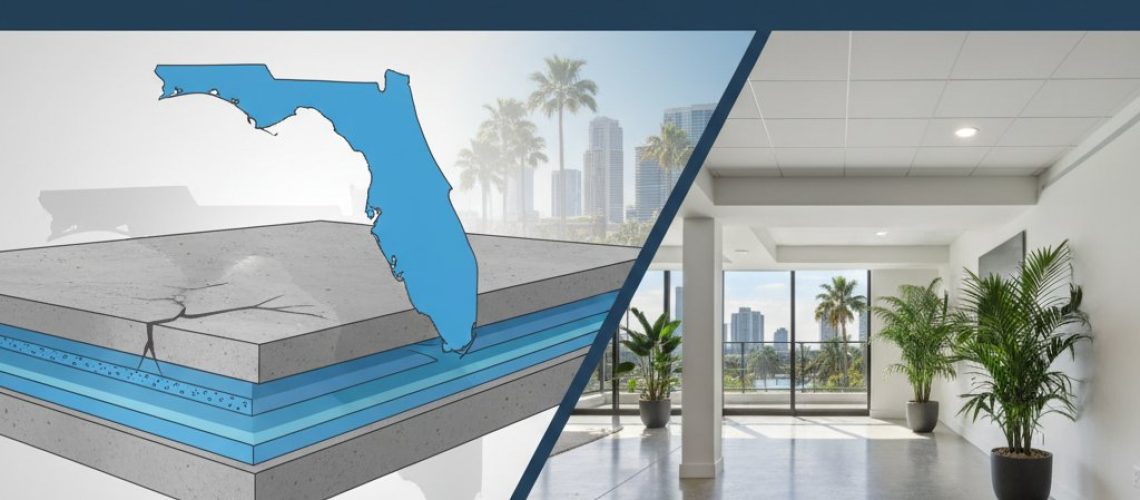
South Florida’s unique environmental conditions create persistent challenges for basement concrete slab waterproofing. With the water table averaging just 3-6 feet below surface level in coastal areas and hydrostatic pressure reaching 4.33 PSI per 10 feet of depth, water intrusion through basement slabs has become a critical infrastructure concern in 2026. Property managers overseeing high-rise condominiums and commercial structures are increasingly seeking permanent solutions that don’t disrupt daily operations or require expensive excavation.
The financial implications of untreated concrete slab leaks extend beyond immediate water damage. According to recent industry data, water intrusion through basement slabs costs South Florida commercial property owners an estimated $47,000 annually in structural repairs, mold remediation, and increased insurance premiums. Understanding modern waterproofing methods—particularly advanced polyvinyl injection technology—has become essential for responsible facility management.
Understanding Concrete Slab Water Intrusion in South Florida
Basement concrete slabs in South Florida face environmental stressors unlike any other region. The combination of saltwater exposure, 80% average humidity levels, and annual thermal expansion coefficients reaching 5.5 x 10⁻⁶ per degree Fahrenheit creates a perfect storm for concrete deterioration.
Water penetrates concrete slabs through several pathways. Hydrostatic pressure forces groundwater through microscopic pores in concrete, which typically has a permeability rating of 1 x 10⁻¹⁰ cm/sec for standard 4,000 PSI concrete. Cold joints where separate concrete pours meet create natural weak points. Control joints designed to manage thermal expansion inadvertently become water entry channels. Deteriorated expansion joints lose their sealing capacity after 10-15 years in coastal environments.
The consequences escalate quickly. Water migrating through basement slabs carries dissolved salts that crystallize within concrete pores, causing spalling and surface degradation. Moisture levels above 75% relative humidity within concrete create ideal conditions for mold growth, posing health risks and triggering liability concerns. Structural steel embedded in concrete slabs begins corroding when chloride concentrations exceed 0.6 kg/m³—a threshold frequently surpassed in South Florida’s saltwater-influenced groundwater.
Traditional Concrete Slab Waterproofing Methods: Limitations and Costs
Conventional approaches to waterproofing a concrete slab have historically required extensive disruption and delivered inconsistent results. Understanding these limitations clarifies why advanced injection methods have gained prominence in commercial applications.
Exterior Membrane Systems
Applying waterproof membranes to the exterior of basement slabs requires full excavation—an option rarely feasible for existing structures. When possible, excavation costs range from $125-$200 per linear foot in South Florida markets. The process demands 4-6 weeks for completion, requires tenant relocation, and disrupts parking garage operations. Even properly installed membrane systems face degradation from root intrusion and settlement shifting, with typical lifespans of 15-20 years before requiring replacement.
Interior Drainage Systems
French drain installation along interior perimeter walls addresses water symptoms without treating the source. These systems require jackhammering 12-18 inches of slab perimeter, installing perforated pipe, and creating sump pump chambers. Material and labor costs average $85-$150 per linear foot. While functional, drainage systems introduce ongoing maintenance requirements—sump pumps require replacement every 7-10 years at $1,200-$2,500 per unit. The approach also consumes usable floor space and creates permanent aesthetic compromises.
Crystalline Waterproofing
Crystalline treatments applied to interior concrete surfaces form calcium silicate hydrate crystals within concrete pores. These systems work effectively on actively wet surfaces and provide coverage at $3-$8 per square foot. However, crystalline solutions require direct access to all affected surfaces and cannot seal existing cracks wider than 0.5mm. The treatment’s effectiveness depends heavily on concrete quality and proper surface preparation. In high-hydrostatic-pressure environments exceeding 230 feet of head pressure (100 PSI), crystalline systems often prove insufficient.
Polyvinyl Injection Technology: The Permanent Solution
Advanced polyvinyl injection concrete slab waterproofing represents a paradigm shift in commercial concrete slab waterproofing. This technology addresses the fundamental challenge: creating permanent, flexible seals within concrete without demolition or operational disruption.
How Polyvinyl Injection Works
The process begins with comprehensive moisture mapping using non-invasive detection equipment that identifies active leak pathways with 98% accuracy. Technicians drill precision injection ports at 12-16 inch intervals along compromised joints and crack networks. These 5/8-inch diameter ports penetrate to strategic depths based on slab thickness—typically two-thirds of the total depth for optimal distribution.
Medical-grade polyvinyl resin is injected under controlled pressure ranging from 40-100 PSI, depending on crack geometry and water flow rates. The hydrophobic resin has a viscosity of 150-300 centipoise, allowing it to penetrate cracks as narrow as 0.002 inches. Upon contact with moisture within the concrete matrix, the resin expands 15-20 times its liquid volume, creating a permanent, flexible seal with tensile strength exceeding 3,000 PSI.
The expanded polyvinyl material remains flexible with an elongation capacity of 400%, accommodating ongoing thermal expansion and structural movement without compromising seal integrity. Unlike rigid repair materials, this flexibility prevents new crack formation adjacent to repair zones—a common failure mode with epoxy injections.
Technical Advantages Over Traditional Methods
Polyvinyl injection delivers measurable performance benefits. The completed seal achieves a water permeability rating of less than 1 x 10⁻¹³ cm/sec—three orders of magnitude lower than untreated concrete. The material’s closed-cell structure resists degradation from sulfates, chlorides, and pH extremes between 3-11, making it ideal for South Florida’s aggressive groundwater chemistry.
Installation timelines represent another compelling advantage. A typical 5,000 square foot basement level receives complete treatment in 2-3 days with zero disruption to occupied spaces. The process generates minimal noise—approximately 75 decibels during drilling—and produces no hazardous dust or fumes requiring ventilation upgrades.
Cost analysis favors injection technology for most commercial applications. Complete basement concrete slab waterproofing using polyvinyl injection averages $18-$32 per linear foot of joint treatment, with total project costs typically ranging from $12,000-$45,000 depending on building size and leak severity. When compared against the total lifecycle costs of drainage systems or membrane replacement, injection technology delivers ROI within 3-5 years.
South Florida-Specific Considerations
Regional environmental factors demand specialized approaches to concrete slab waterproofing methods. South Florida’s tidal influence creates fluctuating hydrostatic pressure that cycles twice daily, stressing conventional waterproofing systems. Properties within 1,000 feet of coastline experience groundwater chloride concentrations averaging 8,000-12,000 PPM—approaching seawater levels—requiring waterproofing materials with exceptional chemical resistance.
Seasonal considerations impact project timing. The June-November wet season brings water tables to seasonal peaks, creating ideal conditions for identifying active leaks but challenging for certain traditional repair methods. Polyvinyl injection specifically requires moisture presence for proper resin activation, making wet-season installation actually preferable for optimal results.
Building codes in Miami-Dade and Broward counties have evolved to address waterproofing performance. The 2026 Florida Building Code amendments require 20-year waterproofing warranties for new construction—a standard that polyvinyl injection systems readily exceed with proper installation.
Case Study: Commercial High-Rise Remediation
A 24-story condominium in Sunny Isles Beach experienced persistent water intrusion through basement parking garage slabs, affecting approximately 180 linear feet of expansion joints and multiple cold joints. Previous attempts using cementitious sealants failed within 18 months. Water infiltration averaged 3-5 gallons per hour during high tides, causing ongoing damage to electrical systems and vehicle complaints.
Assessment revealed hydrostatic pressure reaching 8.7 PSI at the deepest slab sections and chloride concentrations of 11,200 PPM in groundwater samples. The property management team required a solution that maintained full parking availability and carried an extended warranty.
Polyvinyl injection treatment was completed over four nights, treating 180 linear feet of expansion joints and 47 linear feet of crack networks. The project cost $27,400 including assessment and post-treatment verification. Water intrusion ceased within 72 hours of treatment completion. Twenty-month follow-up inspection confirmed zero recurrence, with the installation backed by a 5-year warranty. The solution eliminated recurring $4,000 monthly dehumidification costs and prevented estimated $85,000 in electrical system replacement.
Selecting a Qualified Waterproofing Contractor
Commercial concrete slab waterproofing demands specialized expertise. Qualified contractors should demonstrate specific experience with polyvinyl injection systems, maintaining manufacturer certifications and documented case histories in similar structures. Request verification of general liability coverage exceeding $2 million and workers’ compensation insurance.
Comprehensive assessments should precede any treatment proposal. Professional evaluation includes moisture meter readings, core sampling for strength verification, and groundwater analysis for pH and chemical content. Proposals should specify injection pressure protocols, resin specifications, and detailed warranty terms.
Warranty provisions deserve careful review. Minimum acceptable coverage spans five years and explicitly addresses material failure and labor for remediation. Verify whether warranty transfers to subsequent property owners—critical for maintaining asset value.
Protecting Your Investment
Basement concrete slab waterproofing represents essential infrastructure maintenance, not optional enhancement. Water intrusion through basement slabs compounds exponentially when ignored, transforming manageable repairs into structural crises requiring six-figure remediation.
Modern polyvinyl injection technology delivers the permanent, non-disruptive solution that South Florida commercial properties demand. With completion timelines measured in days rather than months, costs significantly below traditional methods, and performance warranties extending five years, injection systems align with the practical and financial requirements of commercial property management.
The question isn’t whether to address concrete slab leaks, but which methodology delivers the best long-term value. For South Florida properties facing unique environmental challenges, advanced injection technology has established itself as the evidence-based solution.
CLWizard specializes in polyvinyl injection waterproofing for commercial properties throughout South Florida. Our proprietary systems have protected over 300 commercial structures from water intrusion, backed by comprehensive warranties and proven performance data. Schedule a free property assessment to receive detailed analysis of your structure’s waterproofing needs, including moisture mapping, cost projections, and timeline estimates. Contact CLWizard today to permanently solve your basement concrete slab waterproofing challenges with minimal disruption and maximum reliability.
