
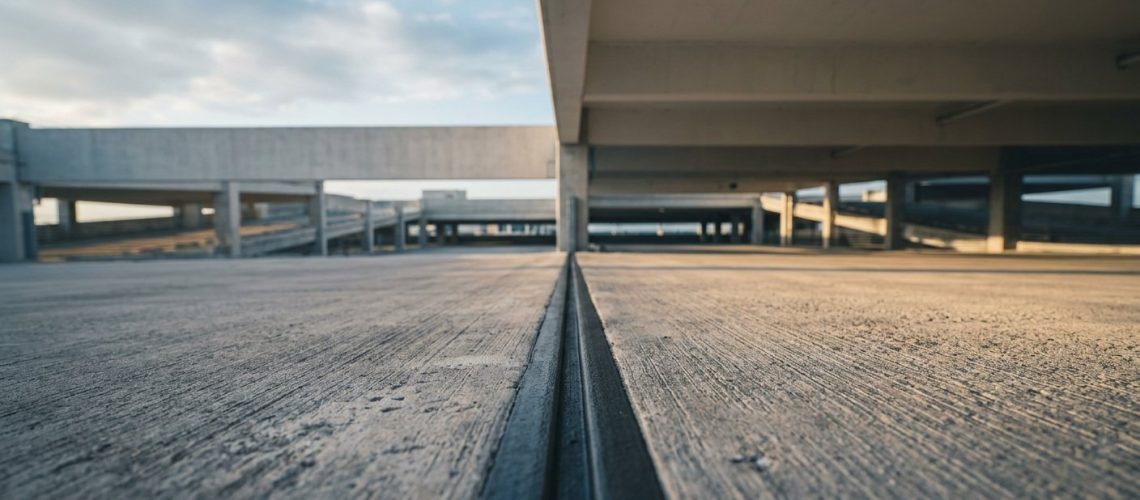
Parking garages lose an estimated 10–15% of their structural integrity over time when expansion joint failures go unaddressed — yet the repair cost differential between early intervention and full structural remediation can exceed 400%. For South Florida commercial property managers and HOA boards overseeing concrete parking structures, that gap represents a critical decision point that comes around faster than most expect.
Expansion joint sealing isn’t a maintenance checkbox. It’s the frontline defense between your parking structure and the relentless combination of saltwater air, thermal cycling, and heavy vehicle loads that define the South Florida environment. Understanding why joints fail — and what permanent repair actually looks like — gives property managers the information they need to act decisively before small leaks become expensive crises.
Why Expansion Joints Are So Vulnerable in South Florida
Concrete expands and contracts with temperature fluctuations. In South Florida, where surface temperatures on exposed parking decks routinely swing between 65°F overnight and 140°F on sun-baked surfaces, that thermal movement is extreme. Concrete has a coefficient of thermal expansion of approximately 5.5 × 10⁻⁶ per °F. For a 200-foot parking deck section, that translates to roughly 0.13 inches of movement per 100°F temperature change — every single day, year after year.
Expansion joints are designed to accommodate this movement. When the sealant materials within those joints degrade, crack, or delaminate, water infiltration begins almost immediately. In coastal environments like Miami, Fort Lauderdale, and West Palm Beach, that water carries dissolved chlorides from salt-laden air, dramatically accelerating the corrosion of embedded rebar and post-tension cables within the concrete structure.
According to the Federal Highway Administration’s bridge and parking structure guidelines, chloride-induced corrosion is one of the leading causes of premature concrete structural deterioration in coastal regions — a finding that directly applies to the parking garages serving South Florida’s high-rises and commercial buildings.
The Failure Modes Property Managers Must Recognize
Expansion joint failures in parking garages rarely announce themselves dramatically. They follow a predictable progression that property managers can learn to identify early:
- Surface cracking of joint sealant: UV exposure and thermal cycling cause conventional sealants to become brittle and develop surface cracks within 3–7 years of installation.
- Delamination: The sealant separates from the concrete substrate on one or both sides, creating a channel for water intrusion even when the sealant appears visually intact from above.
- Compression set failure: Over time, elastomeric sealants lose their ability to recover after compression, leaving permanent gaps that allow both water and debris infiltration.
- Substrate deterioration: Once water reaches the concrete at the joint edges, freeze-thaw cycles (less common in South Florida but present during cooler months) and chloride attack begin degrading the concrete itself, widening the joint and accelerating further failure.
By the time water is actively dripping from a lower parking level ceiling, the failure has typically been progressing for 18–36 months. The visible leak is not the beginning of the problem — it’s a late-stage symptom.
Traditional Repairs vs. Permanent Concrete Joint Waterproofing
The conventional approach to concrete expansion joint repair involves removing degraded sealant, cleaning the joint, and applying a new backer rod and polyurethane or silicone sealant. In ideal conditions, this approach provides adequate short-term performance. In South Florida’s real-world conditions, it rarely does.
Here’s the core problem: surface-applied sealants address the symptom — the open joint — without treating the substrate or the water already present within the concrete assembly. When moisture is trapped beneath a new sealant layer, hydrostatic pressure builds. The new sealant delaminates, often within 12–24 months, and the cycle repeats.
This is why so many parking garage managers describe their expansion joint maintenance as an endless recurring cost rather than a solved problem. The methodology is sound in theory but fails in execution because it doesn’t address the full depth of the problem.
Permanent water intrusion solutions require working from within the joint assembly itself, not just across its surface.
How Polyvinyl Injection Technology Changes the Outcome
CL Wizard’s proprietary polyvinyl injection technology approaches parking garage expansion joint sealing from a fundamentally different direction. Rather than relying on a surface-applied barrier, the process delivers sealing material directly into the joint assembly under controlled pressure, filling voids, microcracks, and delamination planes within the concrete substrate itself.
The polyvinyl compound is formulated to remain flexible after cure — critical for accommodating the ongoing thermal movement in South Florida parking structures. It bonds at the substrate level rather than simply adhering to the concrete surface, which means hydrostatic pressure works with the seal rather than against it. As water pressure builds within the joint assembly, it actually drives the material deeper into the substrate rather than forcing it away.
The process is also inherently non-disruptive. There’s no saw-cutting, no demolition, no removal of parking level finishes. The injection process is performed from the leak-facing surface, typically the underside of a parking deck or along the joint face, without affecting tenants or requiring extended area closures. For occupied commercial buildings and active residential parking structures in Miami and Fort Lauderdale, this distinction matters significantly.
All repairs are backed by a 5-year warranty, reflecting the durability and reliability of the underlying approach. For context, surface-applied conventional sealants rarely carry warranties beyond 1–2 years in South Florida conditions.
Commercial Expansion Joint Repair: What a Proper Assessment Covers
No two parking structures fail identically, which is why legitimate commercial expansion joint repair always begins with a thorough structural assessment. A proper evaluation of a parking garage’s expansion joint condition should include:
- Visual inspection of all joint locations on each level, including soffits and column lines
- Moisture mapping to identify active versus historic leak paths
- Assessment of substrate condition at joint edges to identify existing concrete deterioration
- Identification of post-tension cable proximity to at-risk joint locations
- Documentation of joint widths and movement patterns to confirm appropriate material selection
The International Concrete Repair Institute maintains technical guidelines for concrete repair assessment protocols, including frameworks for evaluating parking structure water intrusion — a useful reference point for property managers reviewing contractor proposals.
Understanding your structure’s specific failure pattern is what allows the repair approach to be calibrated correctly. Recommending repairs without an on-site assessment is not a best practice — it’s a guess.
The Real Cost of Deferred Maintenance
Property managers working within budget constraints often defer expansion joint sealing repairs, particularly when leaks appear minor. The financial logic is understandable but frequently works against long-term property economics.
When water infiltration reaches embedded reinforcement, chloride-induced corrosion of rebar begins. Corroding steel expands volumetrically — up to eight times its original volume — creating internal pressure that causes concrete spalling. Spall repair in parking structures involves concrete saw-cutting, rebar treatment or replacement, patching, and potentially post-tension tendon assessment. The concrete slab waterproofing work that could have protected the structure at a fraction of the cost becomes necessary in addition to structural remediation.
Beyond direct repair costs, active water intrusion in parking garages creates liability exposure from slip-and-fall incidents, potential vehicle damage claims, and in severe cases, structural safety concerns that can trigger mandatory parking area closures under Florida Building Code requirements. For HOAs and commercial property managers, a closed parking structure is not an abstraction — it’s an immediate operational and financial crisis.
Frequently Asked Questions
How do I know if my parking garage’s expansion joints need professional repair?
Key indicators include visible water staining or active dripping on lower level ceilings, visible gaps or cracking in existing joint sealant, rust staining along joint lines (indicating rebar corrosion has begun), and concrete spalling near joint edges. Even without visible leaks, joints older than 7–10 years in South Florida’s environment warrant professional inspection.
How long does expansion joint sealing take for a commercial parking structure?
Project duration depends on the number of joint locations, their condition, and the number of levels involved. Because CL Wizard’s polyvinyl injection process is non-disruptive and doesn’t require demolition or curing-related closures of entire floors, most commercial parking garage projects proceed with minimal operational interruption. A specific timeline is determined during the initial assessment.
Is expansion joint sealing the same as general waterproofing?
No. Expansion joint sealing specifically addresses the dynamic movement joints engineered into concrete structures. General waterproofing treatments address the concrete substrate surface but are not designed to accommodate the ongoing movement at expansion joints. Joint-specific repair requires materials and methods calibrated for that movement, which is why CL Wizard focuses specifically on this application.
Does CL Wizard’s technology work on all expansion joint configurations?
CL Wizard serves commercial properties, condominiums, high-rises, and parking structures throughout Miami, Fort Lauderdale, and West Palm Beach. Every project begins with a professional on-site assessment to evaluate the specific joint configuration, substrate condition, and appropriate repair methodology. Recommendations are made based on actual site conditions, not assumptions.
What does the 5-year warranty cover?
CL Wizard provides a 5-year warranty on all expansion joint repairs performed using its proprietary polyvinyl injection technology. The warranty covers the performance of the repair at treated locations. Specific terms are reviewed with property managers prior to project commencement.
Protecting Your Investment Starts with the Right Assessment
Expansion joint failures in South Florida parking garages are not a matter of if — they’re a matter of when and how severely. The combination of thermal cycling, salt air, humidity, and vehicle loading stress creates conditions that degrade conventional sealants faster than almost anywhere else in the country. Recognizing the signs early and choosing a repair methodology that addresses root causes rather than surface symptoms is what separates one-time problem resolution from an ongoing maintenance burden.
CL Wizard is a licensed, insured South Florida concrete leak specialist providing permanent expansion joint sealing solutions backed by a 5-year warranty. If your parking structure is showing signs of water intrusion — or if your expansion joints haven’t been professionally assessed in the past five years — contact CL Wizard to schedule a no-obligation on-site evaluation. Serving Miami, Fort Lauderdale, and West Palm Beach.
