
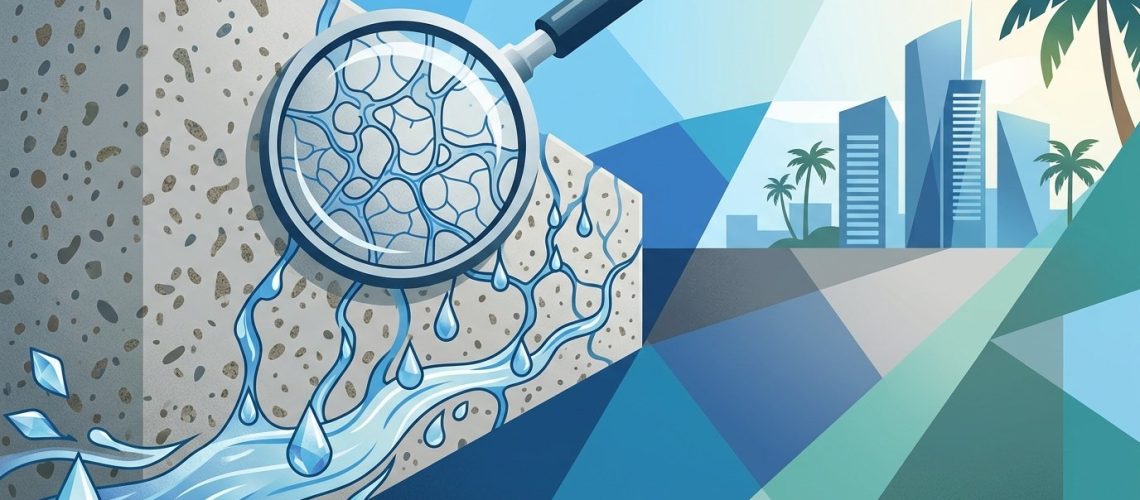
Concrete looks impenetrable. It’s hard, dense, and built to last decades. Yet in Miami, Fort Lauderdale, and West Palm Beach, property managers watch water seep through slabs, walls, and parking structures year after year — often after spending thousands on repairs that last only a season or two. The culprit hiding in plain sight is concrete porosity.
Understanding how water actually moves through concrete — and why South Florida’s environment accelerates that process — is the foundation for making smarter, longer-lasting repair decisions. This guide breaks down the science, the risks, and the solutions available to commercial property owners in 2026.
What Is Concrete Porosity and Why Does It Matter?
Concrete is not a solid, homogenous material. At a microscopic level, it contains an interconnected network of capillary pores, gel pores, and air voids created during the curing process. When the water-to-cement ratio during mixing exceeds approximately 0.38, excess water evaporates and leaves behind pathways — pores ranging from 10 nanometers to several millimeters — that allow moisture to migrate inward.
The Portland Cement Association notes that concrete permeability is one of the primary factors governing long-term structural durability. Higher porosity directly correlates with faster water intrusion, accelerated rebar corrosion, and shorter service life — especially in aggressive environments.
For South Florida property managers, this isn’t abstract chemistry. It’s what causes water stains on parking garage ceilings, efflorescence on exterior walls, and persistent leaks through concrete expansion joints after every heavy rain.
South Florida’s Unique Concrete Challenges
The Miami-to-West Palm Beach corridor presents a combination of environmental stressors that few other markets face simultaneously. Recognizing each one helps explain why standard repair methods underperform here.
Saltwater and Chloride Intrusion
Coastal proximity means that airborne salt particles and chloride ions are constantly depositing on and migrating into concrete surfaces. Once chloride concentrations at the rebar depth exceed approximately 0.6 kg/m³ — the recognized threshold referenced in Federal Highway Administration corrosion research — steel reinforcement begins to corrode. Corrosion byproducts expand up to six times the original volume of steel, fracturing surrounding concrete and dramatically opening existing pore structures to further water penetration.
Thermal Expansion and Contraction
Concrete has a coefficient of thermal expansion of approximately 10 × 10⁻⁶ per °C. In South Florida, surface temperatures on sun-exposed concrete slabs routinely swing 30°C or more between cooler nights and midday heat. That translates to measurable movement in every slab and joint — movement that cracks sealants, opens expansion joints, and enlarges capillary pathways over time. Seasonal cycling compounds this effect year after year.
Hydrostatic Pressure and Humidity
South Florida’s high water table and humidity levels routinely push moisture against below-grade concrete and slab undersides. When external hydrostatic pressure exceeds the capillary resistance of aged or porous concrete, water intrusion occurs even without visible cracks. In high-rise condominiums and parking structures, this creates moisture problems in occupied spaces and corrodes structural steel from the inside out.
Why Traditional Waterproofing Methods Fall Short
Most property managers in Miami and Fort Lauderdale have been through at least one cycle of surface-applied waterproofing: elastomeric coatings, crystalline treatments, or flexible sealants applied over expansion joints. These approaches share a fundamental limitation — they treat the surface while leaving the pore structure beneath unchanged.
Surface coatings can bridge hairline cracks but are mechanically bonded to a substrate that continues moving thermally. When the slab expands or contracts just 1–2 mm at a joint, the coating eventually de-bonds, and the cycle begins again. Many property managers report returning to the same building every two to four years for retreatment — an ongoing capital expense with no end date.
Cementitious patching products face the same limitation. Patching materials applied over existing porous concrete without addressing underlying moisture drive often experience adhesion failure within months, particularly when subjected to hydrostatic pressure from below.
For a deeper look at how water intrusion manifests across concrete structures, the water intrusion solutions resource outlines the full scope of pathways water uses to enter commercial buildings.
Polyvinyl Injection: How Permanent Concrete Leak Repair Works
CL Wizard’s proprietary polyvinyl injection technology addresses concrete porosity water penetration at the source — inside the concrete matrix — rather than on the surface. This distinction separates a permanent solution from a temporary one.
The Injection Process
The process begins with a site assessment to map active leak points, joint conditions, and moisture migration patterns. Injection ports are then installed at measured intervals along the affected area — typically spaced 150 to 300 mm apart depending on substrate thickness and pore density. The polyvinyl material is introduced under controlled pressure, allowing it to penetrate and fill the capillary network within the concrete.
As the material cures, it forms a flexible yet durable internal seal that moves with the concrete during thermal cycles. Unlike rigid epoxy injections that can fracture when the substrate moves, the polyvinyl formulation accommodates the ongoing expansion and contraction inherent in South Florida’s climate — which is precisely why this method produces lasting results where others fail.
Non-Disruptive by Design
One of the most significant operational advantages is what the process does not require. There is no demolition of surrounding concrete, no removal of tile or flooring finishes, no shutting down parking levels for extended periods, and no displacement of tenants or business operations. For HOA boards managing occupied high-rises in Miami Beach or Fort Lauderdale, this is often the deciding factor.
The non-disruptive approach means repairs can typically be completed with minimal interference to daily building operations — a critical consideration when weighing the true cost of any repair method.
Expansion Joints and Slab Waterproofing
Polyvinyl injection is particularly effective at sealing concrete expansion joints, which are among the most common water entry points in commercial and residential high-rises. Expansion joints are engineered to allow movement, which means conventional sealants are fighting against the joint’s core function. The internal injection approach seals the joint while preserving its movement capacity. For specifics on expansion joint repair, the concrete expansion joint leak repair resource provides detailed guidance.
For below-grade slabs and parking decks, the same technology addresses water intrusion in concrete slabs from beneath — stopping hydrostatic infiltration without requiring excavation. More information on slab-specific applications is available in the concrete slab waterproofing guide.
Prevention and Maintenance for 2026 and Beyond
Reactive repair is always more expensive than proactive management. Commercial property owners and HOA boards managing concrete structures in Miami, Fort Lauderdale, and West Palm Beach should build the following practices into their maintenance calendars:
- Annual joint inspections: Inspect all expansion joints and control joints for sealant de-bonding, cracking, or displacement. Early-stage joint failure is inexpensive to address; ignored joints become structural water intrusion problems.
- Monitoring for efflorescence: White mineral deposits on concrete surfaces indicate active water migration through the pore structure. Efflorescence is a visible diagnostic signal, not just a cosmetic issue.
- Post-storm assessments: South Florida’s summer rain events drive significant hydrostatic pressure changes. Inspect below-grade areas and parking decks within 48 hours of major rainfall events.
- Chloride content testing: For buildings within two miles of the coast, periodic chloride penetration testing every five to seven years allows early identification of rebar corrosion risk before structural damage occurs.
- Documentation: Photograph and date all identified leak points to track progression and establish a repair history — essential for HOA reserve fund planning and insurance documentation.
Frequently Asked Questions
How does concrete porosity water penetration differ from a crack leak?
Crack leaks occur through visible fractures in concrete. Porosity-driven water penetration happens through the microscopic capillary network within intact-looking concrete. Both pathways often coexist in South Florida structures, and effective repair addresses both the visible and invisible entry points simultaneously.
Is polyvinyl injection appropriate for occupied buildings?
Yes. CL Wizard’s non-disruptive repair technology is designed specifically for occupied commercial buildings, condominiums, and HOA properties. Work is performed without demolition or tenant displacement, making it suitable for active high-rises, parking garages, and commercial facilities in Miami, Fort Lauderdale, and West Palm Beach.
What warranty is provided on concrete leak repairs?
CL Wizard provides a 5-year warranty on all repairs. This reflects confidence in the permanent nature of the polyvinyl injection solution compared to surface-applied methods that typically require retreatment within two to four years.
How do I know if my building has a concrete porosity problem versus a surface crack?
Signs of porosity-driven intrusion include diffuse dampness or moisture seeping through areas without visible cracks, efflorescence across broad surface areas, and moisture appearing consistently after rainfall even without identifiable entry points. A licensed concrete leak specialist can assess the specific condition through a professional site inspection — remote diagnosis is not reliable for accurate evaluation.
Can surface coatings be applied after polyvinyl injection?
Surface treatments can be applied after injection if aesthetics require it. However, the injection itself provides the primary waterproofing function. Surface coatings become optional rather than essential once the internal pore structure has been sealed.
Take the Next Step Toward Permanent Protection
Concrete porosity is an engineering reality, not a building defect. Every concrete structure in South Florida is working against the same set of environmental pressures — salt air, thermal cycling, humidity, and hydrostatic stress. The difference between a building that requires constant maintenance spending and one that performs predictably comes down to the repair method used and how proactively owners address early warning signs.
CL Wizard serves commercial property managers, HOA boards, and building owners across Miami, Fort Lauderdale, and West Palm Beach with licensed, insured concrete leak repair backed by a 5-year warranty. If your building has persistent moisture problems, the right starting point is an on-site assessment by a concrete leak specialist who can accurately diagnose the source before recommending a solution.
Contact CL Wizard today to schedule your professional site assessment and get a clear, honest evaluation of your building’s concrete moisture challenges.
