
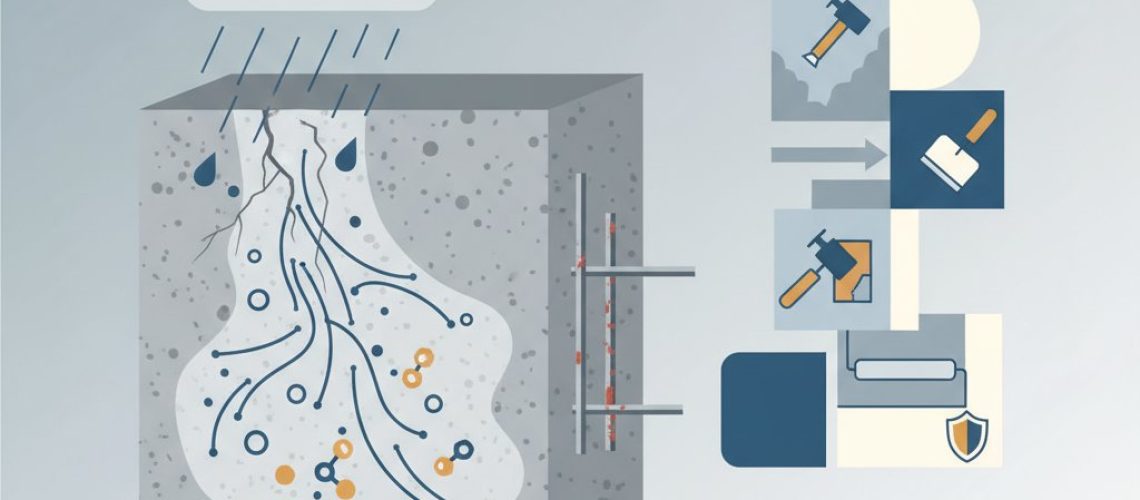
Property managers throughout Miami, Fort Lauderdale, and West Palm Beach face a hidden threat that accelerates silently behind walls and within parking structures: concrete carbonation combined with water intrusion. This dual mechanism doesn’t just create cosmetic damage—it systematically compromises structural integrity while multiplying repair costs with each passing month. By 2026, with South Florida’s aging building inventory and intensifying environmental pressures, understanding and addressing carbonation-driven water intrusion has become a critical maintenance priority.
Concrete carbonation occurs when atmospheric carbon dioxide penetrates concrete’s porous surface, reacting with calcium hydroxide to form calcium carbonate. This chemical transformation lowers the concrete’s pH from approximately 12.5-13 to below 9, stripping away the natural alkaline protection that prevents steel reinforcement from corroding. When water intrusion compounds this process, the degradation accelerates exponentially, creating conditions where repairs become increasingly complex and expensive.
The Carbonation-Water Intrusion Connection in South Florida
South Florida’s environmental conditions create the perfect storm for carbonation-accelerated water damage. The combination of high humidity (averaging 60-80% year-round), salt-laden air from coastal proximity, and temperature fluctuations unique to the region drives carbonation deeper into concrete structures faster than in most other U.S. markets.
According to research published by the National Institute of Standards and Technology, carbonation progresses at rates proportional to the square root of time, typically penetrating 1-5mm per year in standard conditions. However, South Florida’s elevated CO2 concentrations in urban areas, combined with moisture cycling from afternoon thunderstorms and overnight humidity, can double these penetration rates in exposed structures.
When carbonation reaches steel reinforcement—typically positioned 1-2 inches below the concrete surface in parking structures and exterior walls—the protective passive layer surrounding the rebar dissolves. Water intrusion at this stage initiates corrosion that produces iron oxide (rust), which occupies approximately six times the volume of the original steel. This expansion generates internal pressures exceeding 15,000 psi, causing concrete spalling, crack propagation, and progressive structural deterioration.
Identifying Carbonation-Related Water Intrusion in Your Building
Early detection separates manageable repairs from major capital expenditures. Property managers should conduct quarterly inspections focusing on these carbonation-water intrusion indicators:
- Surface staining patterns: Rust-colored streaks emanating from cracks or joints indicate water carrying dissolved iron from corroding rebar
- Concrete delamination: Hollow sounds when tapping concrete surfaces suggest subsurface separation caused by rebar expansion
- Expansion joint deterioration: Crumbling, missing, or water-saturated joint sealants allow direct water access to carbonated concrete layers
- Efflorescence with rust tinting: White crystalline deposits mixed with brown discoloration signal both water movement and active corrosion
- Spalling patterns around penetrations: Concrete flaking near pipe sleeves, conduits, or embedded fixtures where water concentrates
- Repetitive wet spots: Areas that remain damp long after rain events indicate water trapped within carbonated, more porous concrete
The critical distinction between simple moisture problems and carbonation-driven water intrusion lies in progression patterns. Carbonation damage advances systematically outward from initial intrusion points, creating expanding zones of vulnerability that traditional surface waterproofing cannot address.
2026 Assessment Protocols for Commercial Properties
Professional assessment now incorporates advanced diagnostic techniques beyond visual inspection. Phenolphthalein indicator testing provides immediate carbonation depth measurements—when sprayed on freshly broken concrete surfaces, areas with pH above 9 turn purple, while carbonated zones remain colorless. This simple field test reveals carbonation fronts and helps predict where water intrusion will cause the most damage.
Half-cell potential testing measures electrical potential differences across concrete surfaces, identifying active corrosion zones even before visible surface damage appears. Readings more negative than -350 millivolts (using a copper-copper sulfate reference electrode) indicate a 90% probability of active rebar corrosion requiring intervention.
For comprehensive evaluations of high-rises and large commercial structures, ground-penetrating radar (GPR) scanning maps internal concrete conditions, locating voids, delamination, and moisture concentration areas without destructive testing. Combined with carbonation depth profiling, these technologies enable property managers to prioritize repairs based on actual risk rather than visible symptoms alone.
Why Traditional Waterproofing Fails Against Carbonated Concrete
Standard waterproofing approaches—surface coatings, cementitious barriers, and membrane systems—treat symptoms rather than addressing the fundamental problem. Once carbonation has compromised concrete’s alkalinity, surface treatments cannot restore pH levels or halt internal corrosion processes already underway.
Epoxy injection systems, widely marketed for crack repair, create rigid bonds that cannot accommodate the thermal expansion coefficients of South Florida concrete. With temperature swings reaching 40°F between air-conditioned interiors and sun-exposed exteriors, these inflexible repairs typically fail within 18-36 months, requiring repeated interventions that multiply costs while damage continues beneath the surface.
Cementitious waterproofing compounds applied to carbonated concrete actually worsen conditions by trapping moisture within the substrate. As the Portland Cement Association documentation explains, these materials require adequate substrate alkalinity for proper bonding and performance—conditions absent in carbonated concrete.
Traditional expansion joint replacement using polyurethane or polysulfide sealants provides only 5-10 year service life in South Florida’s UV exposure and temperature extremes. When these joints fail in carbonated concrete surroundings, water intrusion accelerates corrosion in already-compromised material, creating compounding failure cycles.
Proprietary Polyvinyl Injection Technology for Permanent Solutions
Permanent resolution of carbonation-related water intrusion requires technology that addresses both the immediate leak pathway and the compromised concrete matrix. CL Wizard’s proprietary polyvinyl injection system penetrates deeply into carbonated concrete, creating a continuous waterproof barrier that flexes with thermal movement rather than resisting it.
The polyvinyl material exhibits a thermal expansion coefficient of 8.0 × 10⁻⁵ per °C, closely matching concrete’s 9-12 × 10⁻⁶ per °C. This compatibility allows the injected material to move with the substrate through daily thermal cycles without debonding or creating new leak pathways—a fundamental advantage over rigid epoxy systems.
Application involves precision injection at calculated pressure (typically 40-100 psi depending on concrete density and crack width) through strategically placed ports. The low-viscosity material penetrates micro-cracks smaller than 0.01mm, filling the porous structure created by carbonation and establishing a three-dimensional waterproof matrix throughout the affected zone.
Unlike surface treatments, this approach works from within the concrete, creating permanent water barriers at actual intrusion points—expansion joints, construction cold joints, honeycomb areas, and crack networks. The polyvinyl material remains flexible indefinitely, accommodating building movement, settlements, and thermal expansion without compromising the seal.
South Florida-Specific Implementation Strategies
Successful carbonation-water intrusion repairs in Miami, Fort Lauderdale, and West Palm Beach commercial properties require site-specific protocols addressing regional challenges:
Saltwater exposure considerations: Coastal properties within three miles of saltwater require chloride ion testing before repair specification. When chloride concentrations exceed 0.2% by concrete weight (measured at rebar depth), corrosion inhibitor treatments must supplement waterproofing to arrest existing electrochemical reactions.
Humidity management: Repairs scheduled during South Florida’s dry season (November through April) allow optimal material curing and performance verification before summer humidity stress-tests the system. However, the non-disruptive nature of polyvinyl injection enables year-round application when property needs demand immediate intervention.
Parking structure priorities: Multi-level parking garages experience the most severe carbonation-water intrusion combinations due to vehicle exhaust (elevated CO2), de-icing salt tracking, and direct weather exposure. These structures benefit from systematic floor-by-floor treatment addressing expansion joints, vehicle impact damage, and construction joints as integrated water intrusion pathways.
High-rise exterior wall systems: Concrete facades on buildings above eight stories experience differential carbonation rates based on sun exposure, prevailing wind patterns, and proximity to ocean spray. Comprehensive treatment plans address these variable conditions rather than applying uniform solutions.
Cost-Benefit Analysis: Permanent Repair vs. Recurring Maintenance
Property managers evaluating repair options should analyze total costs over realistic time horizons. Traditional surface waterproofing for a typical commercial building parking structure costs $8-15 per square foot with expected service life of 3-7 years before reapplication becomes necessary. Over a 15-year analysis period, these recurring costs multiply to $24-60 per square foot while the underlying carbonation damage continues advancing.
Permanent polyvinyl injection solutions targeting actual intrusion points typically require investment of $45-85 per linear foot of treated joint or crack, backed by a 5-year warranty on all repairs. Because the treatment addresses root causes rather than symptoms, properly executed applications require no reapplication, eliminating recurring maintenance cycles and reducing life-cycle costs by 40-60% compared to traditional approaches.
Beyond direct repair costs, property managers must factor operational expenses: tenant disruption, equipment rental for surface access, parking revenue loss during multi-phase traditional repairs, and property value impacts from visible deterioration. Non-disruptive repair technology that allows normal building operations to continue during treatment delivers substantial additional value difficult to capture in simple per-square-foot comparisons.
Regulatory Compliance and Engineering Standards
Florida Building Code requirements for concrete repair have evolved substantially, particularly following high-profile structural failures that focused attention on maintenance standards for aging concrete structures. Commercial property owners now face increased scrutiny during recertification inspections, with engineers specifically evaluating water intrusion remediation approaches and their long-term effectiveness.
The updated Florida Building Code emphasizes performance-based standards rather than prescriptive methods, requiring documented evidence that repairs will perform for their intended service life. This regulatory shift favors permanent solutions with verifiable track records over temporary fixes requiring repeated intervention.
Property managers should ensure any repair contractor provides Florida licensing, comprehensive insurance, and documented experience with the specific concrete conditions present in carbonated, water-damaged structures. The combination of proper licensing and material-specific warranties protects owners from both regulatory compliance issues and repair failure risks.
Creating Your 2026 Action Plan
Addressing carbonation-driven water intrusion requires systematic planning rather than reactive emergency repairs. Property managers should implement this phased approach:
Phase 1 – Comprehensive Assessment (Months 1-2): Engage qualified specialists for building-wide evaluation including carbonation depth testing, moisture mapping, and structural condition assessment. Prioritize areas based on risk severity, occupancy impacts, and structural criticality rather than simply addressing visible symptoms.
Phase 2 – Repair Strategy Development (Month 2): Develop detailed specifications addressing identified conditions with permanent solutions appropriate to each location’s specific challenges. Include contingency provisions for conditions that may be revealed during repair execution.
Phase 3 – Phased Implementation (Months 3-8): Execute repairs in logical sequences that minimize operational disruption while addressing highest-risk areas first. Schedule work to accommodate tenant needs, seasonal weather patterns, and budget cycles.
Phase 4 – Verification and Monitoring (Ongoing): Document completed repairs with photo records and test data confirming water intrusion elimination. Implement quarterly monitoring protocols to verify long-term performance and catch any new issues before they become major problems.
Frequently Asked Questions
How long does concrete carbonation take to cause water intrusion problems?
Carbonation typically progresses 1-5mm annually in standard conditions, but South Florida’s humidity and coastal proximity can double these rates. Most commercial structures built before 2000 with standard 1-2 inch concrete cover over rebar are now experiencing carbonation-accelerated corrosion when water intrusion occurs. The timeline from carbonation reaching rebar to visible surface damage averages 3-7 years depending on moisture exposure frequency.
Can carbonation damage be reversed in concrete structures?
Carbonation itself cannot be reversed—the chemical transformation of calcium hydroxide to calcium carbonate is permanent. However, its damaging effects can be arrested by eliminating water intrusion that drives corrosion processes. Permanent waterproofing using polyvinyl injection technology stops water access to carbonated zones, halting further deterioration while addressing existing leak pathways that allowed the problem to develop.
What makes polyvinyl injection superior to epoxy for carbonated concrete?
Polyvinyl materials exhibit thermal expansion coefficients closely matching concrete (8.0 × 10⁻⁵ vs. 9-12 × 10⁻⁶ per °C), allowing flexible movement through South Florida’s temperature cycles without debonding. Epoxy’s rigidity creates stress concentrations that lead to new cracks in already-compromised carbonated concrete. Additionally, polyvinyl’s lower viscosity enables penetration into micro-cracks and porous carbonated zones that epoxy cannot reach, creating comprehensive three-dimensional waterproofing rather than surface-level crack filling.
How soon should property managers address carbonation-related water intrusion?
Immediate action provides the most cost-effective outcomes. Once carbonation reaches reinforcing steel and water intrusion initiates corrosion, damage accelerates exponentially as rust expansion creates additional cracks that admit more water. Addressing problems during early stages—when surface staining or minor spalling first appears—typically costs 60-70% less than repairs required after extensive delamination and structural compromise develop. Schedule professional assessment within 30 days of identifying potential carbonation-water intrusion indicators.
Does the 5-year warranty cover all carbonation-related water intrusion?
The 5-year warranty covers the specific leak pathways and intrusion points treated during the repair process. It guarantees that water will not re-enter through treated expansion joints, cracks, or other sealed locations. However, carbonation is an ongoing process in concrete exposed to atmospheric conditions. The warranty covers the permanent waterproofing solution applied to identified problems; it does not prevent new carbonation or water intrusion from developing in previously unaffected areas. Regular monitoring helps identify any new issues before they become significant problems.
Take Action Before Damage Escalates
Carbonation-driven water intrusion represents a progressive threat that increases in severity and repair cost with every month of inaction. South Florida property managers who address these issues proactively protect building values, avoid emergency repairs during critical periods, and eliminate the recurring maintenance cycles that consume maintenance budgets without solving underlying problems.
CL Wizard’s proprietary polyvinyl injection technology offers permanent concrete leak solutions specifically engineered for South Florida’s challenging environment. As licensed and insured local Miami concrete leak specialists serving Fort Lauderdale and West Palm Beach commercial properties, we provide comprehensive assessments identifying carbonation-related water intrusion before it becomes a structural crisis.
Contact CL Wizard today for a professional evaluation of your commercial property’s concrete conditions. Our non-disruptive repair approach allows normal building operations to continue while permanently eliminating water intrusion at its source—backed by our 5-year warranty. Don’t let carbonation and water intrusion silently compromise your building’s structural integrity and value.
