
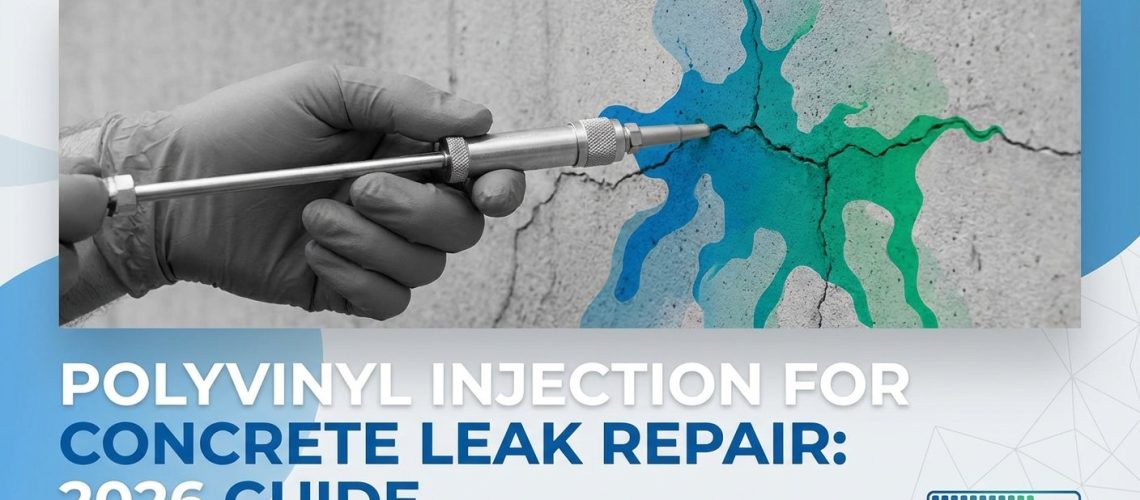
Water intrusion through concrete structures costs commercial property owners in South Florida an estimated $45,000 annually in repairs, tenant complaints, and structural deterioration. Traditional waterproofing methods—epoxy injections, cementitious coatings, and membrane installations—often provide temporary relief while requiring disruptive construction, tenant relocations, and repeat interventions every few years. Polyvinyl injection technology has emerged as the permanent, non-invasive solution that addresses the root causes of concrete leaks while maintaining normal building operations.
Understanding Polyvinyl Injection Technology
Polyvinyl injection represents a fundamental shift in concrete leak repair methodology. Unlike rigid epoxy solutions that crack under structural movement or surface coatings that fail at the penetration point, polyvinyl resin creates a flexible, expanding barrier that moves with concrete as it experiences thermal expansion, settling, and daily stress cycles.
The technology works through hydrophilic (water-activated) polyvinyl resins injected directly into concrete cracks, joints, and porous sections. When the resin contacts moisture within the concrete matrix, it expands up to 400% of its original volume, creating a permanent rubberized seal that fills every void, capillary, and micro-crack within the affected area. The expansion coefficient of polyvinyl resin (0.00012 per °F) closely matches concrete’s natural expansion rate, preventing the seal separation that plagues rigid repair materials.
The Chemistry Behind Permanent Sealing
Polyvinyl injection’s superiority stems from its molecular structure. The resin consists of hydrophilic polymers with molecular weights between 400,000 and 600,000 Daltons, allowing penetration into cracks as narrow as 0.002 inches—far beyond the reach of traditional grouts or epoxies. Once activated by water, cross-linking occurs at the molecular level, creating a three-dimensional polymer network that remains flexible while maintaining tensile strength exceeding 450 psi.
This flexibility proves critical in South Florida’s challenging environment. Concrete structures experience temperature differentials of 40-50°F between air-conditioned interiors and sun-exposed exteriors, causing constant expansion and contraction. Rigid repair materials fail at these stress points within 18-36 months. Polyvinyl’s elastomeric properties allow 25-30% elongation without seal compromise, maintaining waterproof integrity through decades of thermal cycling.
South Florida’s Unique Concrete Challenges
The region’s coastal environment creates a perfect storm for concrete deterioration. Saltwater exposure accelerates rebar corrosion, with chloride ion penetration rates reaching 0.5 inches annually in structures within three miles of the ocean. Humidity levels consistently above 70% maintain moisture within concrete pores, preventing proper curing of traditional repair materials and promoting continuous deterioration.
Thermal expansion presents another significant challenge. South Florida concrete surfaces can reach 145°F under direct sunlight while interior sections remain at 72°F. This 73-degree differential causes expansion rates of 0.087 inches per 100 feet of concrete—enough to crack rigid repair materials within months of application.
Underground parking structures face additional complications. Water table fluctuations during rainy season create hydrostatic pressure exceeding 8 psi against below-grade concrete walls. Traditional waterproofing membranes separate under this pressure, allowing water infiltration that damages finishes, vehicles, and electrical systems.
Polyvinyl Injection vs. Traditional Repair Methods
Understanding the performance differences between repair technologies helps property managers make informed decisions about permanent solutions versus temporary fixes.
Epoxy Injection Limitations
Epoxy injection, while effective for structural crack repair, provides poor waterproofing performance in active leaks. Epoxy’s rigid nature (tensile modulus of 450,000 psi) means it cannot accommodate concrete movement. Within 24-36 months, new cracks form adjacent to epoxy repairs as stress concentrates at the repair boundaries. Epoxy also requires completely dry concrete for proper adhesion—an impossibility in active leak situations.
Cost comparisons reveal epoxy’s hidden expenses. Initial application costs $95-$140 per linear foot, but property managers face repeat repairs every 2-3 years. Over a 10-year period, epoxy repairs for a typical parking garage crack network cost $45,000-$68,000 in direct expenses, plus tenant disruption and temporary waterproofing measures.
Surface Membrane Failures
Cementitious coatings and membrane systems address symptoms rather than causes. Applied to concrete surfaces, these barriers fail at penetration points where water finds pathways through the concrete matrix. Installation requires extensive surface preparation, tenant relocation, and 5-7 days of curing time before areas return to service.
Membrane systems cost $12-$18 per square foot installed, with typical parking deck applications totaling $85,000-$125,000. Expected lifespan ranges from 5-8 years before reapplication becomes necessary. The disruption factor—closing parking areas, relocating vehicles, managing contractor access—adds indirect costs exceeding 30% of direct repair expenses.
Polyvinyl Injection Advantages
Polyvinyl injection repairs active leaks from the injection point outward, requiring no surface preparation, no tenant relocation, and no operational disruption. Technicians drill small ports (⅜-inch diameter) at strategic intervals along crack paths, inject resin under controlled pressure, and achieve complete waterproofing within 24 hours as the resin cures.
The cost structure favors long-term value. Polyvinyl injection costs $75-$105 per linear foot depending on crack depth and complexity—comparable to or below epoxy pricing. However, the permanent nature of repairs backed by 5-year warranties eliminates recurring costs. A typical parking garage crack repair investment of $18,000-$25,000 provides decades of waterproof performance without additional intervention.
The Injection Process: Technical Overview
Professional polyvinyl injection follows a systematic protocol that ensures complete void filling and permanent waterproofing. The process begins with comprehensive leak assessment using moisture meters, thermal imaging, and structural evaluation to map water pathways through the concrete matrix.
Injection port placement follows engineering principles based on crack width, concrete thickness, and hydrostatic pressure. Ports are drilled perpendicular to crack faces at 8-12 inch intervals, extending 50-75% through the concrete section. This positioning ensures resin distribution throughout the crack plane rather than surface sealing.
Resin injection occurs under controlled pressure between 40-80 psi, monitored to prevent concrete damage while ensuring complete void penetration. Technicians observe resin emergence at adjacent ports or crack surfaces, confirming complete fill. The water-activated expansion begins within minutes, with full cure occurring within 24-48 hours depending on ambient temperature and moisture content.
Quality verification includes visual inspection, moisture testing at 48 hours post-injection, and water testing when feasible. The process typically completes within 4-6 hours for standard parking garage cracks, with treated areas returning to immediate service.
Real-World Performance: Case Studies
Aventura Condominium Parking Structure
A 12-story condominium in Aventura experienced chronic leaking in its three-level underground parking garage. Previous epoxy repairs in 2021 and 2023 failed within 18 months, with water intrusion damaging 15 vehicles and creating slip hazards. The property management company faced potential liability exceeding $200,000.
CLWizard performed polyvinyl injection on 340 linear feet of structural cracks in November 2023. Post-repair monitoring through Hurricane season 2024 and 2025 confirmed zero water intrusion despite heavy rainfall events. The $28,500 investment eliminated recurring repair costs projected at $15,000 annually and resolved tenant complaints that threatened occupancy rates.
Coral Gables Commercial Plaza
A mixed-use development’s loading dock area suffered from ground-level slab leaks that flooded storage areas during heavy rains. Traditional membrane installation required closing the loading dock for 10 days—unacceptable for tenants dependent on daily deliveries.
Polyvinyl injection completed repairs during overnight hours across three consecutive nights, maintaining normal business operations. The 180 linear feet of expansion joint treatment cost $16,200 and eliminated flooding issues that previously caused $8,000-$12,000 in annual tenant damages and business interruption claims.
Long-Term Value and ROI
Calculating return on investment for concrete leak repair requires evaluating direct costs, indirect expenses, and risk mitigation benefits. Polyvinyl injection delivers measurable advantages across all categories.
Direct cost savings emerge from eliminating repeat repairs. Traditional methods require reapplication every 3-5 years, creating recurring capital expenditures. Polyvinyl’s permanent solution converts ongoing operational expenses into a one-time capital investment with decades of performance.
Indirect savings include maintained property values, eliminated tenant complaints, avoided liability claims, and preserved structural integrity. Water intrusion causes rebar corrosion that weakens structural concrete, potentially requiring costly remediation. Permanent waterproofing prevents this deterioration cascade.
Risk mitigation provides the greatest long-term value. A single slip-and-fall lawsuit from parking garage water infiltration can cost $150,000-$400,000 in legal fees and settlements. Preventing water intrusion eliminates this liability exposure while maintaining insurance compliance.
Selecting a Qualified Injection Contractor
Not all concrete repair contractors possess the expertise and equipment for professional polyvinyl injection. Property managers should verify contractor qualifications including specific polyvinyl injection training, proper resin handling certifications, and comprehensive liability insurance covering injection work.
Request documentation of previous projects with verifiable references. Qualified contractors provide detailed proposals specifying resin types, injection pressures, port spacing, and expected outcomes. Be wary of vague quotes or contractors unwilling to explain their methodology.
Warranty terms reveal contractor confidence in their work. Professional polyvinyl injection should include minimum 5-year waterproofing warranties covering both materials and labor. Shorter warranty periods or exclusions for specific conditions indicate inexperience or inferior materials.
Maintaining Waterproof Integrity
While polyvinyl injection provides permanent repairs, proper building maintenance extends overall waterproofing performance. Implement quarterly visual inspections of treated areas, checking for new cracks or signs of water intrusion in adjacent sections. Address new issues promptly before minor problems escalate.
Monitor building settlement and structural movement through annual surveys in high-rise structures. Significant settling may create new crack pathways requiring additional treatment. Maintain proper drainage systems to minimize hydrostatic pressure against below-grade concrete elements.
Take Action Against Concrete Leaks
Water intrusion through concrete structures demands immediate attention and permanent solutions. Delaying repairs accelerates structural deterioration, increases liability exposure, and compounds ultimate repair costs. Polyvinyl injection technology provides the non-disruptive, permanent solution South Florida property managers need.
CLWizard specializes in proprietary polyvinyl injection systems backed by 5-year warranties and decades of combined expertise in commercial concrete waterproofing. Schedule a free property assessment to receive detailed analysis of your concrete leak issues, comprehensive repair proposals, and accurate cost projections. Contact CLWizard today at [contact information] to protect your property investment with permanent concrete leak solutions.
