
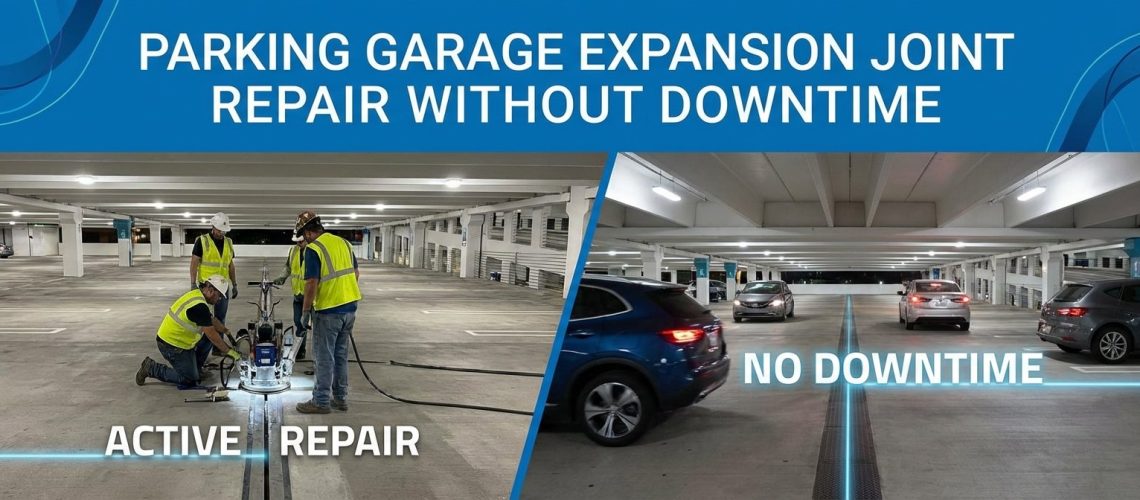
Every parking garage in South Florida faces a critical structural challenge: expansion joints that fail under constant stress. When these joints leak, water cascades through multiple floors, corrodes reinforcing steel, damages vehicles, and creates liability nightmares for property managers. The traditional repair approach—shutting down entire parking levels for weeks—costs thousands in lost revenue and tenant frustration. But there’s a better solution that eliminates leaks while keeping your facility fully operational.
Understanding Expansion Joint Failure in Parking Structures
Expansion joints serve as the flexible connections between concrete sections, accommodating thermal movement that can reach 0.65 inches per 100 feet of concrete in South Florida’s climate. When temperatures fluctuate between 60°F and 95°F throughout the year, concrete expands and contracts continuously. Add saltwater exposure from ocean air, humidity levels averaging 75%, and constant vehicular loads, and you create the perfect storm for joint failure.
Traditional expansion joint systems rely on surface-mounted covers, sealant strips, or compression seals. These materials deteriorate within 3-7 years due to UV exposure, chemical damage from vehicle fluids, and mechanical wear. When they fail, water doesn’t just drip—it floods through the joint gap, traveling through multiple levels and causing progressive damage to structural elements.
The Real Cost of Failed Expansion Joints
A single leaking expansion joint in a multi-level parking garage creates cascading problems:
- Chloride-induced corrosion of reinforcing steel, reducing structural capacity by up to 20% annually
- Concrete spalling and delamination, creating falling debris hazards
- Tenant vehicle damage claims averaging $2,500-$15,000 per incident
- Slip-and-fall liability exposure with settlement costs exceeding $50,000
- Decreased property valuations during inspections and sales processes
- Accelerated deterioration requiring premature structural restoration costing $150-$300 per square foot
Why Traditional Expansion Joint Repair Methods Fall Short
Conventional concrete expansion joint leak repair approaches share a fundamental flaw: they require extensive facility disruption and provide only temporary fixes.
Replacement Systems: High Cost, High Disruption
Complete expansion joint replacement involves removing existing materials, preparing surfaces, and installing new compression seals or metal cover systems. This process requires:
- Closing parking levels for 2-4 weeks during installation
- Concrete cutting and removal creating dust, noise, and debris
- Costs ranging from $75-$200 per linear foot
- Curing times of 3-7 days before reopening areas
- Repeated failures within 5-8 years, restarting the cycle
For a commercial property with 400 linear feet of expansion joints across multiple levels, replacement costs easily exceed $60,000—plus lost parking revenue and tenant dissatisfaction.
Surface Sealants: Temporary Patches
Polyurethane or silicone-based sealants applied to joint surfaces offer quick fixes but limited durability. These materials experience adhesion failure when joints move beyond their elastic capacity (typically ±25% extension). In South Florida’s thermal cycling environment, surface sealants crack and separate within 18-36 months, requiring constant reapplication and maintenance cycles that never truly solve the underlying water intrusion problem.
The Polyvinyl Injection Solution: Permanent Expansion Joint Leak Fix
Advanced polyvinyl injection technology represents a paradigm shift in parking garage expansion joint repair. Rather than replacing surface components or applying temporary sealants, this method fills the entire joint cavity with a hydrophobic, flexible polymer that moves with the concrete while maintaining a permanent water barrier.
How Polyvinyl Injection Technology Works
The process begins with thorough joint assessment using moisture meters and infrared thermography to map the full extent of water penetration pathways. Technicians then drill strategic injection ports at 12-18 inch intervals along the joint length, positioned to ensure complete polymer distribution throughout the cavity depth.
A two-component polyvinyl resin is injected under controlled pressure (40-60 PSI) through these ports. The material exhibits viscosity characteristics specifically engineered for expansion joint applications—thin enough to penetrate the entire joint cavity, including hairline cracks and voids, yet with controlled expansion properties that fill gaps without exerting damaging pressure on surrounding concrete.
The polyvinyl material cures within 15-30 minutes, forming a flexible, watertight seal throughout the joint’s full depth. Unlike rigid materials, the cured polymer maintains elasticity with a Shore A hardness of 60-80, accommodating thermal movement of ±35% without cracking or separating from concrete surfaces. The hydrophobic nature of the polymer actively repels water, and its closed-cell structure prevents moisture transmission even under hydrostatic pressure.
Technical Advantages Over Traditional Methods
Polyvinyl injection for expansion joint sealing delivers measurable performance improvements:
- Thermal Movement Accommodation: Handles expansion/contraction cycles of 0.75 inches per 100 feet, exceeding South Florida’s maximum thermal stress
- Chemical Resistance: Unaffected by petroleum products, de-icing salts, or alkaline concrete leachate
- UV Stability: Maintains structural integrity under constant sun exposure without degradation
- Hydrostatic Pressure Resistance: Withstands water pressure up to 230 feet of head pressure
- Longevity: Expected service life exceeding 20 years based on accelerated aging tests
Non-Disruptive Installation: Keeping Operations Running
The defining advantage of polyvinyl injection for commercial expansion joint repair is the ability to complete repairs without operational shutdowns. The installation process for a typical 200-foot expansion joint across three parking levels takes 4-6 hours total, completed during low-traffic periods like early mornings or weekends.
Because no concrete cutting, surface preparation, or curing time is required, repaired areas remain accessible throughout the process. Technicians work in small sections, cordoning off only 10-15 feet at a time. Within 30 minutes of injection completion, that section is fully cured and vehicles can resume normal use.
This approach eliminates:
- Lost parking revenue from closed levels
- Tenant complaints about access restrictions
- Dust and debris contamination of vehicles
- Noise disruptions to adjacent residential or office spaces
- Extended project timelines stretching weeks or months
Real-World Case Study: Brickell High-Rise Restoration
A 42-story residential tower in Miami’s Brickell neighborhood faced expansion joint water intrusion affecting 600 linear feet of joints across six parking levels. Water penetration had caused visible rust staining on concrete surfaces and multiple tenant vehicle damage complaints.
Traditional replacement estimates ranged from $95,000-$140,000 with 6-week timelines requiring level-by-level closures. The property management team chose polyvinyl injection instead, completing the entire project over two weekends at a total cost of $38,400—a 65% savings.
More importantly, parking operations continued uninterrupted. Three years post-repair, infrared thermography confirms zero water intrusion, and the joints continue performing flawlessly through seasonal temperature variations.
Cost Analysis: Investment vs. Long-Term Value
When evaluating parking garage leak repair options, total lifecycle costs tell the complete story. Polyvinyl injection typically costs $45-$85 per linear foot depending on joint depth and accessibility—comparable to or less than traditional replacement methods upfront.
The dramatic cost advantage emerges over time:
- Zero operational disruption costs: No lost parking revenue or tenant compensation
- Extended service life: 20+ year performance vs. 5-8 years for traditional systems
- Reduced maintenance: No scheduled resealing or inspection requirements
- Prevention of secondary damage: Stopping water intrusion before steel corrosion requires $150+/sq ft structural repairs
- 5-year warranty: Backed by performance guarantees covering material and labor
For a commercial property with 500 linear feet of expansion joints, the 20-year lifecycle cost comparison shows polyvinyl injection at approximately $42,500 total, while traditional methods requiring replacement every 6-7 years reach $180,000-$240,000 over the same period.
South Florida-Specific Considerations
Expansion joint water intrusion challenges intensify in coastal environments. Saltwater aerosols carry chlorides deep into concrete through joint pathways, accelerating reinforcing steel corrosion rates by 300-400% compared to inland structures. Properties within two miles of the Atlantic Ocean or Biscayne Bay face particularly aggressive exposure conditions.
The hydrophobic nature of polyvinyl injection materials provides critical protection by creating a complete moisture barrier that prevents chloride penetration. This characteristic proves especially valuable for aging buildings constructed before 2002 code updates that mandated enhanced concrete cover over reinforcing steel.
Additionally, South Florida’s year-round construction season means repairs can be scheduled flexibly without weather-related delays that plague northern climates. The 15-30 minute cure time eliminates concerns about rain washing away uncured materials or temperature fluctuations affecting chemical reactions.
When to Act: Identifying Repair Urgency
Property managers should pursue concrete joint sealant repair immediately when observing:
- Visible water dripping or flowing through expansion joints during or after rain
- Rust staining on concrete surfaces below joints
- Efflorescence (white mineral deposits) along joint edges
- Spalling concrete or exposed reinforcing steel near joints
- Puddles forming on parking levels with no obvious drainage issues
- Tenant complaints about vehicle water damage in specific parking areas
The progression from minor seepage to structural damage accelerates rapidly. Water infiltration that seems minor—just dampness or occasional dripping—delivers thousands of gallons annually into concrete structures, each gallon carrying dissolved chlorides and oxygen that fuel corrosion processes.
Choosing the Right Commercial Waterproofing Services Partner
Not all concrete expansion joint leak repair providers deliver equivalent results. When evaluating contractors, prioritize:
- Proprietary injection materials engineered specifically for expansion joint applications
- Documented case studies with verifiable long-term performance data
- Comprehensive warranties covering both materials and workmanship for minimum 5 years
- Non-disruptive methodology that maintains facility operations
- Licensed engineers who can assess structural implications beyond just waterproofing
- Thermal imaging and diagnostic capabilities to map complete water intrusion pathways
Take Action: Protect Your Investment
Expansion joint leaks represent one of the most damaging yet solvable problems facing parking garage owners. Every day of delayed action accelerates structural deterioration, increases liability exposure, and compounds eventual repair costs.
The polyvinyl injection approach transforms expansion joint leak fix projects from disruptive, expensive ordeals into streamlined, permanent solutions. With minimal operational impact, superior long-term performance, and comprehensive warranties, this technology enables property managers to solve chronic water intrusion problems definitively.
Don’t wait until minor leaks become structural emergencies. Schedule a free expansion joint assessment to evaluate your facility’s condition, identify water intrusion pathways, and receive a detailed repair proposal with transparent pricing and timeline projections. Expert diagnostics using infrared thermography and moisture mapping pinpoint problems before they become visible crises, protecting your property investment and tenant satisfaction.
Contact CLWizard today for a complimentary parking structure evaluation and discover how non-disruptive polyvinyl injection can eliminate expansion joint leaks permanently—with a 5-year warranty backing results you can trust.
