
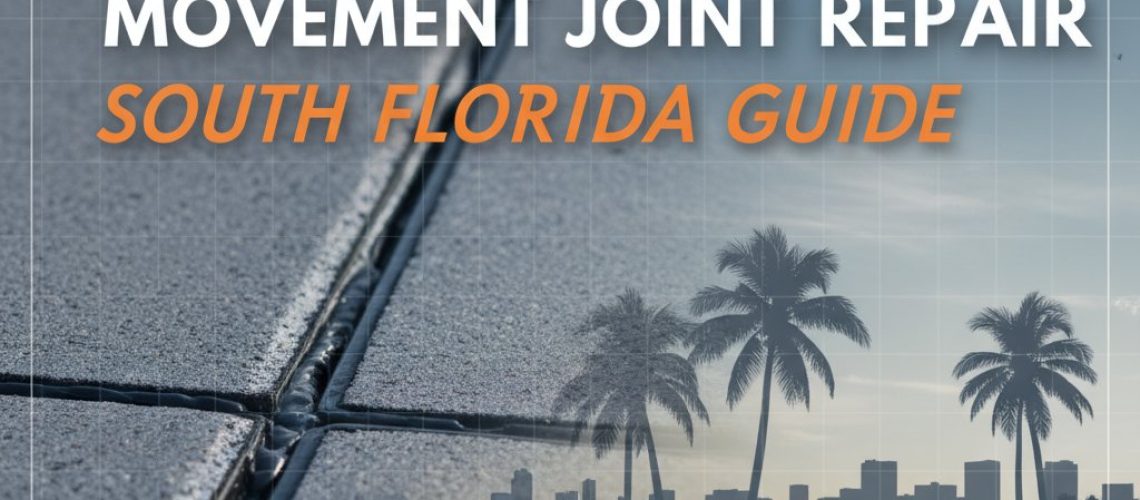
Movement joints in concrete structures serve a critical engineering function: they absorb thermal expansion, structural settlement, and seismic movement while maintaining building integrity. When these joints fail in South Florida’s aggressive coastal environment, the consequences extend far beyond cosmetic damage. Water intrusion through compromised expansion joints causes progressive structural deterioration, parking garage corrosion, interior flooding, and repair costs that escalate exponentially with delay.
South Florida building owners face unique challenges with concrete movement joint repair due to saltwater exposure, humidity levels averaging 76%, and temperature fluctuations causing concrete expansion coefficients of 5.5×10⁻⁶ per degree Fahrenheit. Traditional sealant repairs fail within 18-36 months under these conditions, creating a costly cycle of repeated maintenance.
Understanding Concrete Movement Joints and Why They Fail
Expansion joints are intentional gaps in concrete structures designed to accommodate dimensional changes without cracking. In high-rise buildings and parking garages, these joints typically appear every 30-50 feet, allowing independent movement between concrete sections while maintaining weather resistance.
The joint system consists of three components: the gap itself (typically 0.75-2 inches), a backer rod providing depth control, and sealant material creating a waterproof barrier. When properly maintained, this system protects structural integrity while allowing natural building movement.
Primary Failure Mechanisms in South Florida
Concrete expansion joint waterproofing fails through several interconnected processes particularly aggressive in coastal environments:
- UV degradation: South Florida’s intense solar radiation breaks down polymer chains in conventional sealants within 24-30 months, reducing elasticity by 60-70%
- Saltwater infiltration: Chloride ions from ocean spray penetrate porous sealants, attacking underlying concrete and accelerating corrosion of embedded rebar
- Thermal cycling: Daily temperature variations of 20-30°F cause repeated expansion-contraction cycles exceeding most sealants’ elastic recovery capabilities
- Adhesion failure: High humidity prevents proper curing of many sealant materials, creating bond failure at concrete interfaces
- Biological growth: Algae and mold colonize degraded sealants, further compromising waterproofing integrity
In parking garage expansion joint repair scenarios, vehicle loading adds dynamic stress that conventional repairs cannot withstand, creating puddles and progressive water damage that threatens structural steel and post-tension cables.
The True Cost of Failed Expansion Joint Sealing
Building owners often underestimate the financial impact of deteriorating movement joints. A single compromised expansion joint allowing 5 gallons of water infiltration per rain event (typical for South Florida’s 60+ inches of annual rainfall) introduces approximately 3,000 gallons annually into the structure.
This water intrusion creates cascading damage:
- Concrete spalling requiring removal and replacement at $85-150 per square foot
- Rebar corrosion necessitating structural reinforcement ($12,000-45,000 per location)
- Interior water damage to residential or commercial units ($5,000-25,000 per incident)
- Mold remediation in wall cavities and occupied spaces ($3,000-15,000 per occurrence)
- Emergency tarping and temporary waterproofing ($2,500-8,000 per deployment)
A condominium association in Sunny Isles Beach documented $340,000 in water damage over three years from eight failed expansion joints before implementing permanent repairs. Their traditional sealant approach required reapplication every 2-3 years at $1,200-2,500 per joint, creating a $40,000-60,000 maintenance cycle with zero guarantee of performance.
Why Traditional Concrete Joint Sealant Repair Methods Fail
Conventional approaches to commercial expansion joint repair rely on elastomeric sealants (polyurethane, silicone, or polysulfide compounds) applied to joint surfaces. While these materials function adequately in controlled environments, South Florida conditions expose critical limitations.
Polyurethane Sealants
Standard polyurethane offers good adhesion and moderate UV resistance but degrades rapidly under continuous moisture exposure. Service life in South Florida applications averages 24-36 months before cohesive failure occurs. Movement capability typically ranges from ±25% joint width—insufficient for high-rise expansion joint sealing applications experiencing greater displacement.
Silicone-Based Systems
Silicone sealants provide superior UV and thermal resistance but exhibit poor adhesion to damp concrete surfaces. In humid South Florida conditions where concrete rarely achieves complete dryness, adhesion failure occurs at 40-60% of installations within the first year. Cost ranges from $18-35 per linear foot including surface preparation.
Metal Expansion Joint Covers
Mechanical systems using aluminum or stainless steel covers provide traffic-bearing capability but don’t address underlying waterproofing. Water migrates beneath covers through improperly sealed substrate joints. Installation costs of $75-150 per linear foot make these systems expensive, while maintenance requirements for gasket replacement continue indefinitely.
Polyvinyl Injection Technology: The Permanent Solution
Advanced polyvinyl injection represents a paradigm shift in expansion joint leak fix methodology. Rather than surface application, this technology introduces hydrophobic polyvinyl resin directly into the joint cavity under controlled pressure (40-60 PSI), creating complete three-dimensional saturation.
How the Process Works
The CLWizard proprietary system follows a precise protocol developed specifically for South Florida’s challenging conditions:
- Joint assessment: Infrared thermography and moisture mapping identify active leak pathways and water accumulation zones within the joint structure
- Cavity preparation: High-pressure cleaning (3,000 PSI) removes contaminants, failed sealant residue, and biological growth without damaging concrete substrates
- Injection port installation: Strategic placement of injection ports every 8-12 inches along joint length ensures complete resin distribution
- Polyvinyl introduction: Hydrophobic resin with viscosity of 100-150 cPs is injected under monitored pressure, filling voids and creating molecular bonds with concrete
- Curing and verification: Material achieves 80% cure strength within 2-4 hours; complete cure in 24 hours regardless of humidity levels
The resulting waterproof barrier maintains elasticity across temperature ranges from 20°F to 180°F with movement accommodation of ±50% joint width—double the capability of conventional sealants.
Technical Advantages for South Florida Applications
Polyvinyl injection technology addresses specific regional challenges that compromise traditional repairs:
- Saltwater resistance: Hydrophobic polyvinyl exhibits zero water absorption and complete chloride ion impermeability, preventing the salt-driven degradation that destroys conventional sealants
- Humidity-independent curing: Unlike polyurethane or silicone requiring dry substrates, polyvinyl resins cure through chemical reaction unaffected by moisture presence
- UV stability: Molecular structure resists photodegradation, maintaining physical properties for 15+ years under continuous South Florida sun exposure
- Thermal performance: Coefficient of thermal expansion matches concrete (5.0-6.0×10⁻⁶), eliminating stress concentration at bond interfaces
Case Study: Commercial High-Rise Transformation
A 23-story commercial building in Fort Lauderdale experienced chronic leaking through parking deck expansion joints affecting retail tenants on lower levels. Previous repairs using polyurethane sealants required reapplication every 18-24 months at annual costs approaching $35,000.
Water intrusion damaged inventory, created slip hazards, and generated tenant complaints threatening lease renewals. Building management faced estimated costs of $180,000 for structural repairs if deterioration continued.
CLWizard implemented polyvinyl injection across 340 linear feet of compromised joints over a three-day period with zero tenant disruption. The installation cost of $28,900 included comprehensive waterproofing with a 5-year warranty. Thirty-eight months post-installation, the system shows zero leakage through multiple hurricane events and daily thermal cycling.
The building avoided $180,000 in structural repairs while eliminating the $35,000 annual maintenance cycle—a total financial impact exceeding $285,000 over five years from a single permanent intervention.
Cost Comparison: Temporary vs. Permanent Solutions
Financial analysis clearly favors permanent parking garage expansion joint repair over repeated temporary fixes:
Traditional Sealant Approach (10-Year Period):
- Initial application: $12-25 per linear foot
- Reapplication every 2-3 years: 3-4 additional cycles
- Total cost per linear foot: $48-125
- Ongoing leak risk and secondary damage potential
Polyvinyl Injection System (10-Year Period):
- Single application: $65-95 per linear foot
- No reapplication required
- 5-year warranty with expected 15+ year service life
- Zero leak incidents post-installation
Beyond direct repair costs, permanent solutions eliminate emergency response expenses, secondary damage repairs, tenant compensation, and the management time devoted to recurring maintenance coordination.
Addressing Common Concerns About Advanced Repairs
Will the Process Disrupt Building Operations?
Unlike traditional concrete movement joint repair requiring extended cure times and area closures, polyvinyl injection operates with minimal impact. Most projects complete during normal business hours with affected areas reopening within 4-6 hours. No odors, fumes, or ventilation concerns exist, making the process suitable for occupied buildings.
How Does Performance Compare in Hurricane Conditions?
South Florida buildings face extreme testing during hurricane season. Polyvinyl systems maintain complete waterproof integrity under sustained wind-driven rain conditions. Buildings protected with this technology have successfully weathered multiple Category 3-4 hurricanes with zero water intrusion through treated joints.
What Happens If Building Movement Exceeds Design Parameters?
The ±50% movement accommodation provides substantial safety margin beyond typical structural displacement. In rare cases of excessive settlement or seismic activity, the material’s elastic properties prevent cohesive failure—the system stretches rather than separating, maintaining waterproof integrity even under abnormal stress.
When to Schedule Concrete Expansion Joint Waterproofing
Proactive maintenance prevents expensive emergency repairs. Building owners should schedule professional assessment when observing these indicators:
- Visible cracking or separation in existing joint sealant
- Water staining on concrete surfaces adjacent to expansion joints
- Puddles forming on parking decks after rainfall
- Interior water intrusion corresponding to exterior joint locations
- Sealant material showing brittleness or pulling away from concrete
- White crystalline deposits (efflorescence) near joint interfaces
- Rust staining indicating water reaching embedded reinforcement
Early intervention costs substantially less than addressing advanced deterioration requiring structural restoration alongside waterproofing.
Protect Your Investment With Proven Technology
Concrete movement joints represent critical protection for your building’s structural integrity and operational functionality. South Florida’s aggressive environment demands solutions engineered specifically for coastal conditions—not generic approaches that fail within months.
CLWizard’s proprietary polyvinyl injection technology delivers permanent waterproofing backed by a comprehensive 5-year warranty and proven performance across hundreds of South Florida installations. Stop the cycle of temporary repairs and protect your property investment with a solution designed for the region’s unique challenges.
Contact CLWizard today for a complimentary building assessment. Our team will evaluate your expansion joint conditions, provide detailed documentation of vulnerabilities, and deliver a transparent proposal with no obligation. Discover why South Florida’s most demanding property managers trust CLWizard for permanent concrete leak solutions that protect assets and provide genuine peace of mind.
Call now to schedule your free assessment and take the first step toward eliminating expansion joint leaks permanently.
