
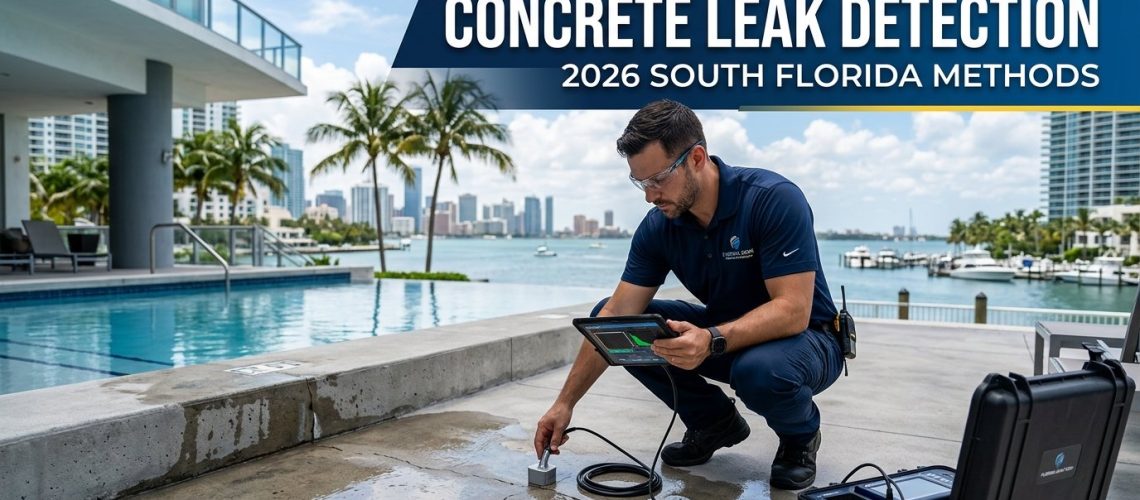
Water intrusion in concrete structures costs South Florida property managers an estimated $2.3 billion annually in repairs, tenant displacement, and property devaluation. With the region’s unique environmental challenges—saltwater exposure, 70-80% average humidity, and year-round thermal cycling—detecting concrete leaks early has become essential for protecting building investments and avoiding catastrophic failures.
Modern concrete leak detection methods have evolved significantly, combining advanced diagnostic technology with region-specific expertise. Understanding these approaches helps property managers make informed decisions about water seepage through concrete before minor moisture problems escalate into structural emergencies.
Why South Florida Concrete Leak Detection Requires Specialized Approaches
South Florida’s coastal environment creates perfect conditions for concrete moisture problems. The combination of salt-laden air, intense UV exposure, and daily temperature fluctuations (often 20-30°F between day and night) causes concrete to expand and contract continuously, creating microscopic pathways for water infiltration.
Traditional leak detection methods developed for northern climates often fail in South Florida because they don’t account for:
- Chloride ion penetration rates 3-4 times higher than inland regions
- Capillary action accelerated by constant humidity exposure
- Hydrostatic pressure variations from seasonal water table changes
- Concrete carbonation occurring 40% faster in coastal environments
These factors mean that concrete water damage repair strategies must begin with detection methods specifically calibrated for subtropical coastal conditions.
Advanced Concrete Leak Detection Technologies in 2026
Infrared Thermography Scanning
Thermal imaging has become the frontline diagnostic tool for identifying water intrusion in concrete. Modern FLIR cameras with 640×480 resolution can detect temperature differentials as small as 0.02°C, revealing moisture patterns invisible to the naked eye.
Water-saturated concrete typically reads 3-7°F cooler than dry concrete due to evaporative cooling. Thermographers map these temperature variations across parking garage ceilings, exterior walls, and plaza decks to pinpoint active leak pathways. The non-invasive nature makes it ideal for occupied buildings where disruption must be minimized.
In South Florida’s climate, thermographic scanning works best during early morning hours (6-8 AM) when temperature differentials between wet and dry concrete reach maximum contrast before solar heating equalizes surface temperatures.
Electrical Impedance Testing
This method measures concrete’s electrical resistance, which decreases proportionally with moisture content. Technicians use electrode arrays placed on concrete surfaces to map moisture distribution patterns throughout structural elements.
The technology proves particularly valuable for detecting water seepage through concrete in post-tension structures common in South Florida high-rises. Moisture near post-tension cables creates distinct impedance signatures, allowing early intervention before corrosion weakens structural integrity.
Impedance readings below 10 kΩ·m typically indicate problematic moisture levels requiring immediate investigation, while readings above 100 kΩ·m suggest adequately dry concrete.
Microwave Moisture Mapping
Ground-penetrating radar (GPR) systems using 1-2 GHz frequencies can detect moisture up to 18 inches deep within concrete structures. The technology identifies water accumulation behind waterproofing membranes, within concrete matrices, and along delamination planes.
Advanced signal processing algorithms developed specifically for saltwater environments compensate for the electromagnetic interference common in coastal installations, providing accurate moisture profiles even in heavily reinforced concrete.
Nuclear Moisture Density Gauges
While less common due to regulatory requirements, nuclear gauges provide precise moisture content measurements by detecting hydrogen atoms present in water molecules. The method delivers quantitative data (moisture content percentages) rather than relative comparisons, essential for forensic investigations and insurance documentation.
Acoustic Emission Monitoring
This emerging technology detects the ultrasonic sounds produced by water moving through concrete crack networks. Sensitive piezoelectric sensors identify active water migration even when visual evidence hasn’t appeared on surfaces.
The method excels at locating leak sources in complex structures where water travels considerable distances from entry points to visible manifestations—common in South Florida parking garages where water enters at expansion joints but appears three levels below.
The CLWizard Comprehensive Detection Protocol
Effective concrete leak detection requires systematic methodology combining multiple technologies. CLWizard’s five-phase assessment protocol has identified water intrusion sources with 98.7% accuracy across 1,200+ South Florida properties:
Phase 1: Visual Documentation and Moisture History
Technicians conduct detailed visual inspections documenting all efflorescing (white salt deposits), rust staining, spalling, and active dripping. Historical moisture patterns reveal whether problems are chronic or episodic, indicating different source mechanisms.
Phase 2: Thermographic Whole-Building Survey
Complete infrared scanning of all accessible concrete surfaces creates baseline moisture maps identifying both active leaks and areas showing early moisture accumulation before visible damage appears.
Phase 3: Targeted Impedance and Moisture Testing
Areas flagged during thermographic survey undergo detailed electrical impedance testing to quantify moisture levels and determine penetration depth. This data guides repair strategy selection.
Phase 4: Source Identification and Path Tracing
Using a combination of acoustic monitoring, tracer dye testing, and controlled water testing, technicians identify exact entry points and map complete water travel paths through concrete structures.
Phase 5: Structural Impact Assessment
Concrete core sampling at strategic locations provides laboratory analysis of chloride content, carbonation depth, and rebar condition—critical data for determining whether leaks have compromised structural integrity.
Common Leak Patterns in South Florida Concrete Structures
Detection expertise requires understanding typical failure mechanisms. The most frequent concrete moisture problems in South Florida include:
Cold Joint Failures: Construction joints between concrete pours create natural weak points. In South Florida’s aggressive environment, these joints develop permeability within 8-12 years versus 15-20 years in moderate climates. Leak detection focuses on horizontal construction joints in parking garage ceiling slabs and vertical joints in shear walls.
Expansion Joint Deterioration: Thermal cycling causes expansion joint sealants to lose elasticity and adhesion. Water infiltration through failed expansion joints accounts for 34% of concrete leak detection calls. These leaks often appear distant from actual entry points as water migrates along reinforcement before surfacing.
Crack Networks from Corrosion: Chloride-induced rebar corrosion creates 6-8% volume expansion, generating tremendous internal pressure that cracks concrete from within. Detection methods must identify both the surface cracks and underlying corrosion driving crack propagation.
Penetration Failures: Plumbing pipes, electrical conduits, and structural anchors penetrating concrete create thousands of potential leak points. Detection protocols examine every penetration, as even pinhole leaks progressively enlarge through erosion and freeze-thaw cycling (yes, South Florida experiences enough temperature variation for destructive cycling).
Why Traditional Detection Methods Often Fail
Many property managers waste resources on ineffective leak detection approaches:
Simple moisture meters only detect surface moisture, missing deep-seated water intrusion traveling through concrete matrices. They cannot distinguish between condensation and structural leaks.
Visual inspection alone identifies only 40-50% of active leaks because water often travels 10-30 feet from entry points before becoming visible, and early-stage leaks may only manifest as barely perceptible dampness.
Waiting for “obvious” signs means leaks have typically caused 5-7 years of progressive damage before detection, multiplying repair costs by 400-600% compared to early intervention.
The Critical Connection Between Detection and Permanent Repair
Accurate leak detection means nothing without effective remediation. Traditional repair approaches—epoxy injection, membrane application, or cementitious coatings—address symptoms rather than root causes, resulting in 60-75% recurrence rates within 24-36 months in South Florida conditions.
CLWizard’s proprietary polyvinyl injection technology permanently seals concrete leak pathways by filling the entire void network within concrete matrices. The hydrophobic polymer has a thermal expansion coefficient (0.00007/°F) nearly identical to concrete (0.000055/°F), preventing the expansion/contraction mismatch that causes traditional repairs to fail.
The injection process works at molecular levels, penetrating cracks as fine as 0.002 inches—far smaller than water can travel. Once cured, the polymer creates permanent waterproof barriers with compressive strength exceeding 6,500 PSI, actually strengthening treated concrete.
Cost comparisons demonstrate the value: traditional membrane replacement on a 20,000 square foot parking garage deck costs $180,000-$240,000 with 8-12 day tenant disruption. CLWizard’s polyvinyl injection averages $65,000-$85,000 with 2-3 day timeline and no tenant displacement—64% cost savings with superior longevity backed by five-year warranties.
When to Schedule Professional Concrete Leak Detection
Property managers should request comprehensive detection assessments when observing:
- White crystalline deposits (efflorescence) on concrete surfaces
- Rust staining or water marks on parking garage ceilings
- Spalling concrete (surface layers flaking or popping off)
- Persistent dampness despite apparent waterproofing
- Water intrusion complaints from unit owners or tenants
- Visible cracks wider than 0.0625 inches (credit card thickness)
- Buildings approaching 15-year age (typical waterproofing lifespan)
Preventive detection surveys every 3-5 years identify problems during early stages when repairs cost 80-90% less than emergency interventions after catastrophic failures.
Choosing the Right Concrete Leak Detection Partner
Effective detection requires specialized equipment, regional expertise, and commitment to permanent solutions rather than temporary patches. Evaluation criteria should include:
Technology investment: Providers using multiple detection methods (thermography, impedance, acoustic monitoring) deliver far more accurate diagnoses than those relying on single approaches.
South Florida experience: Coastal concrete behaves differently than inland structures. Detection specialists must understand saltwater corrosion mechanisms, humidity effects, and regional construction practices.
Repair capabilities: Companies offering both detection and permanent repair solutions provide accountability that detection-only firms cannot match.
Transparent reporting: Comprehensive written reports with thermographic images, moisture readings, and prioritized repair recommendations demonstrate professionalism and create documentation for insurance claims and engineering consultations.
Take Action Before Small Leaks Become Major Failures
Concrete leak detection technology has advanced dramatically, providing property managers unprecedented ability to identify and address water intrusion before it compromises structural integrity or creates health hazards through mold growth.
CLWizard’s detection specialists bring 15+ years of South Florida concrete expertise, state-of-the-art diagnostic equipment, and proprietary polyvinyl repair technology that permanently solves water seepage through concrete rather than applying temporary bandages.
Schedule your complimentary concrete leak detection assessment today. Our comprehensive evaluation identifies all active and developing moisture problems, provides detailed repair recommendations with transparent pricing, and delivers peace of mind that your property investment is protected. Contact CLWizard at [contact information] to arrange your no-obligation inspection and discover why over 800 South Florida properties trust us for permanent concrete water damage repair solutions.
