
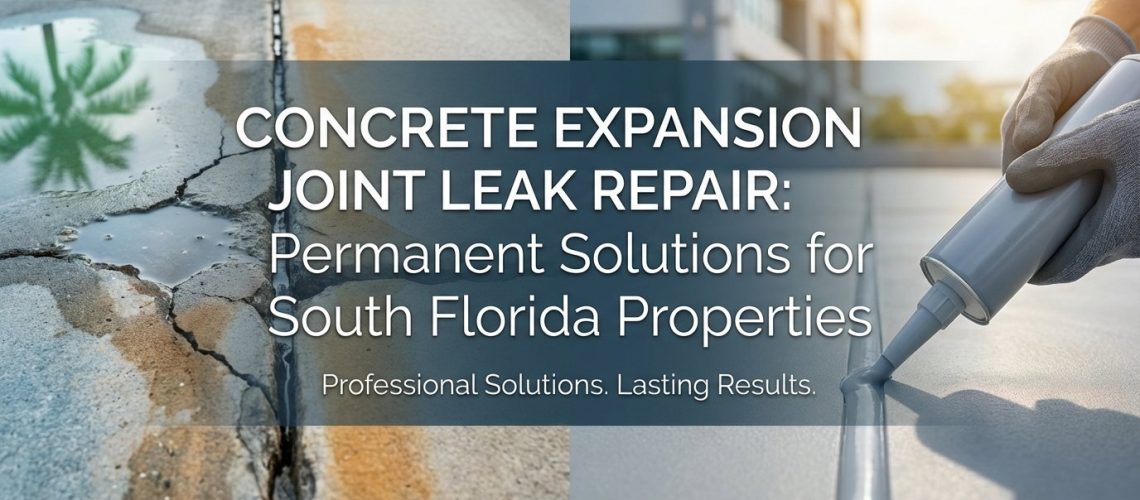
Water streaming through parking garage expansion joints during a heavy rain. Persistent dampness along concrete floor seams. Efflorescence and rust stains marking the path of water intrusion. These scenarios plague thousands of South Florida properties, where expansion joint failures account for approximately 60% of concrete structure water infiltration issues. Unlike cosmetic problems, expansion joint leaks compromise structural integrity, accelerate corrosion, and create liability concerns that demand immediate attention.
Expansion joints serve a critical purpose in concrete structures—they accommodate thermal expansion, contraction, and structural movement that would otherwise cause catastrophic cracking. South Florida’s unique environmental conditions place extraordinary stress on these joints. Temperatures fluctuating between air-conditioned interiors and exterior heat exceeding 95°F create thermal differentials of 30-40°F daily. Combined with saltwater exposure within three miles of coastline and humidity levels regularly above 75%, expansion joint materials deteriorate faster here than virtually anywhere else in the continental United States.
Understanding Expansion Joint Failure in South Florida
Traditional expansion joint systems rely on physical barriers—rubber seals, foam backer rods, polyurethane sealants, or metal troughs filled with elastic compounds. These materials create a mechanical barrier designed to flex with concrete movement while preventing water penetration. The problem? They fail, often within 5-10 years in South Florida conditions.
The degradation follows a predictable pattern. UV radiation from intense subtropical sunlight breaks down polymer chains in rubber and urethane materials. Salt-laden air accelerates oxidation. Water penetrates microscopic cracks, creating freeze-thaw cycles in air-conditioned spaces that widen gaps. Thermal cycling causes materials to harden and lose elasticity. Once the seal breaks, water intrusion begins—and accelerates the destruction.
The consequences extend far beyond wet floors. Water carrying chlorides from saltwater exposure reaches embedded rebar, initiating corrosion. Steel expands as it rusts, creating internal pressure that spalls concrete. In parking structures, vehicle loads stress already compromised joints. Waterproofing membranes underneath concrete slabs fail when constantly saturated. Property managers face mounting repair costs, tenant complaints, and potential structural engineering assessments required by municipalities.
Why Traditional Repair Methods Fall Short
Most concrete expansion joint leak repair approaches simply replace failed materials with newer versions of the same products. A contractor removes deteriorated sealant, cleans the joint, installs new backer rod, and applies fresh polyurethane or silicone. Cost: $15-35 per linear foot. Expected lifespan: 3-7 years in South Florida before the cycle repeats.
These traditional expansion joint sealing methods create temporary solutions for several reasons:
- Adhesion failure: Sealants bond to concrete surfaces but cannot penetrate porous concrete to create mechanical interlock, relying solely on surface adhesion that degrades with exposure
- Limited flexibility: Even high-quality sealants rated for ±25% joint movement experience cohesive failure when subjected to South Florida’s extreme thermal cycling combined with structural loads
- Installation dependency: Performance relies heavily on surface preparation, moisture levels during application, and curing conditions—variables difficult to control in occupied buildings
- Deterioration timeline: Material properties degrade continuously from day one, with accelerated failure in saltwater environments
Metal expansion joint covers offer greater durability but require extensive demolition for installation, create tripping hazards, collect debris, and cost $75-150 per linear foot—still without addressing water that has already penetrated behind the joint face.
Polyvinyl Injection Technology: The Permanent Alternative
Rather than creating surface barriers destined to fail, advanced concrete expansion joint waterproofing uses hydrophobic polyvinyl resin injection to permanently seal the water pathway behind and beneath expansion joint faces. This approach addresses the fundamental problem: water traveling through the joint cavity and into the concrete substrate.
The technology works through controlled injection of specialized two-component polyvinyl resins into the expansion joint cavity and surrounding concrete matrix. Upon contact with moisture present in concrete (typically 4-8% by weight in South Florida structures), the resin undergoes a controlled expansion reaction, increasing volume by 400-600% while maintaining a closed-cell structure.
This expansion creates several critical advantages. The material penetrates concrete porosity, creating mechanical interlock rather than relying on surface adhesion. It fills voids, cracks, and pathways invisible to visual inspection. The closed-cell structure remains permanently hydrophobic—water cannot permeate or degrade the material. The foam remains flexible with compression strength appropriate for structural applications while accommodating ongoing joint movement. Expansion coefficients match concrete, preventing differential thermal stress.
The Injection Process
Proper concrete expansion joint leak fix using injection technology follows a methodical protocol. Technicians first assess joint configuration, movement patterns, and water intrusion pathways using moisture meters and thermal imaging when appropriate. Injection ports are strategically drilled at 12-18 inch intervals along the joint, angled to reach the cavity behind the joint face and penetrate the substrate.
Injection begins at the lowest point or most active leak location, with technicians monitoring resin flow and pressure. As material fills cavities and penetrates concrete, injection points are progressively sealed and the process advances along the joint. Total material volume varies based on joint width, depth, and concrete condition, typically requiring 0.5-2.0 pounds of resin per linear foot for parking garage expansion joint repair applications.
The entire process for a typical 200-linear-foot expansion joint requires 4-6 hours, with the area ready for traffic within 2-3 hours of completion. No demolition, no tenant disruption, no multi-day closures—critical factors for occupied commercial properties.
Performance Comparison: Injection vs. Traditional Methods
Data from South Florida properties demonstrates the performance differential between technologies. Traditional sealant replacement shows a 35-40% failure rate within three years of installation in saltwater-exposed structures. By year five, failure rates exceed 70%, with complete replacement necessary. Total cost over a 10-year period: $45-70 per linear foot accounting for multiple re-applications.
Polyvinyl injection technology demonstrates 98% effectiveness after five years in identical exposure conditions. The material does not degrade from UV exposure, saltwater contact, or thermal cycling. Because penetration into the concrete matrix creates mechanical interlock throughout the zone rather than at a single surface plane, joint movement does not compromise the seal. Ten-year cost: $40-60 per linear foot with a single application.
Beyond direct cost comparison, the value proposition includes elimination of recurring repair cycles, protection of underlying waterproofing systems that cost $25-45 per square foot to replace, prevention of rebar corrosion requiring structural repairs at $200-400 per square foot, and avoidance of tenant disruption that creates vacancy risk and reputation damage.
South Florida-Specific Considerations
Coastal properties within the three-mile saltwater zone face accelerated deterioration of all expansion joint materials. Traditional sealants in these locations often fail within 18-36 months. The chloride content in salt spray directly attacks polymer chains, while salt crystals create abrasive wear on joint faces. Polyvinyl injection materials remain unaffected by saltwater exposure, with chemical composition resistant to chloride attack.
High-rise structures present additional complexity. Thermal differentials between sun-exposed and shaded elevations create uneven expansion patterns. Wind loads at elevation add dynamic stress to joints. Access challenges increase labor costs for traditional repairs. The non-invasive nature of injection technology eliminates many access complications, with equipment transportable via standard elevators and minimal staging requirements.
Hurricane season brings another dimension to expansion joint performance. Wind-driven rain creates hydrostatic pressure that forces water through any joint weakness. Properties with compromised expansion joints experience catastrophic water intrusion during major storms, affecting multiple floors and causing extensive interior damage. Permanent waterproofing before hurricane season provides essential protection against these events.
Case Applications and Results
A Boca Raton condominium tower faced persistent leaking through parking garage expansion joints affecting the residential lobby below. Previous sealant repairs had failed twice in four years. Polyvinyl injection was applied to 340 linear feet of expansion joints. Post-installation monitoring through two hurricane seasons and three years of service shows zero water intrusion, with the property manager reporting complete resolution of the issue that had generated resident complaints and board meeting discussions for years.
A Fort Lauderdale commercial property with a five-level parking structure experienced water streaming through floor-level expansion joints during every rain event. The water damaged vehicles, created slip hazards, and accelerated deterioration of the structure’s post-tension cables—a critical safety concern. Following injection treatment of 580 linear feet of joints across multiple levels, water intrusion ceased completely. Structural engineers confirmed that halting water penetration prevented further corrosion of post-tensioning systems, avoiding repairs that would have exceeded $400,000.
Making the Decision: When to Choose Injection Technology
Polyvinyl injection represents the optimal solution when permanence matters more than minimal upfront cost. Properties facing repeated sealant failures, dealing with structural water damage, preparing for sale or refinancing, or managing liability concerns from water intrusion benefit most from this approach.
The technology proves particularly valuable for parking structures, plaza decks, rooftop terraces, and any concrete expansion joint where water penetration creates secondary damage. Properties with occupied spaces below leaking joints, where water intrusion affects tenant areas or causes operational disruption, see immediate return on investment through problem elimination.
A professional assessment determines candidacy. Joints must have adequate cavity depth for injection (typically 1.5 inches minimum), and concrete must not be structurally compromised beyond repair capacity. Most expansion joint leak scenarios meet these criteria, making injection applicable to approximately 85-90% of cases.
Protection That Lasts
Expansion joint leaks represent more than maintenance annoyances—they’re progressive structural threats that worsen with time. South Florida’s environmental conditions accelerate this deterioration, making permanent solutions not just preferable but essential for long-term property protection.
Polyvinyl injection technology provides that permanence. By addressing water intrusion at its source, penetrating concrete rather than coating surfaces, and using materials engineered for extreme conditions, this approach eliminates the repair-and-repeat cycle that drains maintenance budgets and compromises structural integrity.
The combination of permanent effectiveness, minimal disruption, competitive lifecycle costs, and comprehensive warranty protection makes injection technology the clear choice for property managers and owners seeking definitive concrete expansion joint leak repair solutions.
Stop managing recurring expansion joint leaks and start preventing them permanently. CLWizard offers comprehensive assessment and polyvinyl injection services throughout South Florida, backed by a 5-year warranty. Contact us today for a free property evaluation and discover how permanent concrete expansion joint waterproofing protects your investment, eliminates tenant disruptions, and ends the costly cycle of temporary repairs. Call now or visit our website to schedule your no-obligation assessment.
